
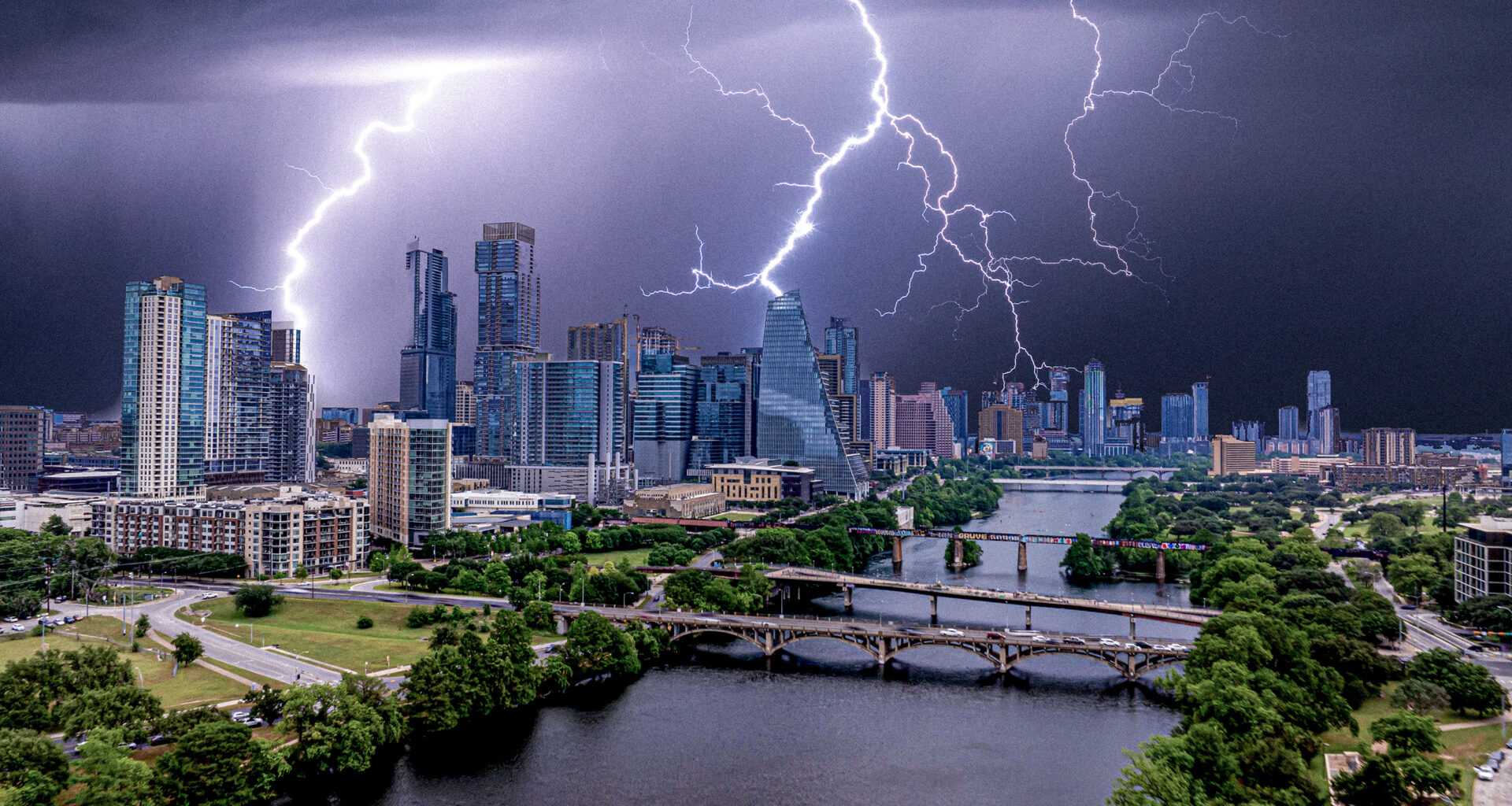
Several extreme weather events live in Austin’s recent memory, including ice storms, floods, fires, and heat waves. The enduring challenge for the city is navigating how to balance response to the immediate impacts of climate change while also planning for long-term resilience.
Currently, the city’s approach is two-pronged. On one side is climate adaptation, a key initiative being the Climate Equity Plan composed of 17 goals addressing sustainability, the reduction of carbon emissions, and land use. The goals serve as a stepping stone to help the city reach net-zero greenhouse gas emissions by 2040 and call on various city departments such as Austin Energy, waste management, and transportation to develop applicable solutions.
The other component is climate resilience, which the city works toward by improving preparation for weather extremes and understanding how everyday stressors such as heat and air quality impact the lives of Austin residents.
An ongoing partnership between UT researchers and city leaders through the UT-City CoLab is an example of a collaborative effort to understand how climate data can be used in practice for stronger planning and preparedness, said Marc Coudert, climate adaptation and resilience manager with the Austin Climate Action and Resilience Department.
“Thinking about day-to-day [impact] is really key, and that’s something the city doesn’t have the capacity to do,” Coudert said. “Working with nonprofits and universities, and working together locally, within your neighborhood or within your region, is the only way we could really be truly resilient.”
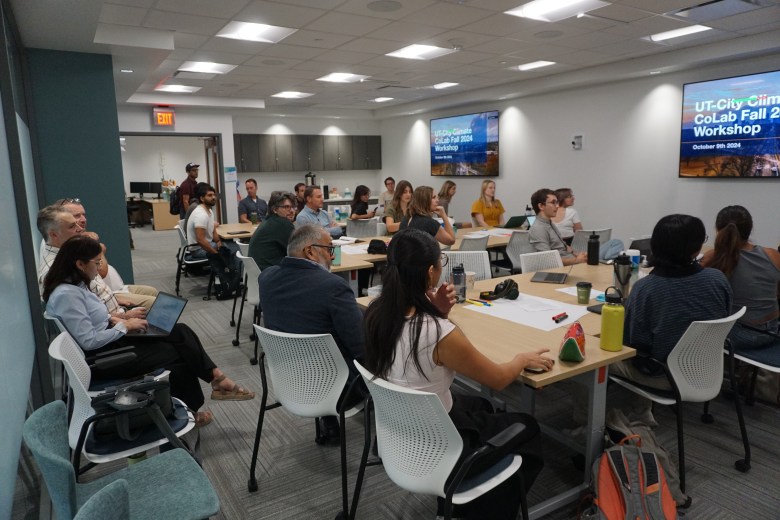 A UT-City CoLab workshop Credit: UT-City CoLab
Climate data is collected and analyzed at different levels of geographic scale. Global climate projections such as the reports developed by the Intergovernmental Panel on Climate Change are useful, but not immediately actionable for cities, said Dev Niyogi, co-lead for the CoLab and professor in the department of earth and planetary sciences at UT’s Jackson School of Geosciences.
“This translation of useful to usable requires a unique set of partnerships, where you actually have people who are familiar with the data sets, people who are familiar with the global projections, and people who are aware and familiar with what is needed right now,” Niyogi said.
Among several projects Niyogi led in the lab, a report on climate projections to understand Austin’s future weather patterns found that maximum temperatures in the summer are projected to rise by 10 degrees Fahrenheit by the end of the century under a “high-emissions scenario,” or the conditions where greenhouse gas emissions continue increasing due to human activity. Additionally, Austin is expected to experience more frequent heat waves and fewer frost days, among other impacts, according to the report.
Naveen Sudharsan, a postdoctoral fellow with the Jackson School and member of the CoLab, is part of the effort to create the models and tools to downscale global data to the local level. Under the Austin CARES project, which received a nearly $1 million grant from NASA, the team develops maps to understand heat hazards in Austin. This year, the CoLab received $3 million in federal funding, $1.25 million in UT staff contributions, and a $300,000 investment from the city to support projects scheduled for completion in 2026.
Last month, Austin Climate Action and Resilience announced five new projects underway between the CoLab and various city departments. Among the lab’s recent projects is Data to Decisions with the Austin Watershed Protection Department to understand how urban rainfall and flooding impacts different parts of the city. Allysa Dallmann, program coordinator of the TExUS Lab, said her research aims to find patterns of rainfall so city leaders can understand in real time which specific areas may be more at risk for flooding.
The strategies that the lab has developed are gaining traction regionally and across the globe. After working with a team of researchers on weather forecasting at the 2024 Paris Olympics, the lab brought back ideas on how to address urban rainfall – which are now being applied to their work with watershed protection.
“It’s a two-way exchange of ideas [and] a two-way exchange of benefits by this local and global engagement,” Niyogi said.
In partnership with the United Nations Educational, Scientific and Cultural Organization, the lab has also worked to expand their model to cities in Portugal and India. Work with UNESCO has prompted conversation on how to bring the Co-Lab model to island states such as Jamaica, which are particularly vulnerable to climate change and sea level rise, Coudert said. Being positioned near a major research university is an advantage not all communities have, which the team is conscious of, and sees as an opportunity to build global relationships and share their research and data.
“All cities around the world are impacted by [climate change],” Coudert said. “They all need to be thinking about the future and trying to figure out how to be more resilient and adaptive.”
This article appears in December 5 • 2025.
A note to readers: Bold and uncensored, The Austin Chronicle has been Austin’s independent news source for over 40 years, expressing the community’s political and environmental concerns and supporting its active cultural scene. Now more than ever, we need your support to continue supplying Austin with independent, free press. If real news is important to you, please consider making a donation of $5, $10 or whatever you can afford, to help keep our journalism on stands.