
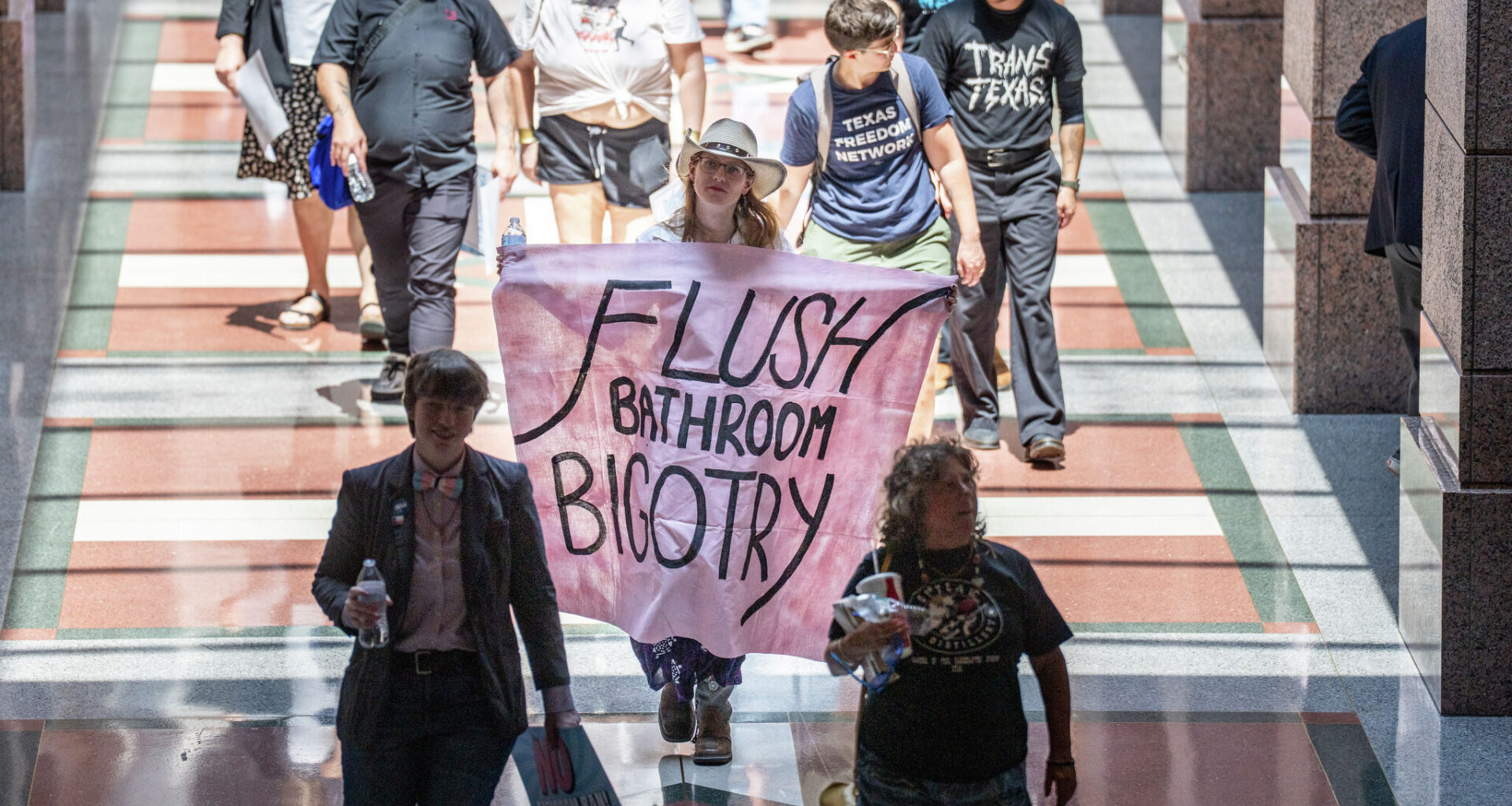
Melody Tremallo marches through the Capitol following a rally against the proposed bathroom bill and abortion pills bill in Austin. The bill – Senate Bill 8 – is now in effect.
Mikala Compton/Austin American-Statesman
Students and their families bring in personal items while moving into Alvarez Hall at UTSA. Several students had to move residences because of the bathroom bill becoming law.
Josie Norris/San Antonio Express-News
Transgender students at Texas public universities will no longer legally be allowed to use multi-stall restrooms matching their gender identity starting Thursday, when Senate Bill 8 — better known as the “bathroom bill” — takes effect for public agencies, schools and universities across the state.

The law mandates all multi-occupancy restrooms in public buildings be exclusively designated for males or females as defined by an individual’s reproductive organs, not their presenting or identifying gender.
Article continues below this ad
Sen. Mayes Middleton, R-Galveston, who authored the law, called SB 8 the “strongest” women’s privacy act in the nation to protect women — though no statistical evidence indicates safety risks increase when transgender individuals use the bathroom matching their gender identity.
The new restrictions are another challenge that transgender students must reckon with in Texas higher education. Multiple university systems have recently restricted courses that appear to “advocate” for gender ideology, and the University of Texas and Texas A&M University no longer offer gender-affirming care for students. The Texas Tech University system will no longer teach the existence of more than two genders and is reviewing all courses concerning sexual orientation. Senate Bill 17, passed in 2023, removed university-sponsored support for marginalized students, which resulted in the closure of LGBTQ resource centers across the state.
MORE: Texas ‘most extreme’ in anti-LGBTQ bills, advocates say. How supporters plan to fight back
The bathroom bill passed this September after a decade-long push to advance the legislation. In 2017, when similar legislation was introduced, prominent members of the state’s business community argued passing such a law would harm Texas’ ability to attract new businesses and jobs to the state.
Article continues below this ad
Rather than punish individuals, the 2025 law puts the onus on public agencies to take “every reasonable step” to ensure that the law is being followed — and invites individuals to report violations to the Attorney General that could lead to lawsuits or fines.
“The actual legislation doesn’t really tell folks what they should be doing as far as enforcement is concerned,” Brad Pritchett, CEO of Equality Texas, an LGBTQ advocacy non-profit, said in an interview. “What it does is it kind of creates a kind of threat to any municipality. At any time someone could accuse them of being noncompliant with the law.”
How local universities responded
Texas universities are responding in different ways.
Article continues below this ad
Ahead of the compliance deadline, UT San Antonio relocated 30 students to different dorms, KSAT reported and the American-Statesman confirmed with the university, giving students little notice to move. Spokesperson Joe Izbrand said UTSA “is working with each of them individually to ensure a smooth transition.”
But Texas State University’s bathrooms were compliant with the bill before SB 8’s passage and the university determined “no significant changes” were needed in current policies, spokesperson Jayme Blaschke told the American Statesman.
The University of Texas at Austin also expects few changes from its implementation and no impact on dorms, but did create an interim policy on “privacy in restrooms and similar facilities” that states the law’s limits.
Austin Community College said Tuesday it is updating signage and designations for impacted multi-stall restrooms, “while all single-use restrooms will remain available to anyone who prefers them.”
Article continues below this ad
The college hosted forums across the district to explain implementation and convened a working group with multiple stakeholders to shape new guidelines and rules together with “clarity, consistency, and care,” the statement, shared by Spokesperson Sydney Pruitt, said.
“ACC is still assessing the total cost of compliance and the number of facilities impacted,” the statement said.
Exceptions and enforcement
Texas’ law does not apply to single-stall restrooms, individuals under 10 years old accompanied by an adult, emergency medical help, law enforcement, custodial staff and companions of those who need assistance. It also does not apply to non-public spaces, including private universities or colleges
Article continues below this ad
If the Attorney General — a position Middleton is currently campaigning for in the Republican primary — agrees that a university, school or agency did not comply with SB 8, the institution has 15 days to rectify the issue or face a $25,000 initial fine. Repeat offenders may be subject to subsequent penalties of $125,000.
“Texas will not bend to the woke left’s gender delusions, and we will not allow men into women’s private spaces,” Middleton wrote in a post on X Sept. 3. “This law is for all the daughters—and future daughters—of Texas.”
The law’s lack of enforcement provisions could lead to “vigilante” oversight by individuals, making schools, with more restrooms and people than a typical government office, more vulnerable to accusations of noncompliance, Pritchett with Equality Texas noted.
S. Gupta, a transgender UT student and co-director of the Queer Trans Black, Indigenous and People of Color agency, a student LGBTQ advocacy group, said going to the bathroom now feels like “a cruel game of tag.”
Article continues below this ad
“I tuck my hair back, suck my chest in and walk confident; though scared,” he said of using the men’s restroom. “Crouching as soon as I walk into the bathroom scouting for stalls with no shoes, requesting my male friends to walk in with me, keep me company, purely out of fear of someone saying anything about me in the wrong bathroom.”
MORE: ‘We are not going away’: Queer joy persists at UT despite anti-LGBTQ legislation proposed
At UT, Gupta said students now rely on word-of-mouth or the website Tabroom as a resource to find single-stall restrooms on campus. Finding one feels like “choosing peace,” he said.
Article continues below this ad
Twenty states have adopted restrictions on bathrooms based on gender, but scholars at the University of California Los Angeles law school’s Williams Institute, a leading research institute on public policy impacting LGBTQ people, found in a 2025 study that restrictions often led to more harassment and sometimes violence for transgender individuals.
They found no indication women’s privacy or safety was jeopardized when transgender individuals were allowed to use their bathroom of choice.