
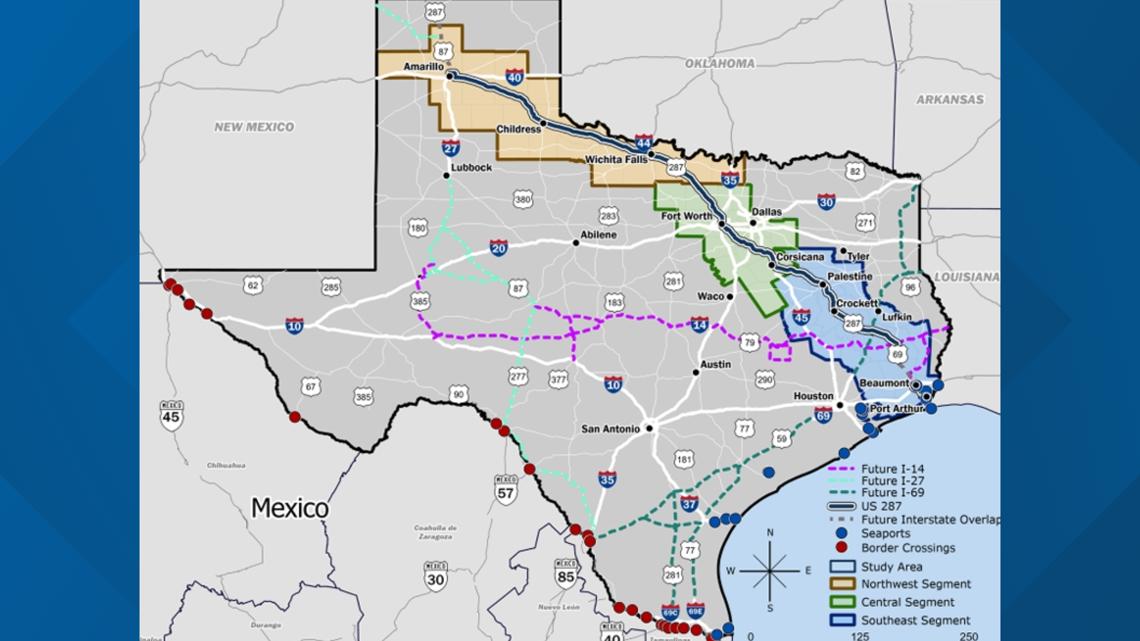
The state’s newest interstate would provide a more direct route between the Texas coast and the Panhandle.
FORT WORTH, Texas — The state’s newest interstate could cut through East Texas and connect DFW to Amarillo, providing a more direct trade route between the Texas coast and the Panhandle.
The $24.5 billion project would transform U.S. 287 into an interstate. The transformation is outlined in a feasibility study published this summer by the Texas Department of Transportation (TxDOT). The new interstate would connect Port Arthur to Fort Worth and Fort Worth to Amarillo.
The plan, which TxDOT planners are still considering, would increase the state’s gross domestic product by $11.6 billion by 2050 and create about 47,000 jobs, according to the feasibility study. The study projects a total net return on investment of $39.6 billion.
The new interstate would address growing congestion across the state, diverting traffic from some of the nation’s busiest roads, the study found. Building the new interstate would save 44 minutes of travel time per vehicle, according to the study.
“This is due to higher travel speeds, access-controlled facility, and elimination of frequent stops at intersections in towns,” the study reads.
The feasibility study analyzes the current conditions of the road, the potential benefits of the upgrade, and any challenges associated with creating the interstate.
U.S. 287 is currently 671 miles long and overlaps with 39 miles of existing interstates, which leaves 613 miles of non-interstate road to be upgraded, according to the study. The highway currently connects Texas’ coast with Colorado, Wyoming and Montana.

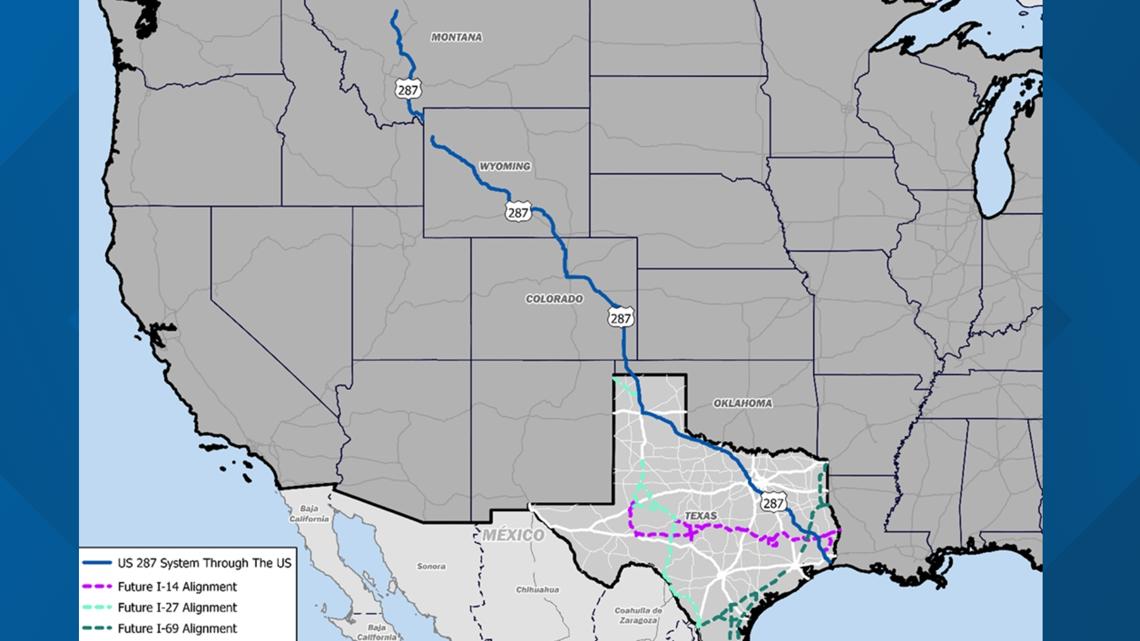
Before starting work on U.S. 287, Congress would have to designate it as an interstate, according to the Dallas Business Journal. Then, the corridor would have to be upgraded to meet interstate standards, including a minimum of two travel lanes in each direction, minimum lane widths, paved shoulders and minimum ramp lengths.
“The building of an interstate system is a decades-long strategic initiative. There is no specific federal or state funding program set aside to build future interstate highways,” the report reads.
Some barriers to upgrading the corridor include 54 overpasses that do not meet interstate standards and were not designed for current loading requirements, the study says. Currently, U.S. 287 is not a “high priority corridor” on the National Highway System or designated as a Future Interstate.
The interstate expansion could reduce traffic accidents by 28%, the study found, and average daily truck traffic on the route would increase by 116%, the study states.
“US 287 remains an essential corridor for economic opportunities, national defense, freight movement, and regional mobility,” the report reads. “Careful consideration of funding and strategic priorities will be crucial in ensuring that US 287 continues to serve as a vital corridor in the transportation network of Texas, linking Southeast to Northwest Texas and beyond.”