
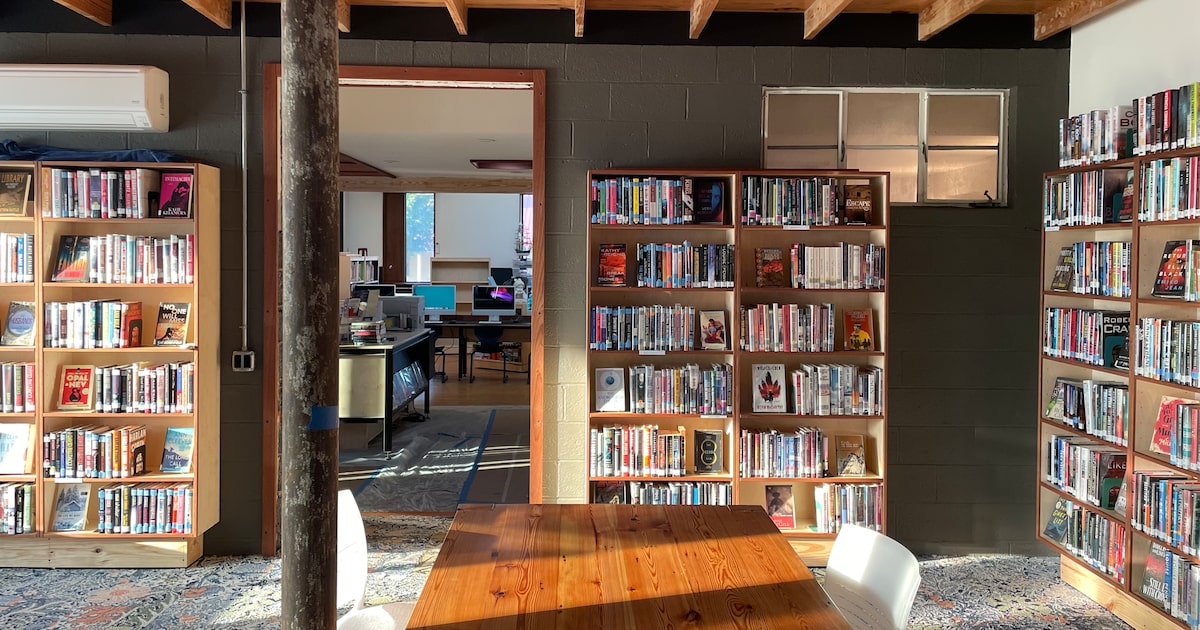
The West Texas town of Marathon (pronounced Mara-thun) is not the most likely place to find an advanced and highly crafted work of modern public architecture. The unincorporated desert outpost, best known — to the extent it is known at all — as a rest stop on the route into Big Bend National Park, has a population well under 500. Its most notable building, until now at least, was the Gage Hotel, a restrained block of beige brick that opened nearly a century ago.
A new public library, designed and built by Dallas architect Dan Shipley, should change that. Although it is not the kind of avant-garde showpiece one might find in a big city, it is a deeply sensitive work of architecture that respects and elevates its environment.
Shipley was familiar with Marathon when he was approached about the project, in 2017, by Steven Jones, a theatrical producer from Dallas who serves on the library’s board of trustees. “I’d been to Marathon quite a few times over the years and was intrigued by it,” says Shipley. “A building in the desert — what could be better? Of course I had no idea what was going to be involved.”
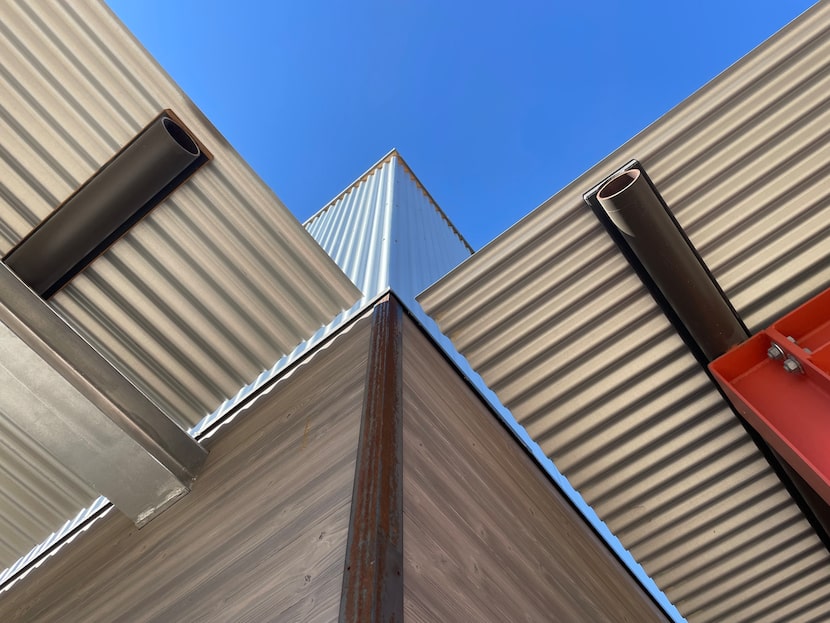
Exterior detail of the Marathon Public Library.
Dan Shipley / Dan Shipley
News Roundups
Building in rural Marathon turned out to be a considerable challenge, one that required a series of preliminary visits so Shipley could “get real” about the local contractors and craftsmen that might be available, and the level of work he could expect from them. “The last thing I wanted was to draw some perfect jewel box and then it’d be way over budget even if we could find somebody to build it,” says Shipley. “I was determined that this was going to be a project that did right by the community.”
He discovered that good contractors were in short supply, and the best were booked far into the future on higher-budget projects for the well-heeled art crowd in Marfa. His solution was to take on project management himself, supervising the local tradesmen — electricians, plumbers, roofers — while importing experienced craftsmen from North Texas. For Shipley, that meant frequent visits from Dallas, a 500-mile trip in a Honda Passport filled with building supplies. “I mean, I knew it would be a huge undertaking,” he says. “It was like the film Fitzcarraldo, when they took the steamship over the mountain.”
There were benefits to working in a small town. Marathon has no building department and no zoning, and outside of sanitary regulation there is little oversight from the county of Brewster. More critically, by eliminating the contractor middleman and overseeing the work himself, Shipley could achieve the kind of bespoke, thoughtful detailing that is a hallmark of his design. “If they said, Dan, we need to hire a general contractor, it needs to be somebody local, I would not have drawn the same building. It wouldn’t be anything like this because they would never be able to build it,” he says, speaking frankly about the complexity of his work. “I just know how to get this stuff done.”
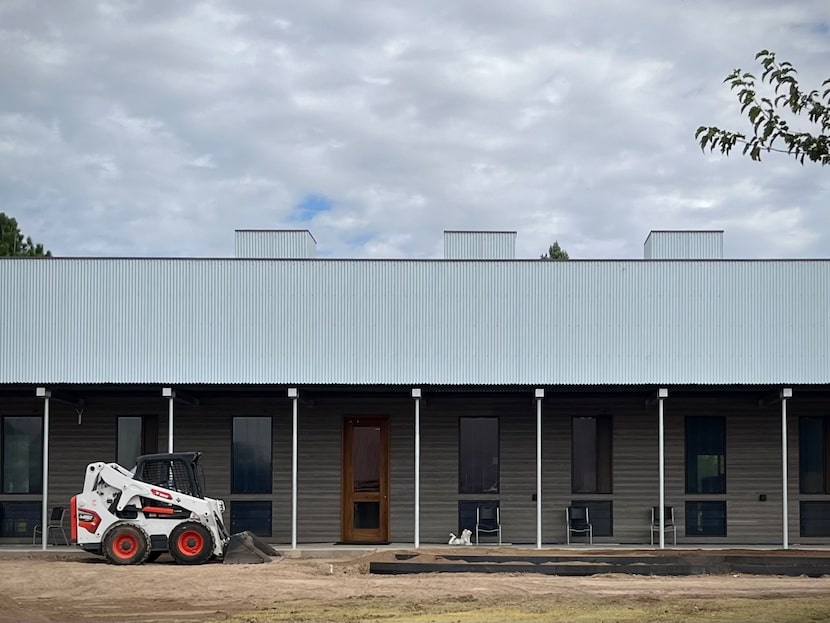
The south-facing porch gives enclosure to the town square.
Mark Lamster / Mark Lamster
Shipley’s building is not entirely new; it incorporates the town’s original library, a concrete box built in 1955 that was not even 800 square feet in area. Shipley’s design attached a significantly larger box to its southern flank, expanding the library’s size by some 500%. Shipley also restored a neighboring one-room adobe schoolhouse from 1888 for use as a museum. The overall budget for the project was $1.6 million, most of it coming from a pair of grants from private foundations.
“For years we had these big dreams for all these different programs and services that we wanted to offer,” says Dara Cavness, the library’s director. “And we didn’t have the space.”
They have it now, and in a building that creates linkages to a small group of civic structures — a community center, a justice center and the renovated school building — that had little architectural coherence or connection. It achieves this by having no true front — it is accessible from all sides — and by placing an elongated porch on its southern flank, thereby giving a sense of enclosure to a bit of underused lawn that is technically Marathon’s town square.
“It’s urban planning,” says Shipley, “in a place that’s not really that urban.”
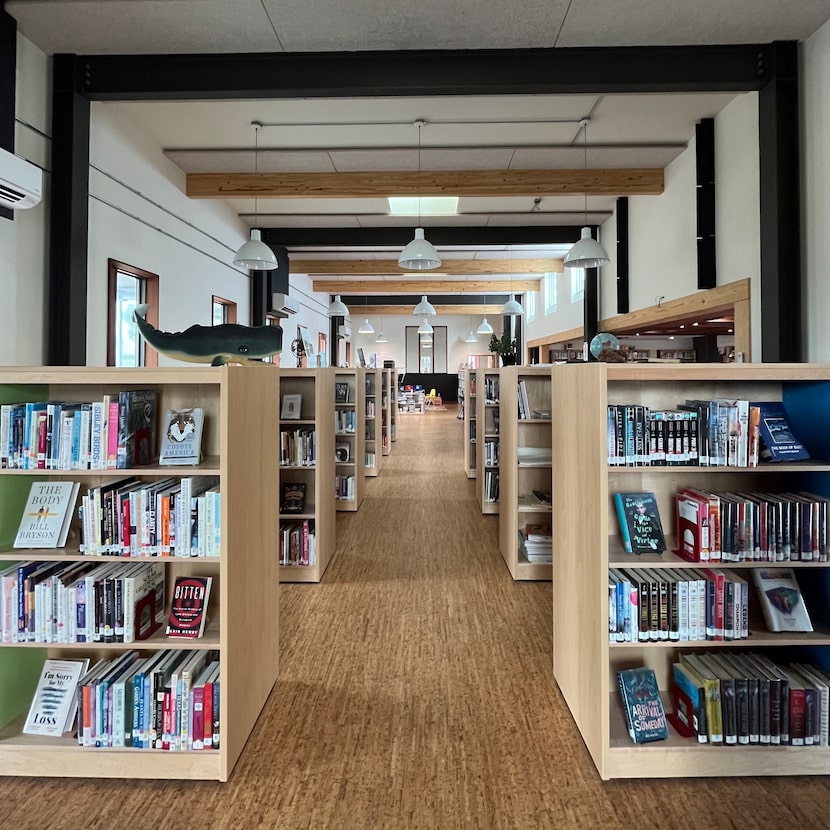
Interior of the Marathon Public Library.
Mark Lamster / Mark Lamster
Aesthetically, it both stands out and fits in. A large box sheathed in metal siding and raw wooden panels, it has an austere, rough-edged quality that is unabashedly modern but feels natural to West Texas. A large cylindrical water tank of corrugated metal, set by the library’s side like a work of sculpture, enhances its industrial sensibility.
“The building is very much of the area, with materials that are of the area,” says Jones, the library board member who recruited Shipley. “It’s exactly what it should be. It’s not trying to be something that it’s not.”
The building’s structure is supported by a sequence of five steel arches that run its length. Walls are enclosed by large insulated panels that were prefabricated in Arkansas and shipped for installation in Marathon, a process requiring far less work on-site.
The library’s interiors are warm and bright, with high, sky-lit ceilings and custom-designed furniture. Cork floors are soft underfoot and reduce noise levels. Tables are composed of chunky blocks of wood and books are stored on wheeled open shelves so that spaces can be easily reconfigured for events. A community room with an open kitchen allows for additional programing while the library is in operation.
“I’m starting to feel like being a library is our second job, with community center being the first,” says Cavness, describing a familiar situation for libraries today, both in rural and metropolitan communities.
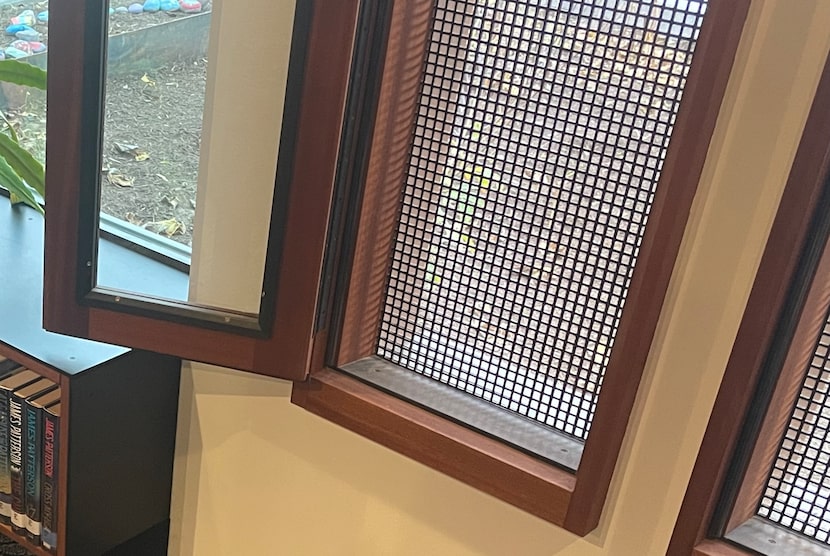
Detail of “vent door” at the Marathon Public Library.
Mark Lamster / Mark Lamster
The library’s spaces are enhanced by Shipley’s characteristically inventive detailing. Wooden moldings are given a slight tilt along their top edges so they don’t accrue dust. Coat hooks are made of repurposed crowbars. Windows have what Shipley calls “vent doors,” frames with a bronze insect screen sandwiched between two grids of perforated steel that allow the window to be opened to the elements without compromising security. “Most libraries would never have any expectation of natural ventilation,” says Shipley.
In less assured hands, the building’s material richness — so many bespoke details, myriad types of wood — might feel overwrought, but Shipley makes it work, creating something that rises above the sum of its many parts.
“We didn’t know that the community was going to really appreciate how important this building is, and how beautiful it is, but they do,” says Jones. “They get it.”
It is a good lesson: Quality architecture, regardless of style and location, is always welcome.
 Lamster: How Frank Gehry became America’s most influential architect
An appreciation of the architect who designed Bilbao’s Guggenheim Museum and made buildings sculpture.
 Frank Gehry, the most celebrated architect of his time, dies at 96
Gehry died Friday in his home in Santa Monica after a brief respiratory illness, a spokesperson said.