
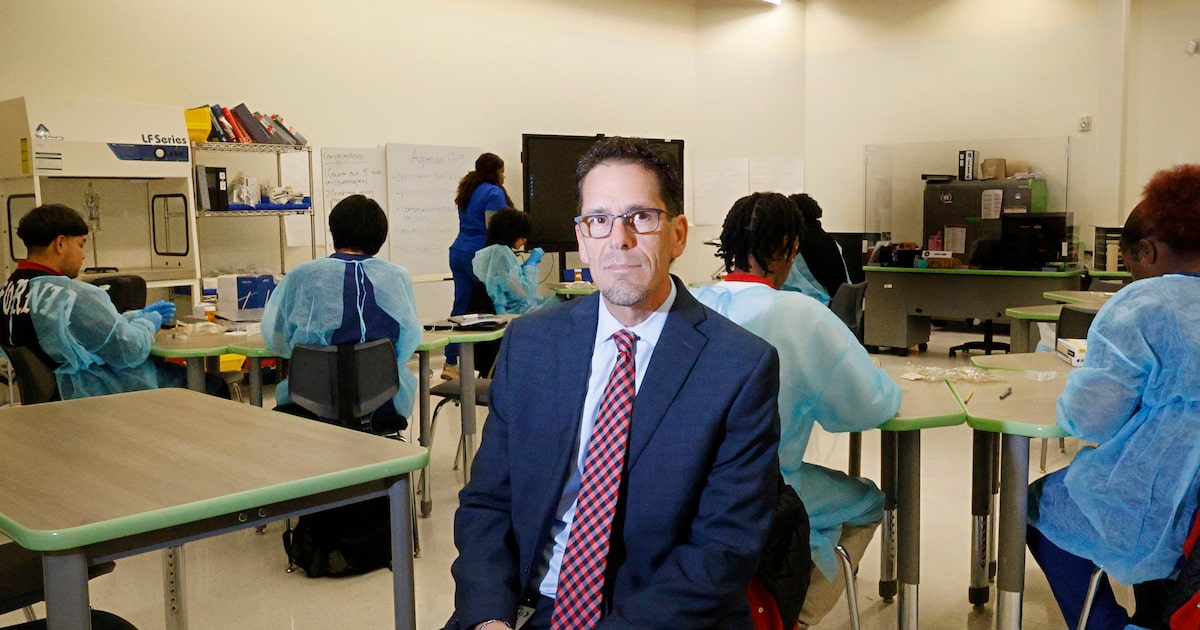
Brian Lusk, Dallas ISD’s deputy superintendent of school and academics, will be El Paso ISD’s next superintendent after the school board there approved his selection Tuesday night.
The veteran educator is leaving Dallas ISD after three decades. He started his education career as an elementary school teacher in South Dallas and has held multiple teacher, principal and administrative roles in the district, including chief of strategic initiatives. In recent years, Lusk has spearheaded the expansion of Dallas ISD’s ambitious career preparation and college readiness programs.
“I love the opportunity I had in Dallas to work in an urban setting, and I think there are so many things that align to what the work is being done here in El Paso,” Lusk said. “I feel like the experience that I’ve had and the leadership I’ve been able to engage in has prepared me for this.”
In his new role, Lusk will lead the largest district in El Paso, which serves over 48,000 students. His first day is Dec. 10.
The Education Lab
El Paso ISD’s board of trustees selected Lusk as the sole finalist in late November, months after former superintendent Diana Sayavedra suddenly resigned in June. Board members highlighted his track record in achieving student outcomes in a large, urban school district similar to El Paso. Nearly 35,000 students in El Paso, about 73%, are economically disadvantaged, compared to 90% of Dallas ISD’s 140,000 students.
El Paso made significant academic gains over the last year and received a B in this year’s state accountability ratings. Like other districts across Texas, El Paso ISD is facing declining enrollment, campus closures and a $6 million budget shortfall.
Related

“Dr. Lusk has spent his entire career serving students and school communities, and that commitment resonates deeply with who we are as a district,” Board President Leah Hanany said in a release. “We warmly welcome both him and his wife to El Paso and look forward to the exciting work ahead.”
Lusk, who grew up in Pennsylvania, says he knew he wanted to be an educator when he was 10 years old and coached younger kids in soccer. He holds a degree in elementary education, a master’s in educational administration, and a doctorate in educational leadership and policy from the University of Texas at Austin.
He said he was drawn to El Paso ISD because of its board’s high expectations and the investments the district has made in career and technical education and early childhood education.
Dallas ISD Superintendent Stephanie Elizalde said Lusk’s work in Dallas to expand those programs, as well as his efforts to help significantly reduce the number of D- and F-rated schools, has prepared him to lead El Paso ISD.
Related

“I think what El Paso is going to see is that he’s going to be able to come around and bring people into a united vision around the things they value,” she said. “He’s going to get them to continue to stay focused on kids, but at a new level.”
As deputy superintendent in Dallas ISD, Lusk oversaw 228 schools and led the district’s academics, college and career readiness, counseling services, innovation, and athletics. Under his leadership, the district opened two new career institutes, which provide high schoolers hands-on training in areas such as health science, manufacturing and aviation that may not be available on their home campus.
The district has taken a multi-pronged approach to readying students for life after high school, recognizing that while many will thrive in college, others want to enter directly into the workforce and earn a livable wage.
Related

“There were a lot of kids who weren’t really connected to school and we weren’t meeting the needs of them, and so we’ve done a much better job of meeting the needs of all of our learners,” Lusk said of the career institutes.
He has said he believes Dallas ISD needs to be the “economic engine for the city” and align programs and pathways with the local job market.
Children born in Dallas County have a 2 in 3 chance of not earning a living wage when they grow up, according to the Commit Partnership.
The numbers show Dallas ISD’s approach is getting students on track. Under Lusk’s leadership, roughly 91% of graduates were deemed ready for college, career or the military based on state standards last year. Prior to the pandemic, that figure sat at roughly half.
Related

Over 900 juniors and seniors held internships this year, Lusk said, which helps students realize that careers after high school or college are possible. Hundreds of students earn associate’s degrees each year when they graduate from a Dallas ISD high school under the P-TECH program Lusk helped launch.
“My North Star is having a pathway or program for every student,” Lusk said. “I always talk about this idea of the pathway to prosperity because every single one of our students deserves that …It means we have options and we make sure there are no barriers for those students to get them.”
Related

Lusk also helped steer partnerships with regional schools and companies, including an international baccalaureate school at Paul Quinn College in southern Dallas and a West Dallas STEM school in collaboration with Toyota and Southern Methodist University.
“I’m proud of those because what they’ve done is provide more options and considerations for families,” he said.
Elizalde, who worked with Lusk for over 14 years, described him as someone who is skilled at listening to communities before making decisions. She pointed to the smooth rollout of Dallas ISD’s new school counselor excellence initiative, a pay-for-performance program that aims to retain the best counselors, which Lusk oversaw earlier this year.
“He brought principals and counselors in and said, ‘Tell me, what are the challenges to your job? What are the metrics that would be meaningful?’” Elizalde said. “It takes a lot of time to do that. Consensus decision making is very messy and time consuming, but its implementation is so much smoother.”
When Elizalde tapped Lusk to be her deputy in 2023, she knew he would be a superintendent one day. She said his deep knowledge of curriculum instruction paired with school leadership experience means he can bring the right people together to level up a district’s work.
“There’s a saying that when you’re the first to break through, you’re the one that hits the brick wall. Everyone goes behind you because the hole has already been made,” Elizalde said. “Brian has the ability to be the first through that wall, of trying something new that no one else has done before.”
The DMN Education Lab deepens the coverage and conversation about urgent education issues critical to the future of North Texas.
The DMN Education Lab is a community-funded journalism initiative, with support from Bobby and Lottye Lyle, Communities Foundation of Texas, The Dallas Foundation, Dallas Regional Chamber, Deedie Rose, Garrett and Cecilia Boone, Judy and Jim Gibbs, The Meadows Foundation, The Murrell Foundation, Ron and Phyllis Steinhart, Solutions Journalism Network, Southern Methodist University, Sydney Smith Hicks, and the University of Texas at Dallas. The Dallas Morning News retains full editorial control of the Education Lab’s journalism.