
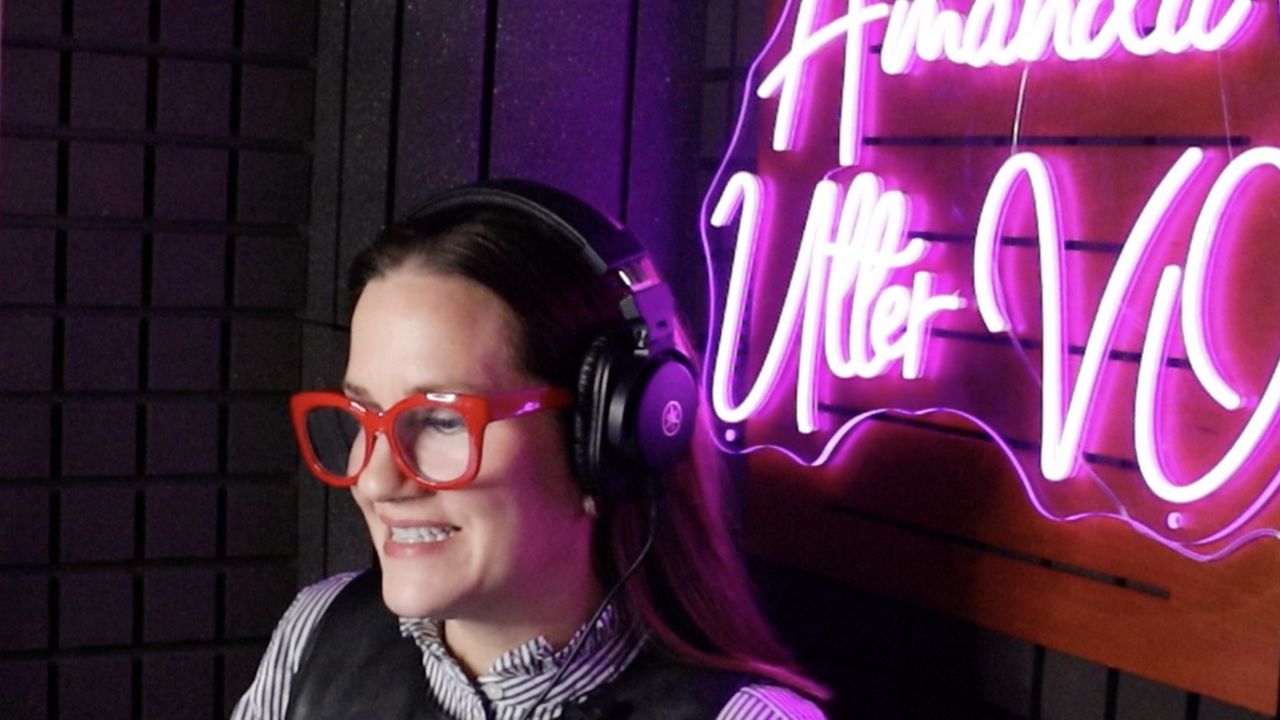
TEXAS — Amanda Utter has voiced commercials, in-store specials and has also been the announcer for live events across her 20-year career. But within the last five years, artificial intelligence (AI) has advanced enough to where she is unsure of her future in the voiceover industry.
“I want our children coming up to be able to have a life in the arts like I had,” she said. “And I don’t want that taken away because a robot thinks they can do it better.”
Utter is alluding to a U.K.-based company, ElevenLabs, introducing celebrities’ voices in their “Iconic Marketplace.” Most recently, actor Michael Caine was announced to join the company’s roster of available celebrity AI voices.
“The Iconic Marketplace is a curated, two-sided platform where companies can request access to iconic talent for projects and content,” said the company in its Nov. 28 announcement.
“The Iconic Marketplace is the performer-first approach the entertainment industry has been calling for. In addition to Caine, over 25 other iconic voices are available on the platform today, including those of Dr. Maya Angelou, Alan Turing, Liza Minelli, and Art Garfunkel,” it said.
Included in the projects and content are commercials and advertisements, which Utter has worked on for companies like H-E-B and Discount Tire. However, AI has started to impact her career.
“It’s impacting the everyday actor, the middle income, the regular person. That’s who’s getting hit the hardest,” she said.
“While many big brands are relying on humans, I have lost some work to one company that I have been working with for a while. They chose to take a human, clone their voice, and utilize that voice as much as they want,” Utter added.
She also observed an impact when it comes to smaller gigs and projects. The “low hanging fruit,” Utter calls them, that a lot of voiceover actors start with like she did, are being taken up by AI voiceovers instead of people.
Utter noted that along with the threat to booking gigs, ads using AI — depending on the individual consumer — could lose credibility.
“I’m not going to trust your brand, I’m not going to trust your product,” she said.
“I have options when I’m a consumer or a listener, and I’m going to choose the human every time,” Utter added.
Gary Wilcox, a professor of advertising and public relations at the University of Texas at Austin, noted that for some consumers, it’s not a matter of knowing that an ad was delivered by a real person, but rather believing it did.
“I think consumers want to feel that something is genuine that they want to believe in,” he said. “Your perception is your reality.”
“You and I see different things. We may see the same message but come away with different perspectives. What you focus on is different than what I focus on,” Wilcox said.
Wilcox said he doesn’t know what the future of AI voiceovers will be, but he is keeping a close eye on how regulations might evolve as AI does. He says companies cannot mislead a consumer, but could using an AI voiceover of a celebrity be considered deception?
“That could be,” he said. “Depends on how the FTC [Federal Trade Commission] and the courts determine that. The companies need to pay attention to the regulatory stuff, and I’m sure they are.”
Back in her recording booth, Utter avoids the risk of misleading by standing behind real, human actors. Even when it comes to a contract wanting to repurpose her voice for another project using AI, she’s very specific about what she will agree to.
“I will be sure that the usage is very clear,” she said. “Say it was for in-store radio, it would only be used for this many stores, it will run for this long, and we will use it for this many spots.”
Utter continues to work on projects with companies who she says have expressed continued interest in working with real actors, but she’s unsure whether that same sentiment will carry over the following years as AI continues to grow.