
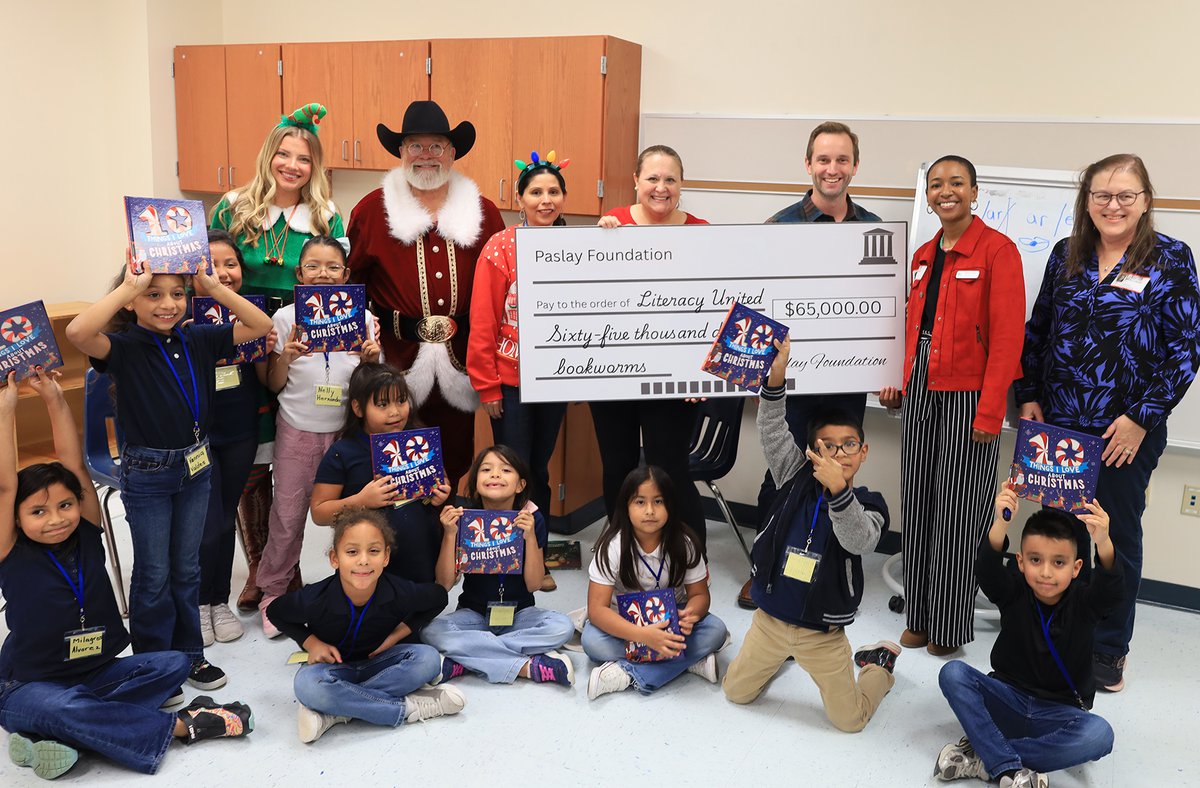
It’s 3:30 p.m. at Contreras Elementary on Fort Worth’s south side, the hour when most classrooms sit quiet and fluorescent lights flicker off one by one. But inside a small room in a fully-decorated hallway, a group of second graders leaned over phonics cards and picture books, laughing, sounding out blends, and refusing — even after a full school day — to call it quits. This is Bookworms, an after-school reading intervention program run by Literacy United, and on this particular December day, the usual routine came with an unexpected flourish.
Local restaurateur Marcus Paslay walked in alongside his wife Emily, flanked by Santa and an enthusiastic elf, carrying a check for $65,000. The gift — presented to Literacy United executive director Kary Johnson — is earmarked for Bookworms, a program serving children in Pre-K through second grade who are struggling with reading and often don’t have books, resources, or academic support at home.
For Paslay, the moment was personal. He grew up with dyslexia, wrestling with words that refused to behave on the page.
“I performed really poorly in school growing up, and it was always a struggle for me,” he said while sitting at a tiny student desk.
His turning point came when his parents moved him to Hill School, where he spent three years getting the kind of targeted instruction that changed the trajectory of his life.
“We feel very pressed to help out and especially at a young age where we can get ahead of that confidence curve and reinstall confidence in learning in kids who are very bright,” Paslay added.
That urgency has shaped the Paslay Foundation’s broader mission. The couple recently committed $250,000 to Fort Worth organizations serving young learners with dyslexia, ADHD, autism, and related learning differences — a group that includes Hill School, LinkED, and Literacy United. The goal is to support early testing, evidence-based tutoring, and individualized interventions before children fall years behind.
Johnson has spent the last two years building Bookworms into a model for early literacy support in the Fort Worth Independent School District (FWISD). Selected schools are high-need campuses where students frequently arrive without books at home or the kind of language-rich interactions that help reading take root. Bookworms provides structured lessons grounded in the science of reading, led by a certified teacher with advanced training in reading therapy or special education and supported by carefully trained volunteers.
“We were very intentional that we are working with children under third grade,” Johnson said. “By the time kids get to third grade, they’ve often had several years of school failure. We’re trying to prevent those problems from developing.”
The results show up not only in phonics skills and decoding scores but also in confidence — an ingredient Johnson argues is as essential as any curriculum. Parents agree.
Jennifer Davila, whose second-grader participates in Bookworms, says the program fills a gap she didn’t know how to address. “My daughter wasn’t reading fluently, not even small words,” Davila said. Once teachers identified dyslexia and added Bookworms to her daughter’s support system, “she gets home, she grabs a book, and she will read on her own,” she shared. “That just made me so happy.”
Bookworms lean heavily on partnerships — from FWISD educators and university volunteers to local churches, private schools, and civic organizations. Oh, and when we say volunteers, we aren’t just talking about a few retirees babysitting. Johnson and her team provide master’s degree-level professionals to guide the classes.
Saturdays bring Bookworms Parent University, where families gather for workshops and shared meals. Summers bring extended programming, because, as Johnson puts it, “time is the enemy when it comes to reading problems.”
Expansion is the long-term goal, but carefully. Johnson insists on landing in campuses where principals, teachers, and families are all committed to sustained collaboration. She has a waiting list of schools that want the program, as well as parents from across the district calling for help navigating testing and intervention options.
For now, though, she’s focused on the moment — on the second graders at Contreras, on the volunteers reading aloud to the families who show up on Saturdays with questions and hope. And on the gift that will keep the program alive for another year — a gift she describes as “life-giving.”
“So many children will be impacted,” Johnson said. “We’re serving a hundred children this year. This [check] will help a hundred children have a better trajectory.”