

El Paso health officials are reporting the highest number of whooping cough cases since the COVID-19 pandemic, reflecting a statewide trend.
There were 23 pertussis cases identified in El Paso County through October this year, which is almost four times higher than at this time last year, according to the El Paso Department of Public Health’s latest notifiable conditions report. Statewide, more than 3,500 pertussis were cases reported, the highest in more than a decade and with the majority of infections occurring in children, according to the Texas Department of State Health Services.
Whooping cough is a contagious disease that spreads through respiratory droplets. The disease got its name because people can develop a high-pitched “whoop” when they gasp after a coughing fit. Infants, who are particularly vulnerable, often don’t make the characteristic sound because they can’t cough as strongly. Instead they may gag, gasp, vomit, turn blue or have pauses in breathing.
Vaccination, timely evaluation and early antibiotics remain the most effective tools to prevent severe disease, said Jose Luis Salas, a registered nurse at El Paso Children’s Hospital who’s certified in infection control.
Prior to the vaccine’s introduction in the late 1940s, whooping cough was one of the most common childhood illnesses and a leading cause of childhood death in the United States.
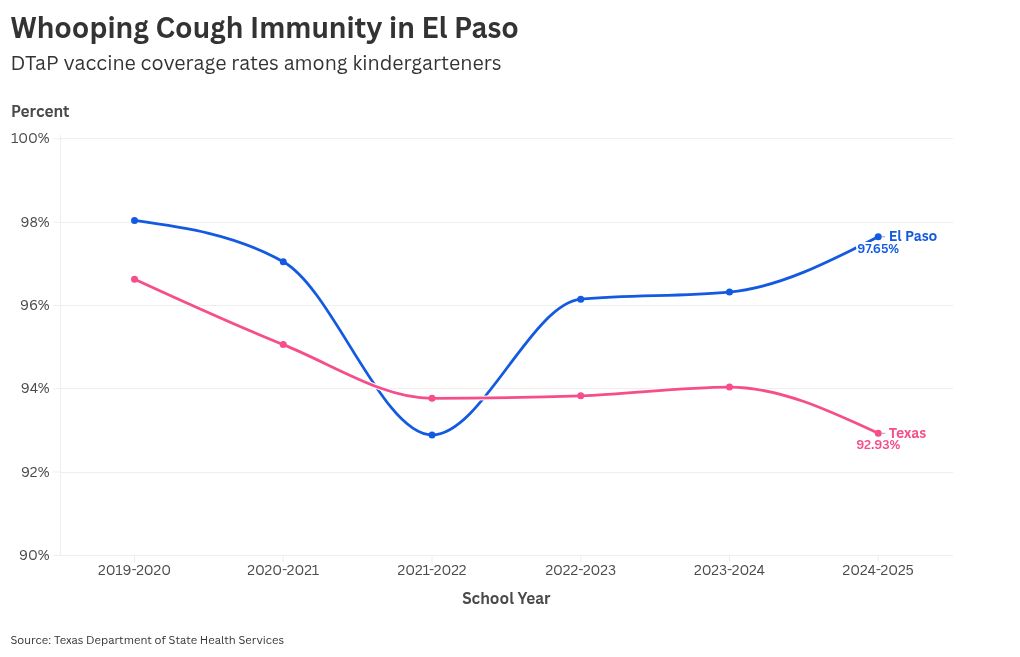
Comparing the largest Texas counties, El Paso children are among the most widely vaccinated against pertussis. But childhood immunization rates have fallen elsewhere in Texas. Maintaining high vaccine coverage – thresholds typically above 90% – is crucial for achieving herd immunity.
The state health department reported 97.6% of El Paso kindergarteners were vaccinated with the DTaP or related vaccine compared to 92.9% of all Texas kindergarteners. Dallas and Travis are the largest Texas counties to have DTaP vaccination rates below 90% for kindergarteners.
DTaP is a combination vaccine for diphtheria, tetanus and pertussis, recommended in five shots from 2 months to 6 years old. Older children and adults receive another vaccine – Tdap – as a booster with reduced dosage.
 Jose Luis Salas, RN
Waning immunity and lower routine vaccination coverage since the pandemic have contributed to the increased spread of pertussis, Salas said. A decrease of a single percentage point in a community’s vaccine coverage can represent hundreds to thousands more children left unprotected.
Both El Paso Children’s Hospital and University Medical Center of El Paso have recorded more visits for whooping cough this year than in the previous five years combined. Both locally and nationally, whooping cases are already higher this year than in 2019 prior to the pandemic.
“As is typical with pertussis, children who are not yet fully vaccinated or are too young to have received all recommended doses are at higher risk for more significant symptoms,” Salas said. “I strongly urge everyone to follow up with their healthcare provider, get vaccinated and make sure anyone visiting your newborn has received their Tdap or flu vaccine.”
Most of the children hospitalized at El Paso Children’s Hospital are infants, particularly those 12 months and younger because their immune systems are still developing and they haven’t completed their DTaP vaccine series. Older children diagnosed this year could generally be managed as outpatients, recovering with standard care and early treatment, Salas said.
As people gather indoors for the holidays, viruses spread quickly through close contact. Salas advised El Pasoans to wash their hands often, get vaccinated, stay home when sick and seek medical attention early. If people must go out while ill, they should wear a mask and keep their distance in waiting rooms or other public areas.
“When each of us takes responsibility, we protect not only ourselves but our entire community,” Salas said. “Together, we can minimize the spread of respiratory diseases and keep this holiday season a safe and healthy one for all.”
Related
LISTEN: EL PASO MATTERS PODCAST