
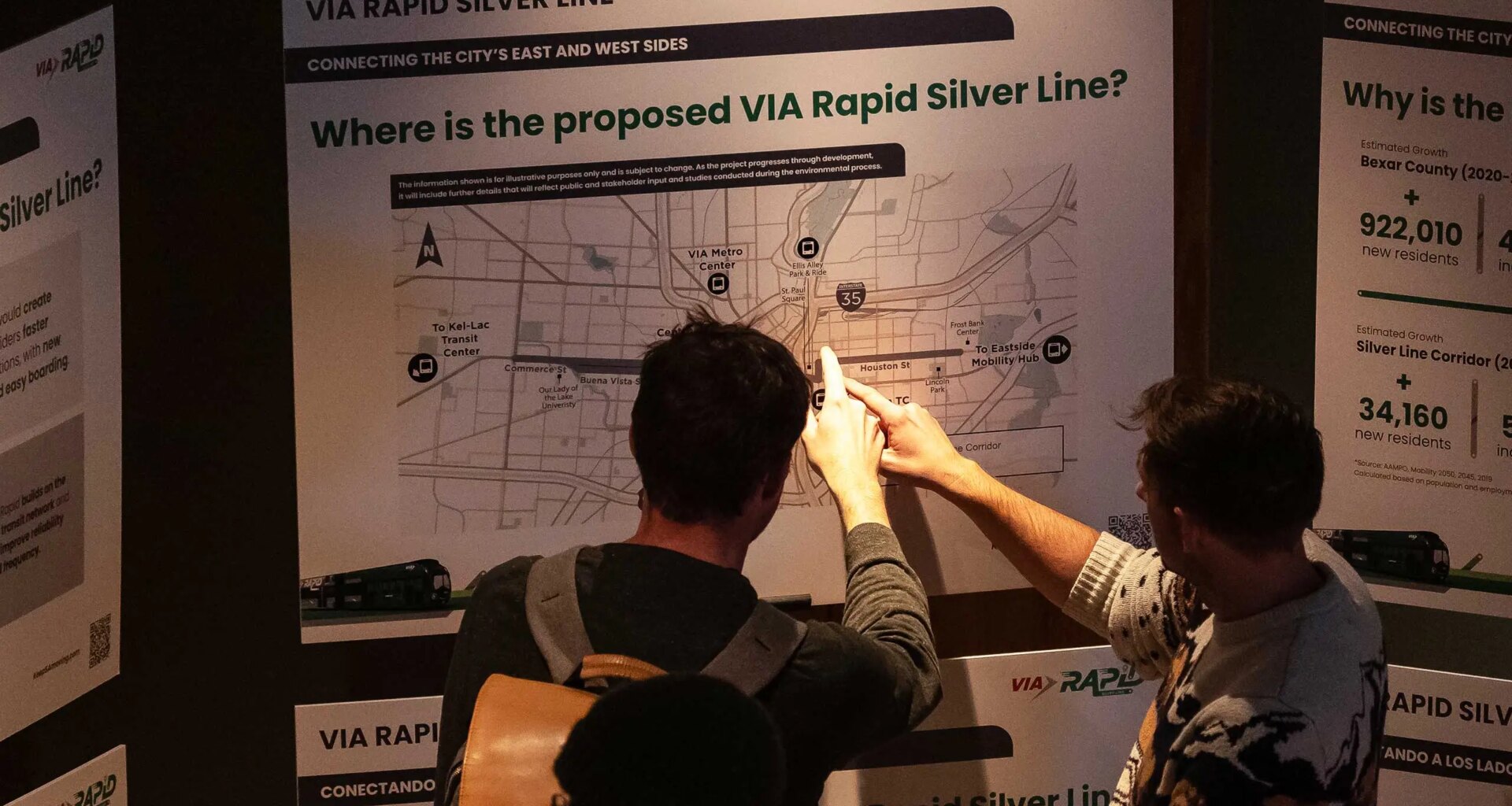
Researchers at University of Texas at San Antonio say they’ve found space along some of the city’s busiest streets to build housing for 600,000 new residents by 2050.
Their project identified more than 7,000 acres of vacant land or underutilized parking spaces near proposed transit corridors that could be turned into new housing.
Ian Caine, the UT San Antonio architecture professor who led the work, said a combination of new development and projects filling in around existing buildings could bring new housing to VIA’s proposed transit hubs while respecting local history.
“If you develop on underutilized, vacant land along some of these routes, you could meet San Antonio’s entire housing shortage,” Caine said.
The project, called Vacancy to Vitality, identified vacant parcels and unused parking areas along transit corridors that are not restricted by factors like flood risk, ownership or size and proposed policies and designs to create development without displacing residents or historical businesses and buildings.
Researchers looked at land a half-mile from seven of VIA’s proposed rapid transit corridors and found more 2,700 acres of vacant land and 4,700 acres of underutilized parking spaces they say could be converted into housing.
Some of those ideas — like turning motels into workforce housing, adding multifamily housing to strip malls or turning malls into large mixed-use communities — aren’t new, Caine said. He wanted to add data and ideas to San Antonio’s discussion about housing.
The project, which combined research with renderings created by UT San Antonio architecture students, identified some of the places and ways to introduce them to San Antonio. Caine said it was not a definite proposal for city growth, but could introduce possibilities to developers.
“This is a thought experiment about how San Antonio will grow over the next 25 years,” Caine said at a panel discussion on Tuesday.
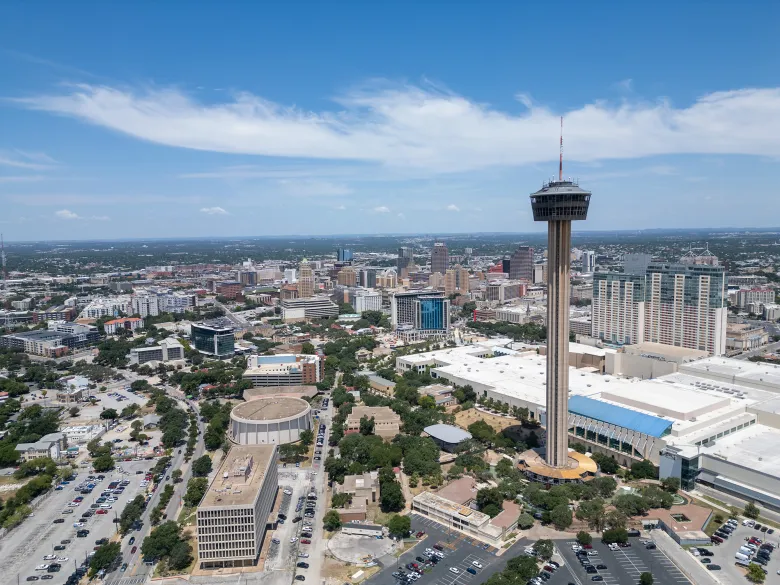 Drone image of the Tower of Americas overlooking downtown San Antonio in August 2025. Credit: Cooper Mock for the San Antonio Report
The project focused on VIA’s proposed advanced rapid transit corridors. Two of those are in development — the Green Line broke ground earlier this year and the Silver Line could start construction in 2027 — while five others included in the research are merely proposed.
Caine said the research still focused on alternative forms of transportation, like self-driving cars and public transit.
“We’re imagining a future where private gas-powered cars and large parking lots are less common,” he said. “We want to prioritize people over cars.”
That would be a big change. Driverless car company Waymo will introduce its services to San Antonio in 2026, but more than 80% of San Antonio workers commuted by car in 2024, according to U.S. Census Bureau data. That’s more than 600,000 people.
Even with that number of car users, Caine said that many of San Antonio’s parking spaces were underutilized. In the U.S., parking spaces are empty around 75% of the time, but can have environmental effects, like holding in heat and preventing rain from reaching the earth below.
There are 877,000 parking spaces in the study area around those VIA transit corridors, Caine said. That’s around six parking spaces for every 1,000 gross square feet of commercial space, around double the national average. Researchers estimated that two-thirds of those spots could be set aside for development, more than 4,000 acres.
Filling in those unused spaces with mixed use development can be more environmentally friendly, reduce infrastructure costs and reduce travel times, particularly if it’s near public transit.
Caine stressed that it was important to develop without displacing businesses or residents of those neighborhoods. Part of the project was mapping residents’ vulnerability to displacement and gentrification.
Caine said private owners would have to take on the development. How many people can be housed on the land would depend on what kind of housing developers build.
City policymakers have focused on transit-oriented development, or TOD, and approved rules last year meant to lessen urban sprawl and encourage denser building near public transportation.
Vacancy to Vitality is on display at San Antonio Central Library until early January.