
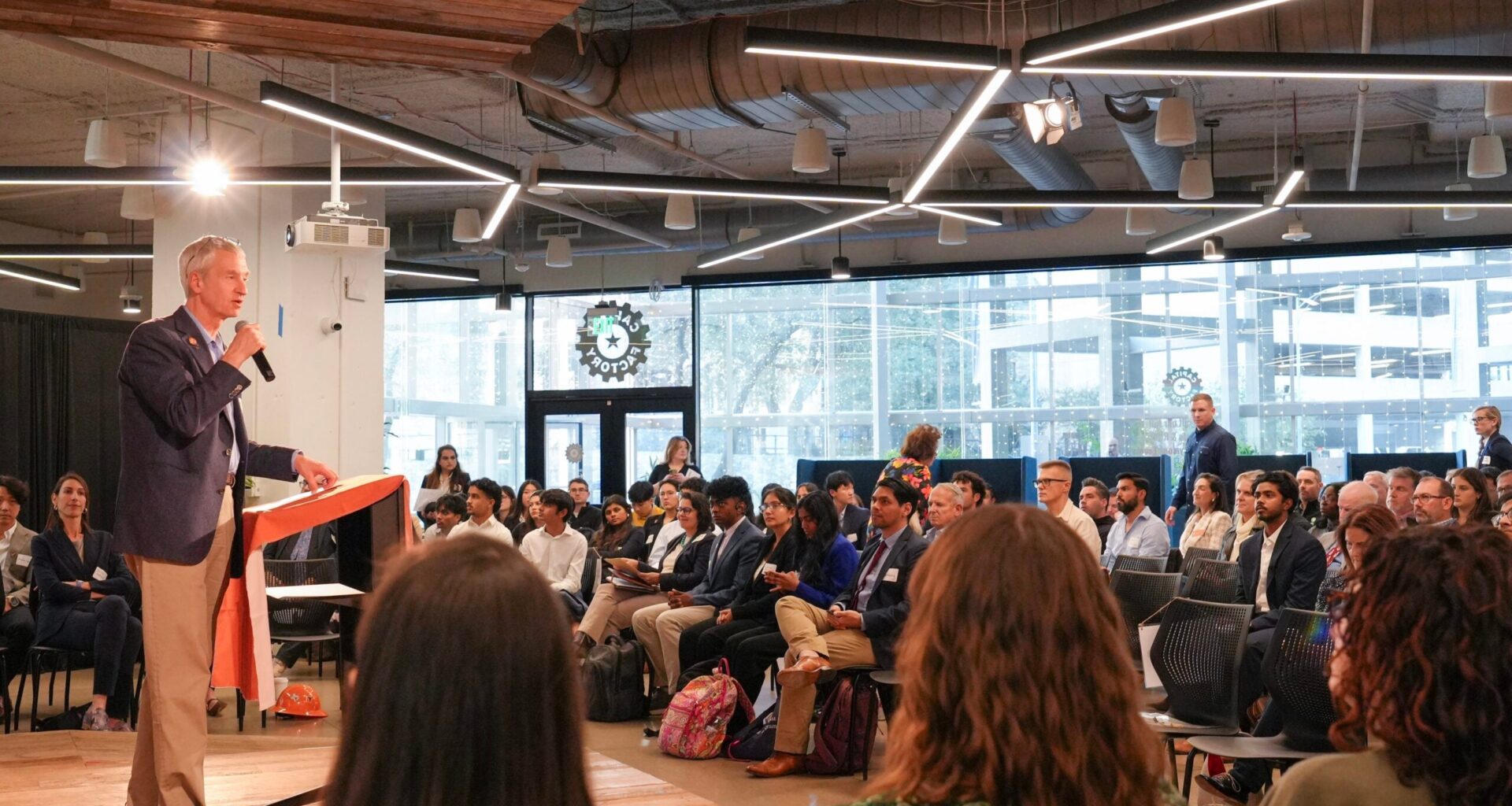
For the past 10 years, Texas Health Catalyst, a hub for life sciences and health care innovation at Dell Medical School, has identified innovative technologies and connected UT teams with industry advisers and investors to support transformative health care technology. In addition, the program’s $1.7 million in seed funding has catalyzed more than $100 million in follow-on funding across 76 projects.
“At UT Austin, our momentum has never been stronger — our research expenditures have doubled over the last decade,” said Fernanda Leite, Ph.D., interim vice president for research. “We’re cultivating a venture-oriented mindset across campus. This is where Texas Health Catalyst plays a vital role. We foster exactly the type of cross-campus innovation that accelerates translation.”
This fall’s innovation challenge focused on robotics, automation and autonomous care, aiming to address critical gaps in health care through technology to support clinical teams and to extend care beyond hospital walls.
Participating teams at the event, hosted by Capital Factory, presented on a variety of project topics, ranging from humanoid robots that can disinfect operating rooms to haptic simulators aiming to improve pediatric cardiac surgery training. Teams included physicians, engineers, scientists, medical students and more from across the UT campus.
With the emerging UT Medical Center on its way, even more collaboration and innovation are on the horizon: The medical center will unite the University’s strengths in medicine, engineering, life sciences, innovation and more to deliver world-class, patient-centered care in Austin.
“Around 20% of hospitals already have robotics or automated systems in daily operations, and we are just at the beginning of the autonomous revolution,” says Stephen Ekker, Ph.D., associate dean of innovation and entrepreneurship at Dell Medical School. “We are building the hospital of the future as part of the UT Medical Center, and one of our pillars of excellence will be robotics, automation and native AI tools and technologies.”
Robotics and Autonomous Tools
During this cycle, teams are leveraging technology to improve patient care both within and outside hospital walls. One project, led by Andrew Chang, MBA, technical project manager at Dell Med, and Gurpreet Singh, M.D., assistant professor of surgery and perioperative care, featured an active therapy robot and AI platform designed to support patients recovering from complex orthopedic surgeries at home.
The robot can detect muscle activation and provide both active and resistance exercises, while smart sensors enable real-time monitoring of recovery progress. Clinicians can supervise and guide rehabilitation remotely through a tele-rehab platform, and AI helps spot early warning signs to improve care. Although this solution can make rehabilitation care more accessible for everyone, it especially makes a difference in rural or underserved areas where care can be harder to access.
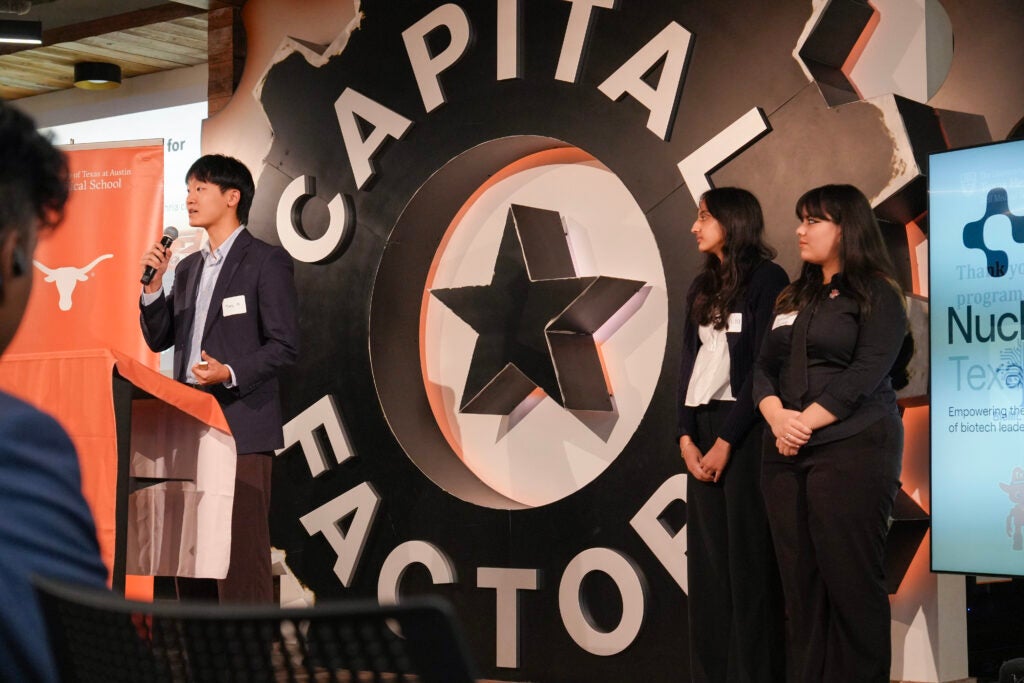 Photo by Bailey Evertson
Teams are also using AI as a patient resource, such as a bilingual chatbot that helps the public access information on treating and preventing HIV. “Stigma, fear of discrimination, and lack of evidence-based knowledge can keep people from seeking care,” says Aliza Norwood, M.D., project lead and associate professor at Dell Med. “Our AI HIV Clinical Assistant aims to fill the gap by creating a chatbot that iteratively tailors evidence-based, stigma-free information and tailored linkage to care based on community focus groups and communications experts.”
A project aiming to support fetal surgeons with mapping blood flow in real time took home the Trail Blazer Award, given for the most creative and novel solution. This tool can help surgeons treating conditions such as twin-to-twin transfusion syndrome, in which one twin takes too much blood from the other, through flexibility and improved visualization in comparison to traditional tools. Robotic innovations like this can not only increase twin survival rates, but also widen the access of care for patients who must travel long distances for specialized care.
Looking Ahead: The Future of Brain Health
Aligned with the recent establishment of the Dementia Prevention and Research Institute of Texas, the Spring 2026 Texas Health Catalyst challenge cycle will focus on dementia, neurodegeneration and the future of brain health.
Learn more about the call for proposals.
2025 Texas Health Catalyst Finalists:
“A Dexterous Robot Enhanced With Laser Speckle Contrast Imaging for Placental Vascular Surgeries” (Project Leads: Michael Kasman; Ann Majewicz Fey, Ph.D.; Andrew Dunn, Ph.D.)
“AI-Driven Written Exposure Therapy for Patients With Post Traumatic Stress Disorder” (Project leads: Alexander Rasgon, M.D.; Ying Ding, Ph.D.)
“Hygeia Touch: Toward a Contact-Based Cleaning Humanoid for the Operating Room” (Project Leads: Claire Sokas, M.D.; Ann Majewicz Fey, Ph.D.; Luis Sentis, Ph.D.)
“A Novel Active Therapeutic Robotic and Artificial Intelligence Platform for Complex Orthopedic Surgery Rehabilitation” (Project Leads: Andrew Chang, MBA; Gurpreet Singh, M.D.)
“Automated Multilingual Tool for Phoneme Assessment in Dysarthric Speech Care” (Project Leads: Eunjung Yeo, Ph.D.; Jun Wang, Ph.D.; David Harwath, Ph.D.)
“Optimizing Diagnostic Cystoscopy to Increase Access and Improve Diagnostic Capabilities and Reduce Cost to the Healthcare System” (Project Leads: Sarah Vij, M.D.; Farshid Alambeigi, Ph.D.)
“Expanding Equitable HIV Care Through a Bilingual AI Clinical Assistant” (Project Leads: Anthony Lopez; Aliza Norwood, M.D.)
“SUTR: Pediatric Congenital Heart Disease Surgical Training Tool” (Project Leads: Charles Fraser III, M.D.; Janavi Seshadri)