
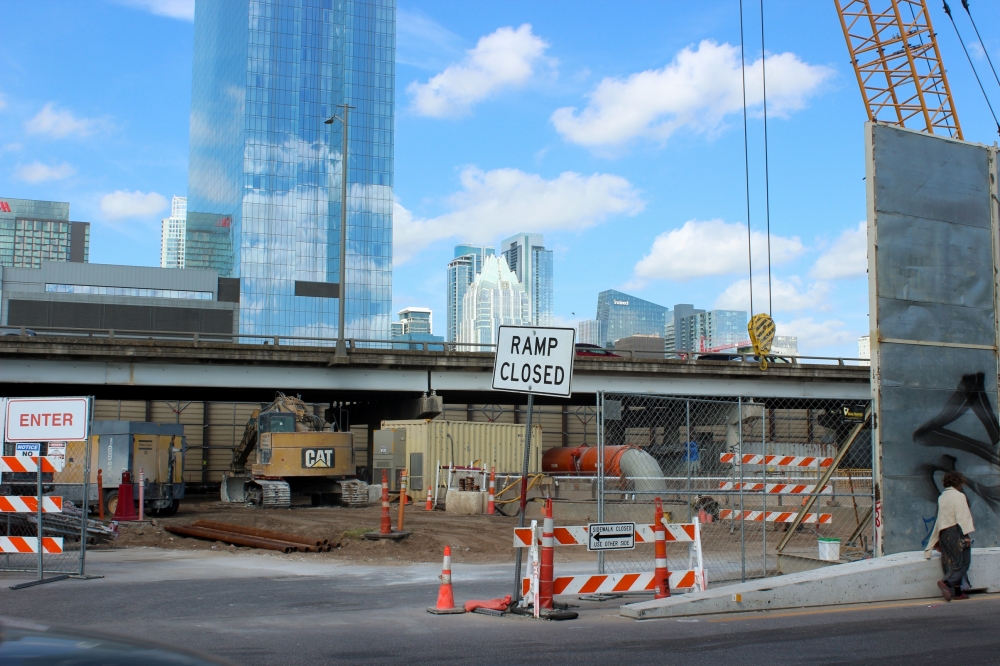
City of Austin officials now face a 2025 deadline to define the scope of several cap and stitch projects that could reshape traffic and neighborhoods across the city.
What’s happening?
In an update delivered to the Austin Mobility Committee Dec. 4, city officials were confronted with a revised timeline from the Texas Department of Transportation for its I-35 Capital Express Central project.
This new schedule introduces a complex set of financial pressures and risks for the city’s cap and stitch initiative, a plan to construct land bridges over the expanded I-35, which is intended to heal the decades-old divide created by the interstate, according to city officials.
The update presents a bit of a paradox: while the construction of key city-funded elements has been delayed by three years, the deadline for committing the remaining millions of dollars to the project has been unexpectedly moved forward, forcing difficult decisions on an accelerated timeline.
In May, Austin City Council approved an advance funding agreement with TxDOT for up to $104 million to fund the roadway support elements for three downtown caps and two northern stitches, using $41 million from a state infrastructure bank loan and $63 million from certificates of obligation.
However, TxDOT would be requesting the first substantial payment for the decks themselves in May 2026, under a schedule meant to spread costs over several years, with much larger “balloon payments” due in the final years of construction, when the actual bridge decks are built, city staff said.
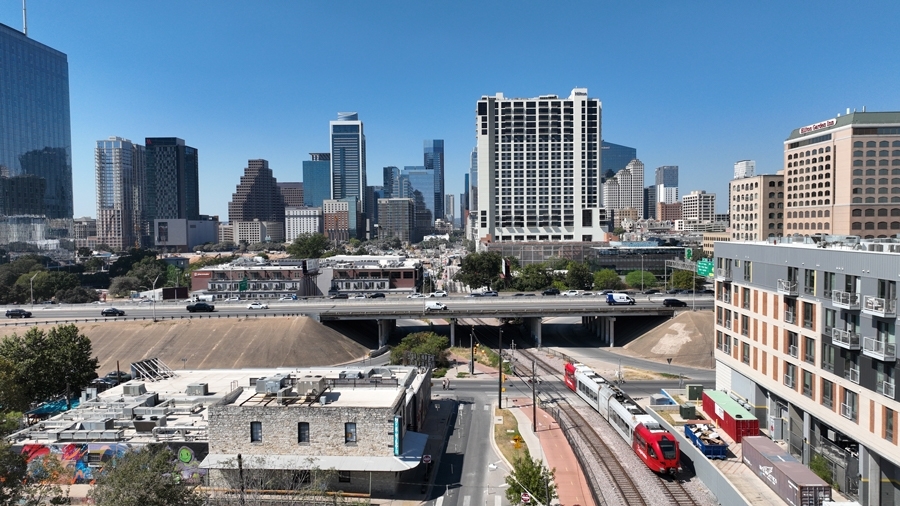 This image shows the current view of I-35 and the CapMetro Rail line in Downtown Austin near Fourth Street. (Courtesy Texas Department of Transportation)A closer look
TxDOT has made the decision to split the massive I-35 overhaul into two primary phases. The first, an “advanced construction package,” is scheduled to go to bid in 2027 and will include work on overpasses like the MLK Jr. Boulevard bridge and utility relocations. The second, the “ultimate construction package,” which contains the city’s cap and stitch elements, will not go to bid until 2029.
This means the construction of the city-funded foundational roadway elements and the cap decks themselves has been pushed out three years, from an anticipated 2026 start to 2029.
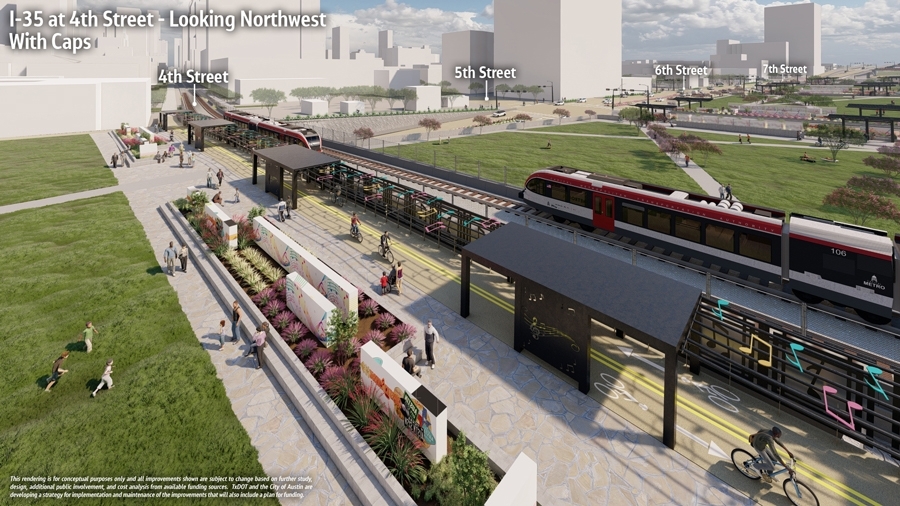 The proposed cap with elevated CapMetro Rail line near Fourth Street in Downtown Austin. (Rendering courtesy Texas Department of Transportation)Despite postponing the construction work, TxDOT has advanced its deadline for the city’s funding commitment for the horizontal cap decks from November 2026 to May 2026. TxDOT’s rationale for this change is a need to “enter into scope and budget negotiations with their consultant sooner than initially anticipated,” city staff told Mobility Committee board members.
This accelerated deadline has serious financial implications, said a representative from the city’s finance team, explaining that it forces the city to commit funds when project designs are only 30% complete, a significant reduction from the 60% design milestone previously planned. This earlier stage of design offers far less cost accuracy, with the representative saying, “The city’s risk profile has increased.”
Council Member Paige Ellis echoed staff’s concerns.
“This puts the city in a very tough spot when we are in a moment of having to make some very tough decisions about our own city budget and trying to make sure we’ve got the dollars available to accommodate all of this need,” Ellis said. “It’s not helpful to have our timelines moved up and for us to have to be committed to funding when we’re only at 30% design, I just think that’s a pretty poor practice.”
What we know
Progress continues on other components, including the design and community engagement for the northern stitches aimed at reconnecting neighborhoods.
A key goal of the overall cap and stitch initiative is to reconnect East and West Austin, and the proposed northern stitches are considered central to that effort in the Hancock and Cherrywood neighborhoods. These improved crossings are envisioned as more than just bridges; they are potential community spaces capable of holding trees and even two-story buildings, according to city documents.
The city held a public open house on Nov. 22, drawing approximately 125 people to review and provide feedback on four distinct design alternatives for two 300-foot stitches. These concepts, developed with a stakeholder working group, all fit within the established $24 million budget for the foundational roadway elements, a spokesperson with the city’s transportation and public works department confirmed.
The community was presented with four options that revolve around two primary stitch locations:
Options A and B: These alternatives feature a Red Line Stitch that closely follows the CapMetro commuter rail line, paired with two different configurations for a second stitch at 41st Street.Options C and D: These alternatives replace the Red Line Stitch with a central Hancock Stitch over the main lanes, also paired with the same two configurations for the 41st Street stitch.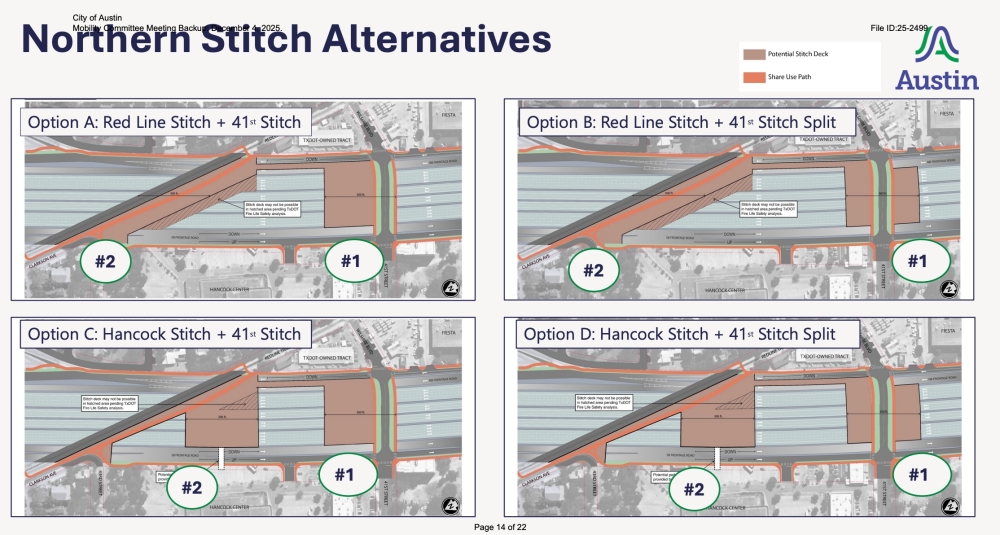 In a public open house Nov. 22, the city’s transportation and public works department presented four options for the configuration of two northern stitches. (Renderings courtesy city of Austin)City staff now face a firm December 2025 deadline to select the final locations. However, community advocates voiced concerns at the meeting about the compressed schedule.
Hayden Black Walker of Reconnect Austin told the committee that the timing between the November open house and the end-of-month decision is “really tight,” asking for “a couple of extra months” to allow time to vet potential private partners needed for the project.
The decision on the final locations will be made by City Council members and staff based on technical feasibility, staff evaluation criteria and community feedback. During the meeting, Ellis confirmed with staff that the choice will be made based on an internal scoring structure and “will not require a new City Council vote.”
Parkland impacts
As planning for these new connections solidifies, attention is also being paid to the project’s effects on existing public spaces.
During the meeting, officials confirmed that several parks, including Palm Park, Edward Rendon Sr. Metro Park and Chicano Park, will be affected by the project through 2033.
The impacts will vary, including temporary and permanent use of land for construction staging, the relocation of city utilities from TxDOT’s right-of-way into parkland, and necessary detours for the Ann and Roy Butler Hike-and-Bike Trail. The estimated cost associated with this use of parkland is approximately $19 million, said Richard Solis, division manager of Austin parks and recreation.
To compensate for these impacts, TxDOT has proposed a $25 million boardwalk along Lady Bird Lake, to be managed by The Trail Conservancy. However, during public testimony, resident Chris Flores called the project “frivolous” in tight budget times.
“This is park mitigation money, and I would like to ask that this money be—instead of paying for a boardwalk—that it be given to the parks department so that the parks department can buy parkland in the quadrant of the city that’s losing parkland, and that would be in East Austin,” Flores said.
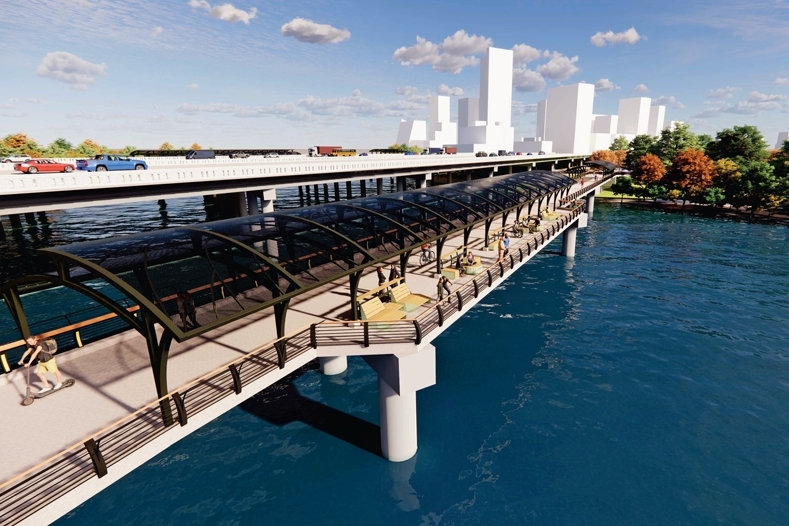 Construction on the Lady Bird Lake bridge will bring periodic trail and lake closures through 2033. (Rendering courtesy Texas Department of Transportation)Looking ahead
The following dates could define the scope of Austin’s cap and stitch vision:
December 2025: City Council members will make the final decision on the locations for the two northern stitchesMarch 2026: Staff are scheduled to present a comprehensive financing plan for the caps and their amenities to City Council during a work sessionMay 2026: TxDOT’s advanced deadline for City Council to make its funding commitment for any horizontal cap decks it wants included in the “ultimate construction” bid package to ensure the best possible pricingStaff noted the May deadline is not the final opportunity to add decks. Caps can still be incorporated later through change orders during the construction process. Staff cautioned, however, that this option would almost certainly increase costs.