
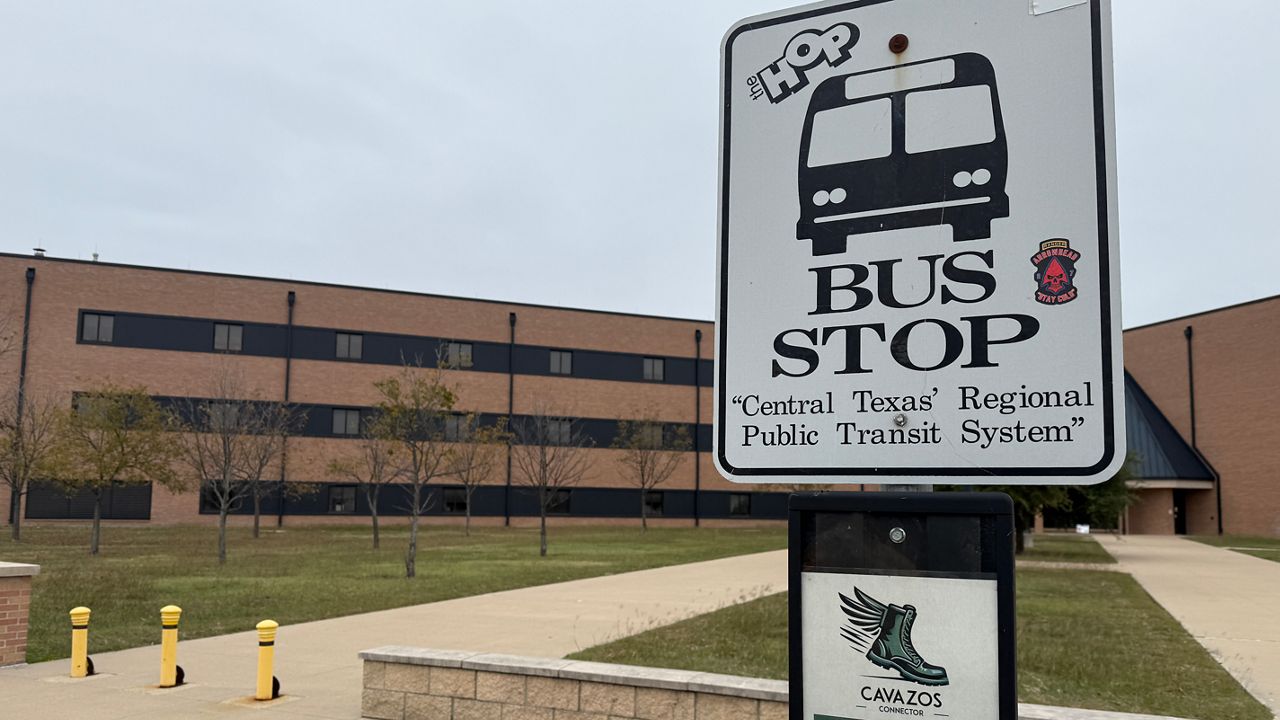
FORT HOOD, Texas — Several military installations in and out of Texas are currently exploring mass transit — and some are wanting to follow the blueprint set by Fort Hood in Central Texas.
With the press of a button, Fort Hood’s answer to a major problem discovered on the base rolls to its next destination.
“At the time Fort Cavazos, now today Fort Hood leadership reached out to Hill Country Transit District the need for single soldier and family transportation has always been something that Fort Hood had tried to provide,” said Mercedes Foshag, transit planner at Hill Country Transit District.
At the end of last year, Foshag said her company had plans to bring microtransit to Central Texas cities.
“Killeen, Temple, Belton, Copperas Cove, and Harker Heights, which we would consider the urban zone,” said Derek Czapnik, director of operations at Hill Country Transit District.
But due to Fort Hood’s interest, the plan was fast-tracked, combining the Army base and the urban region.
“So, riders can start on Fort Hood and then make their way into the broader region all on the same app, and they use our regional commuter to get from city to city, including Fort Hood,” said Foshag.
It’s called the Cavazos Connector. It officially launched March 2024.
Think of it like an Uber or Lyft for soldiers — except it’s free. Riders from the rest of the region have a base cost of $2, with a 50% discount for military and elderly passengers.
“Prior to the Connector, we had an installation shuttle funded by the Department of the Army to specific stops, for example, medical treatment facilities, etc. And we averaged 3,000 per year riders. Compared to 350 thousand in a nine-month period utilizing this system,” said David Duncan, deputy support operations officer at Army Field Support Battalion-Hood (AFSBN-Hood).
Fort Hood is the largest military installation in the U.S. by population.
Duncan said about 20% of arriving soldiers at Fort Hood don’t have a car or a driver’s license.
“Before, average soldier would have to walk upwards to two miles to get to a nearest MWR facility to enjoy things or even further in some cases,” said Czapnik.
They said this new addition helps with quality of life for the soldiers.
And other military installations like Fort Drum in New York, Fort Bliss in El Paso and Fort Carson in Colorado have noticed, with the latter recently visiting Fort Hood to replicate the same systems.
“Fort Hood is 20 miles across. So, it’s a large installation, and it’s got the off-post housing areas that are even further, so it’s a large geographic area to be servicing,” said Duncan.
The director of operations at Hill Country Transit District, which operates the Cavazos Connector, said there are 16 vehicles deploying about 72 fleets daily and transporting about 40,000 passengers a month.
Along with shuttling in Killeen, Harker Heights, Copperas Cove, Belton and Temple, the Cavazos Connector also operates in the three counties adjacent to Bell County. That’s Lampasas, Coryell and Milam counties.