
Downtown, the Capitol tree is lit. Nearby, at Zilker Park, more than two million lights make large-scale, fantastical displays shine at Trail of Lights.
Up north in Hyde Park, residents of 37th Street deck the block from Guadalupe to Home Streets with “the weirdest lights you will see,” a decades-old tradition that draws pedestrians each year. And at the University of Texas campus, Longhorn lights illuminate the South Mall, known as “the six-pack.”
Down south in Circle C, neighbors battle for the best-decorated home, using lights, inflatables and unique themes (like the king of rock and roll, Elvis Presley) as their weapons of choice. And much further east, at Circuit of the Americas, Peppermint Parkway’s drive-through show lights up the track with the Grinch and other characters starring in place of F1 drivers.
The cumulative effect of these and other displays across the Austin area can be seen from space.
Nighttime satellite imagery from NASA shows that neighborhoods across the U.S. get 30 to 50 percent brighter in December. The change is most noticeable in rural and suburban areas, away from city lights that are bright year round.
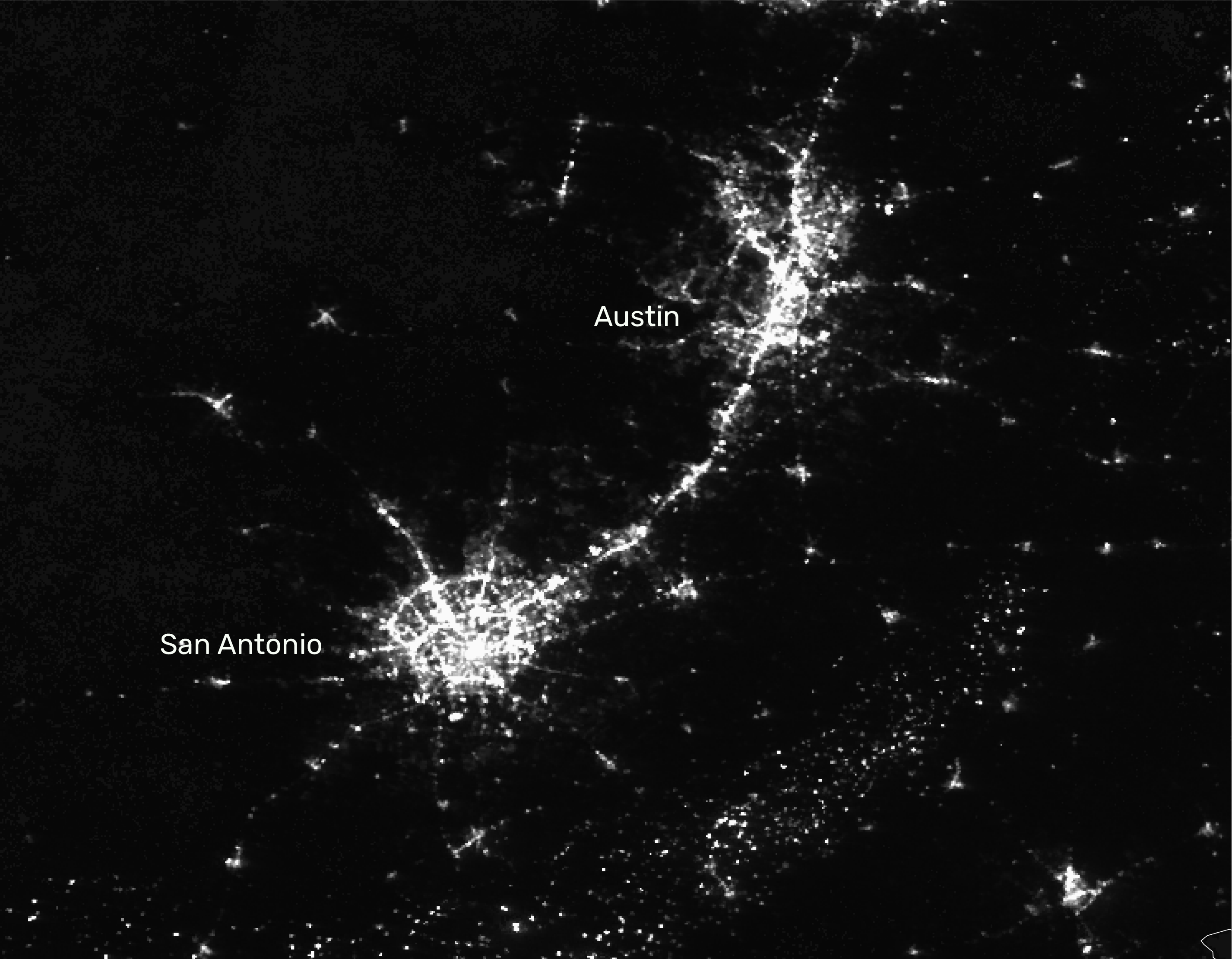
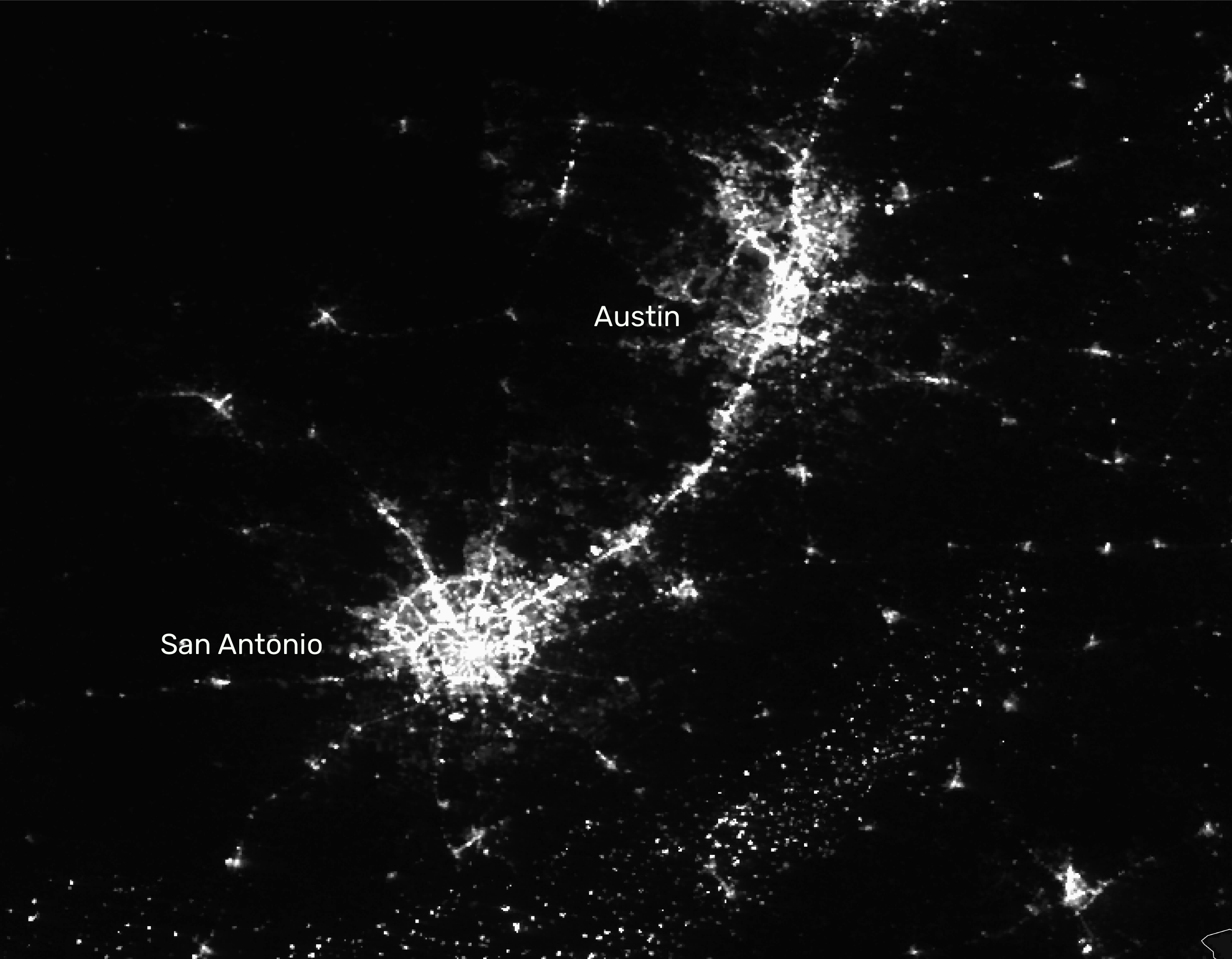
Austin Nighttime Lights in November 2023 versus December 2023
Slide the button back and forth to see how Austin lights change in December.
Nov. 2023
Dec. 2023
Source: NASA Black Marble
The shades of gray on the map represent radiance, or the amount of reflection of light off of Earth’s surface.
NASA scientists have been using nighttime satellite imagery since the 1970s to explore human behaviors and activity. Initially, low quality and the effects of moonlight, snow and vegetation limited how detailed conclusions could be made. But in 2012, technology was upgraded to use the Visible Infrared Imaging Radiometer Suite (VIIRS), which is much better at exploring trends on a day-to-day level.
“It’s a very good indicator for human activities,” said Zhuosen Wang, a principal investigator on the NASA Black Marble project, which focuses on nighttime satellite imagery. “So for our Black Marble, what’s unique is that we correct the lunar effect and also atmospheric effect.”
And researchers have noticed that light patterns often follow holidays, like Christmas or Ramadan, in places where they are widely celebrated.
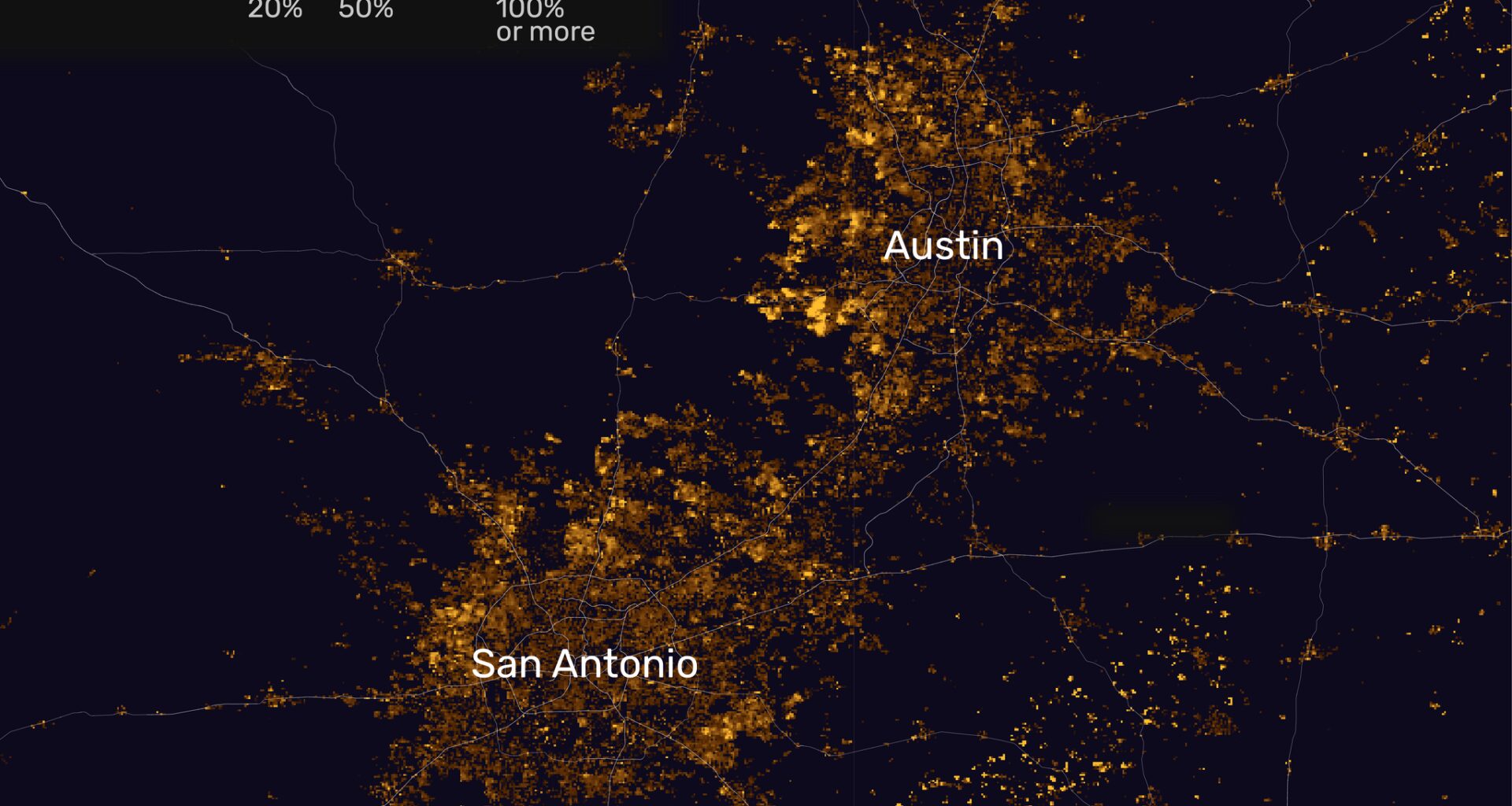
Austin suburbs glow brighter in December
The suburbs of Austin and San Antonio were brighter in December 2023 than surrounding months.
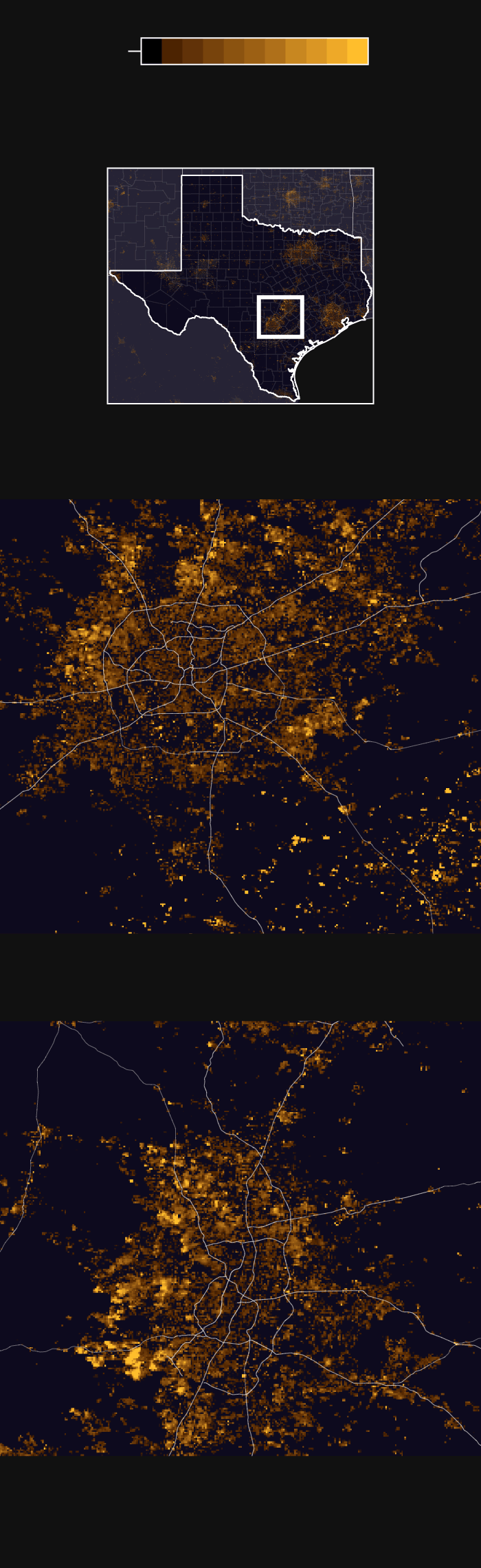
Chart: Hanna Zakharenko / Hearst DevHub•
Source: NASA Black Marble
All negative values grouped into the same color.
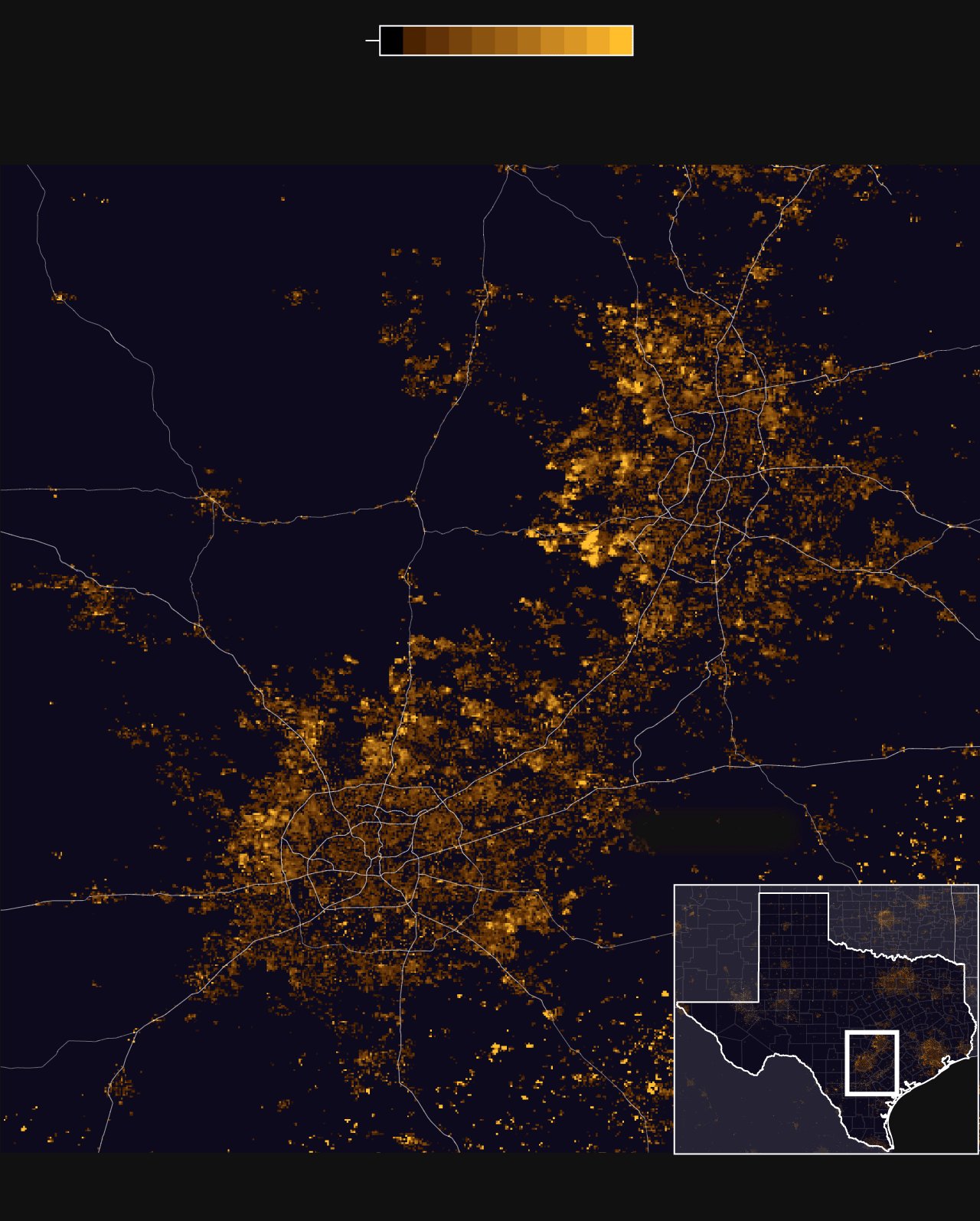
Chart: Hanna Zakharenko / Hearst DevHub• Source: NASA Black Marble
All negative values grouped into the same color.
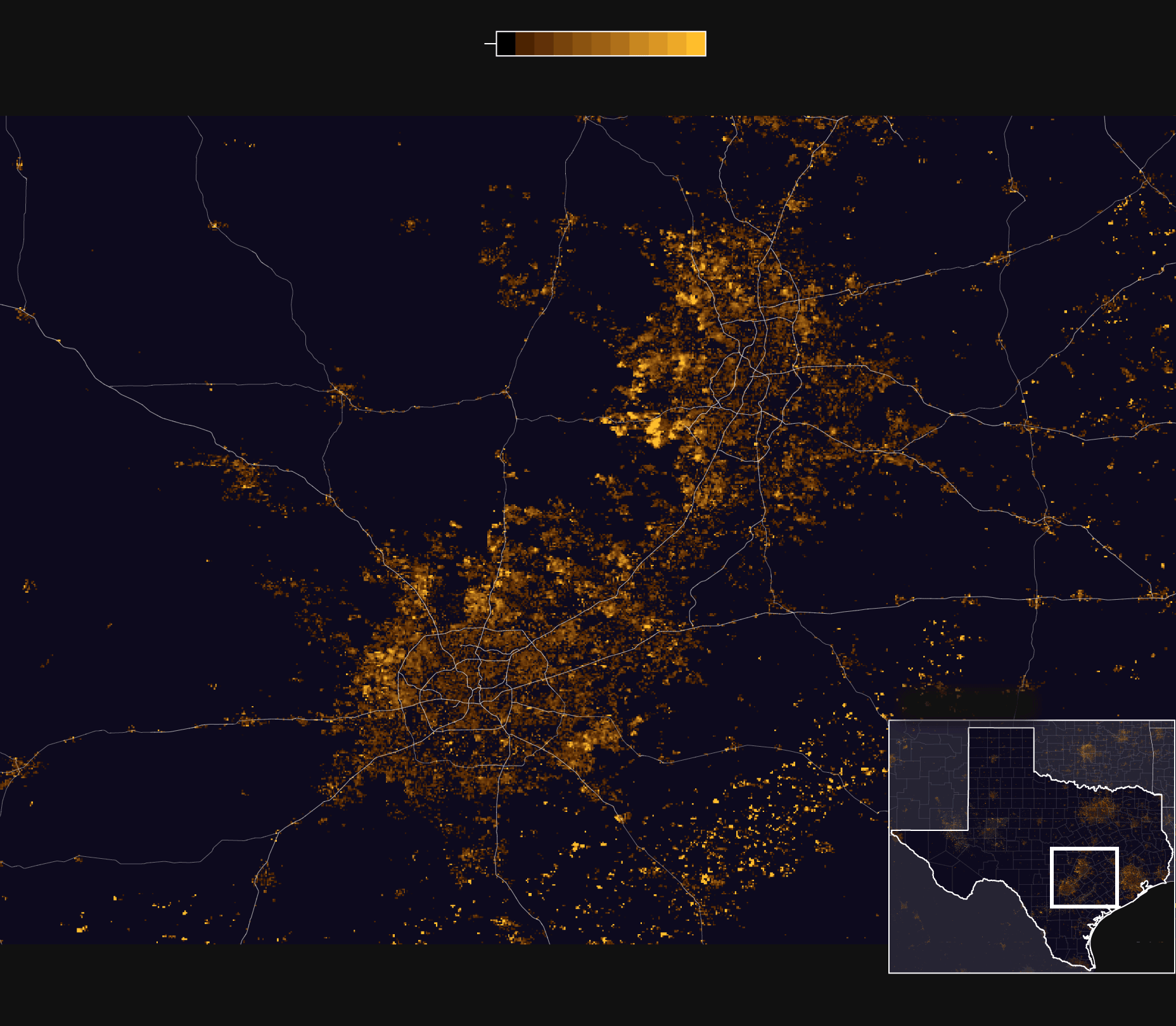
Chart: Hanna Zakharenko / Hearst DevHub• Source: NASA Black Marble
All negative values grouped into the same color.
A look at radiance values in December 2023 compared to the surrounding months (November 2023 to March 2024) shows how much certain parts of the Austin area get brighter in December. The percent change in these areas reveals how much brighter the suburbs were last December compared to the rest of the fall and winter.
“We are not seeing those consistent lights throughout the other months, but we are specifically seeing that during the holiday months,” said Ranjay Shrestha, a senior research scientist at NASA.
Besides exploring human activity, scientists also use nighttime satellite imagery to look at the impacts of natural disasters.
Shrestha noted that by exploring nighttime lights they can track how much a location is impacted by a disaster, and if response actions are taking place.
“It’s lights or lack of lights that also tells you the magnitude or impact of any disaster,” he said.
CreditsReporting, design and graphics by Hanna Zakharenko/Hearst DevHub. Reporting by Ana Gutierrez/Austin American-Statesman. Reporting and Editing by Alice Bazerghi/Austin American-Statesman. Editing by Janie Haseman/Hearst DevHub and Danielle Rindler/Hearst DevHub.