
At Dallas Executive Airport, small planes regularly thunder down a runway and blast into the open sky. Less than a four-minute walk away, one aircraft has been sitting in quiet limbo — dormant and deconstructed.
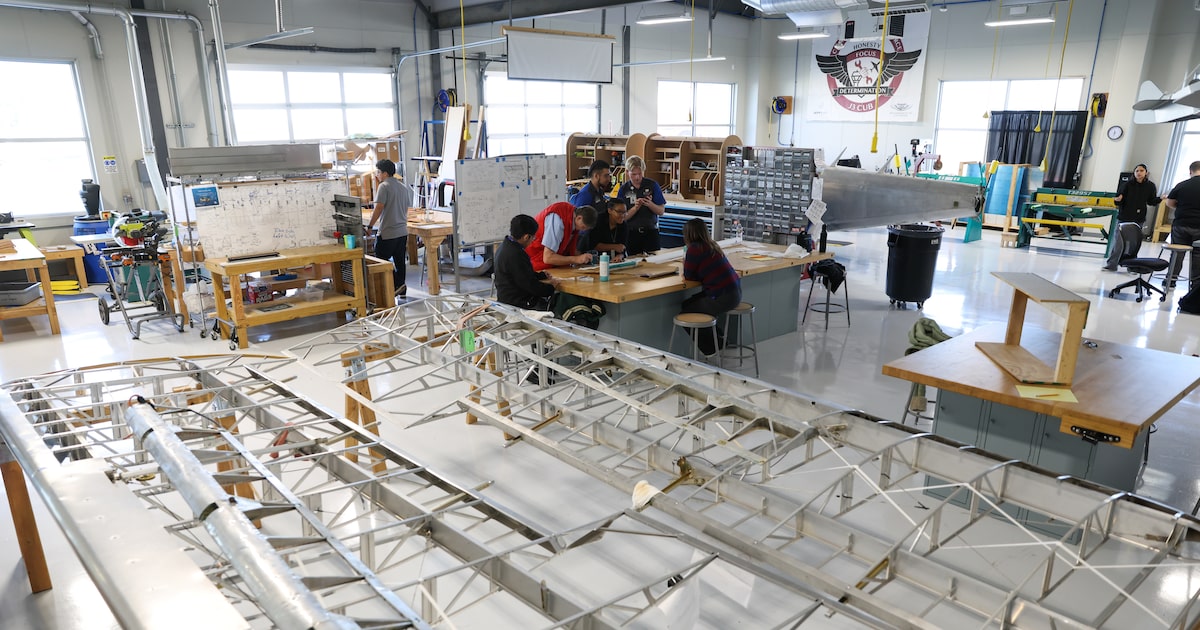
In a classroom at the Henry B. Tippie National Aviation Education Center, the wings of a 1946 Piper J-3 Cub plane lie barren, resembling a gargantuan metallic skeleton. Twice a week, the room becomes a buzzing hive for eight students from Dubiski Career High School who are working to give this World War II-era plane a second life.
On a Monday this month, instructor Rhett Rechenmacher and high school senior Cesar Trevizo were stationed at a pair of sewing machines, which flickered and hummed. He was guiding his student on how to hem pieces of white fabric together.
“Hold your left hand,” Rechenmacher said sternly.
The Education Lab
While Trevizo hopes to become an aircraft mechanic, he found himself fiddling with the sewing machine because attaching fabric onto the metal structure was the next step to return the aircraft to its former glory. If metal framework is the plane’s skeleton, fabric is the skin.
“[Rechenmacher] doesn’t just want us to start sewing it on, if we don’t know how to sew, at least a little practice,” Trevizo said.
Reconstructing planes requires students to be a “jack of all trades”: a seamstress, carpenter, metallurgist, blacksmith and more, Rechenmacher said. That’s why he warns “lazy men” to stay away from the profession.
The gruff plane mechanic admits his teaching style is like him: old school. Fooling around isn’t suggested under his watchful eye. The former cowboy has a penchant for horses, but once he started working on planes, he found a calling. Now, he teaches an aviation sheet metal class at Workforce Training Academy USA, in addition to the high school program.
“Cows are a young man’s business. You can only get kicked for so long,” he mused. “If they told me about this in high school, I would have went with this.”
He walked to the other side of the room, where he slid a giant pair of scissors down a roll of fabric. He glanced up at the students around him, ensuring he still held their attention. Then he showed them how to fold the textile around a wooden frame.
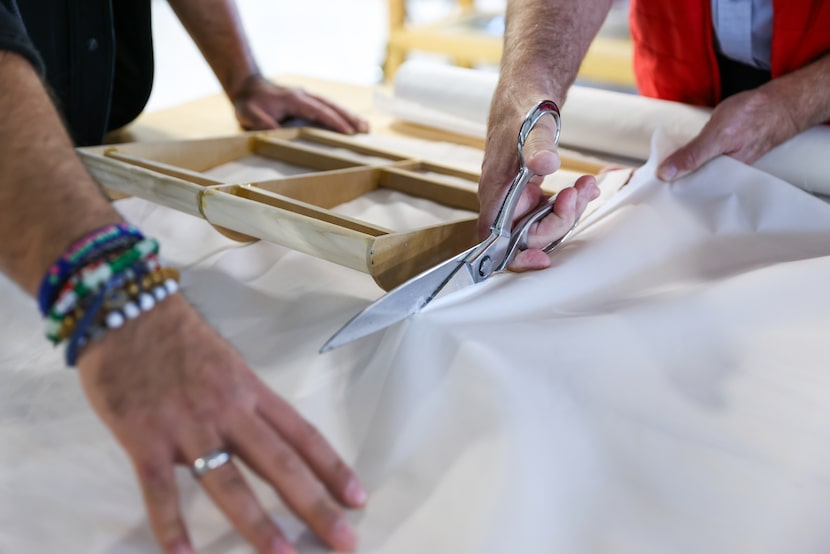
Intern Cesar Trevizo helps instructor Rhett Rechenmacher cut fabric during class at the National Aviation Education Center on Monday, Dec. 8, 2025, in Dallas. The practice frame helps students prepare to cover the real wing.
Christine Vo / Staff Photographer
In the middle of the demonstration, Trevizo handed his slip of cloth to the instructor, showing neat rows of stitches running down the side.
“It looks like we’ve found our seamstress!” Rechenmacher proclaimed.
Preparing for takeoff … and careers
The restoration project started in 2019 and moved to its current location in the National Aviation Education Center in 2021. Over time, it has enrolled 89 students who participate for class credit.
The internship receives about 20 applications annually, and six to 10 students are accepted, according to Libby Belcher, marketing specialist at the National Aviation Education Center.
Each year, a new group of Dubiski Career High School students make progress on the restoration. The first year, students disassembled the aircraft, which was purchased from a man in Alabama in 2018. Then, they built the metal frames of the wings. Now, they’re getting started on attaching the fabric.
Schools like Dubiski Career High School are helping the state prepare students for the workforce, as demand and competition grow. Ten years ago, Gov. Greg Abbott outlined an ambitious vision: at least 60% of Texans between the ages of 25 to 34 will have a certificate or degree by 2030.
By 2031, about 63% of Texas jobs will require some postsecondary education and training beyond high school, according to a report by Georgetown University.
Related
At Dubiski Career High School, students earn their high school diploma and follow a four-year career track — “it’s like picking a college major, but you’re in high school,” said principal Diondria Phillips.
Students can specialize in anything from cosmetology to graphic design, and Phillips noted aviation and engineering were identified as “high-need” careers in the region.
“We look at preparing students, so that our area has workers in those fields,” she said.
Alumni of the program at the National Aviation Education Center have gone on to pursue aviation careers, interning or working at aircraft companies like SpaceX and Gulfstream Aerospace. Some are attending Stanford University and Texas Southern University.
Jonathan Machuca worked on the Piper J-3 Cub during the 2023-24 school year. Now, he’s attending flight school, and hopes to eventually fly for a commercial airline.
The Piper J-3 Cub is no American Airlines jet, but if this beloved aircraft ever took to the skies, he’d “probably sign up to be one of the first people to fly it.”
“Without the program, I would not be at all where I am today,” Machuca said. “The program allowed me to step into aviation, but also see everything that it has to offer.”
Related
Current students in the program are pondering what comes after graduation. Trevizo is considering pursuing an Airframe and Powerplant certification, which would license him to work on planes.
Sitting in the back room, surrounded by blueprints and cabinets filled with bolts, washers and hooks, the budding mechanic looks out the window for inspiration. The planes coming in and out remind him of future possibilities.
Up, up and away
That morning, most of the students had their feet firmly planted on the ground, but one took to the skies. As part of the program, students can steer a plane themselves — under the supervision of a certified volunteer pilot, of course.
William Coulter, 18, dreams of becoming a pilot and he was the lucky duck. He tossed his varsity jacket on a stool and zipped into a tan jumpsuit, slipping his aviation sunglasses in the front pocket.
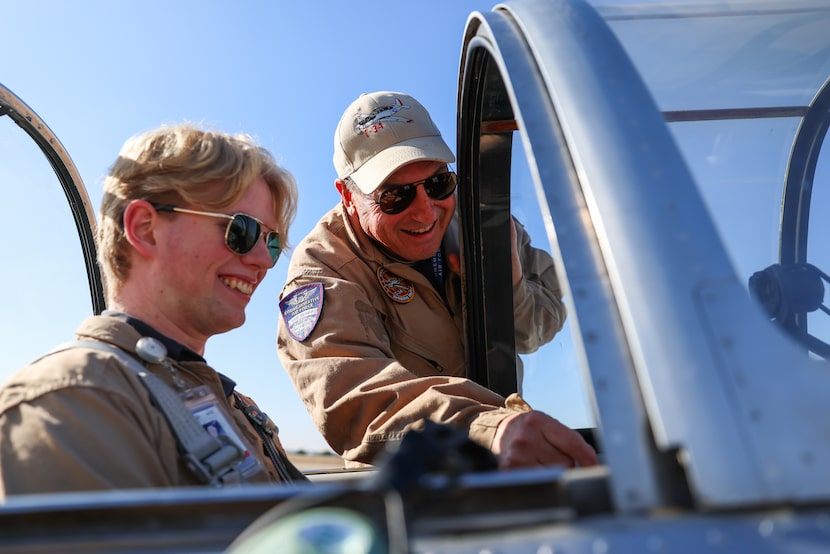
William Coulter, intern at the National Aviation Education Center, (left) prepares to fly a U.S. Air Force T-34A plane with Frank Vaughn, CAF member and volunteer, during class at the National Aviation Education Center on Monday, Dec. 8, 2025, in Dallas. Students are able to fly at least once during the course.
Christine Vo / Staff Photographer
On the tarmac on the clear yet mildly chilly day, he surveyed the plane, a Beechcraft T-34 Mentor from the 1950s. As part of the preflight ritual, he held up a small cup of blue-tinted fuel, checking for contaminants before pouring the fluid into the tank.
Finally, the high schooler stepped into the plane, as his co-pilot Frank Vaughn hollered: “He’s ready!”
The two pilots — seasoned pro and starry-eyed rookie — buckled up. Seatbelts stretched across their chests, and headgear clamped over their ears.
As his blonde hair was tousled by the wind, Coulter waved farewell to the onlookers on the ground — a small (but mighty) crowd of three. The plane roared down the runway, and before long, the aircraft shrank into a mere dot, zooming across an expansive blue sky.
When his feet touched the ground again, Coulter showed a fellow student pictures on his cellphone, with a smile plastered on his face.
“I was surprised at just how quickly we accelerated, especially on takeoff,” Coulter said. “It was a very stable flight for most of it.”
Staying grounded
For Rechenmacher, the sky isn’t his preferred rodeo. He finds flying to be “the most boringest thing.”
“You sit there, and it’s like, ‘Okay, now what?’” Rechenmacher exclaimed with confusion, his eyes widening.
The instructor is adamant: the fun happens on the ground. The tinkering, observing the metal stretch and shrink, shaping the wood, he said.
He said restoring a plane teaches students about responsibility. When the pilot walks off the plane, he no longer claims responsibility for it, but a mechanic is “responsible for that plane until the day he dies,” he said.
“A plane can’t pull over on a cloud and call AAA,” Rechenmacher said.
Eventually, the students will leave on the minibuses they arrived in. They’ll go home, back to the classrooms at Dubiski Career High School. Maybe they’ll go to a university or a workforce training academy.
Wherever they go, he said, the responsibility of the 1946 Piper J-3 Cub will follow them.
The DMN Education Lab deepens the coverage and conversation about urgent education issues critical to the future of North Texas.
The DMN Education Lab is a community-funded journalism initiative, with support from Bobby and Lottye Lyle, Communities Foundation of Texas, The Dallas Foundation, Dallas Regional Chamber, Deedie Rose, Garrett and Cecilia Boone, Judy and Jim Gibbs, The Meadows Foundation, The Murrell Foundation, Ron and Phyllis Steinhart, Solutions Journalism Network, Southern Methodist University, Sydney Smith Hicks, and the University of Texas at Dallas. The Dallas Morning News retains full editorial control of the Education Lab’s journalism.