
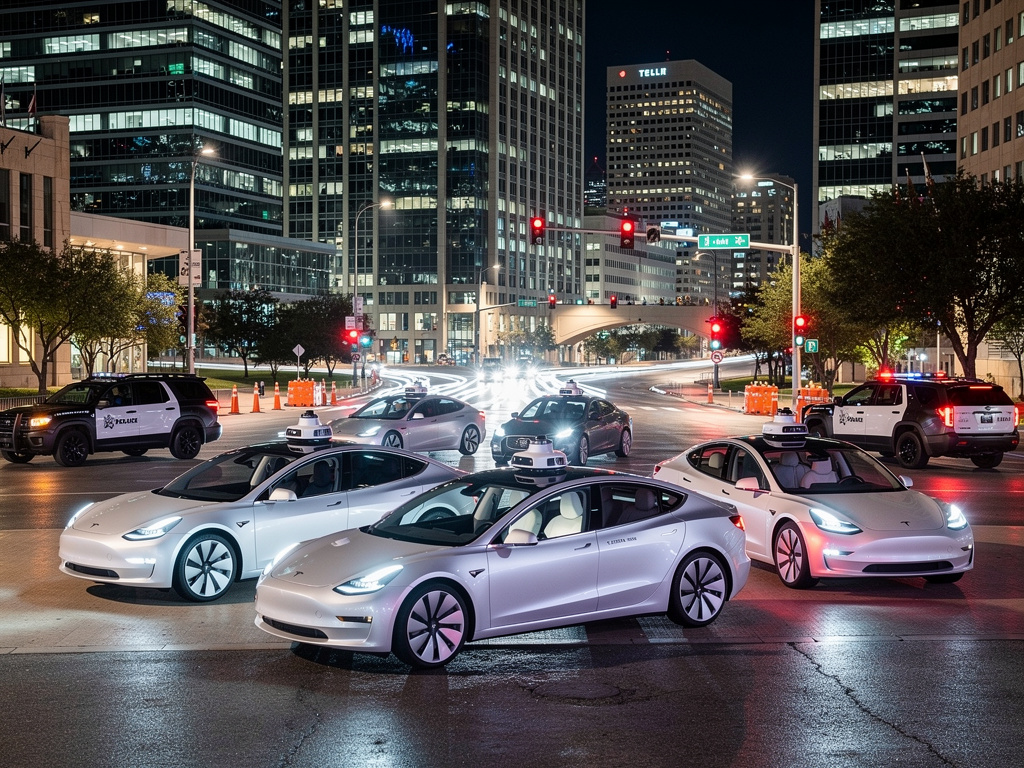
Elon Musk’s Tesla has long promised a future where cars drive themselves, ferrying passengers without human intervention. Now, that vision appears to be materializing on the streets of Austin, Texas, as the company begins testing its robotaxis without safety drivers behind the wheel. This move marks a pivotal shift in the autonomous vehicle sector, where Tesla is pushing boundaries that competitors like Waymo have approached more cautiously. According to recent reports, Tesla vehicles have been spotted navigating public roads in Austin entirely unoccupied, a development confirmed by Musk himself on social media.
The transition comes after years of anticipation and delays. Tesla’s robotaxi service, initially teased with ambitious timelines, has been operating in limited capacities in Austin and San Francisco with human monitors on board to intervene if needed. These safety drivers, often seated in the passenger side, served as a safeguard against the technology’s potential shortcomings. But as of mid-December 2025, videos and eyewitness accounts show Model Y vehicles cruising autonomously without anyone inside, signaling that Tesla believes its Full Self-Driving (FSD) software is ready for unsupervised operation.
This step forward is not without controversy. Industry observers are watching closely, bracing for potential incidents that could undermine public trust in autonomous tech. Tesla’s approach contrasts sharply with rivals who have accumulated millions of miles under supervised conditions before going fully driverless. Musk, ever the optimist, has framed this as a paranoid emphasis on safety rather than a necessity driven by technological limitations.
Pushing the Envelope in Autonomous Testing
Musk’s confirmation came via a post on X, where he stated that testing is underway with no occupants in the car, aligning with Tesla’s goal to remove safety monitors by year’s end. This follows a series of updates from the company, including the rollout of advanced FSD versions that handle complex scenarios like parking lot navigation and route planning. Posts from Tesla’s official X account highlight how the fleet learns from real-world data, accumulating what equates to centuries of driving experience daily to refine its AI.
Drawing from recent coverage, Futurism reports that the removal of human safety monitors is a confirmation of long-standing speculation, with Musk acknowledging the preparations. The article notes the anticipation of accidents, given Tesla’s history of high-profile crashes involving its Autopilot system. Yet, Tesla insists its vehicles are among the safest, citing top ratings from bodies like the Insurance Institute for Highway Safety (IIHS) and the National Highway Traffic Safety Administration (NHTSA).
In Austin, the testing phase represents a microcosm of broader ambitions. Tesla aims to expand unsupervised robotaxis to other states like Nevada, Florida, and Arizona soon. This expansion is built on a foundation of over-the-air software updates that continuously enhance vehicle capabilities, from seatbelt pre-tensioning in collisions to adaptive navigation powered by Tesla Vision.
Regulatory Hurdles and Safety Debates
The absence of safety drivers raises immediate questions about regulatory compliance. In the U.S., autonomous vehicle testing often requires permits that mandate human oversight, especially on public roads. Tesla’s move could test the limits of these rules, potentially inviting scrutiny from federal and state authorities. For instance, while Waymo operates fully driverless in select cities after rigorous vetting, Tesla’s accelerated timeline has drawn skepticism.
Recent news from TechCrunch describes this as one of the final hurdles before Tesla can claim a true robotaxi service, positioning it to compete directly with established players. The report emphasizes that unsupervised testing in Austin is a precursor to public rides, though access remains limited to waitlists for now.
Safety remains the paramount concern. Tesla’s FSD system, while advanced, has faced criticism for incidents where it failed to detect obstacles or misinterpreted road conditions. Musk has countered by pointing to data showing Tesla vehicles outperform human drivers in safety metrics. However, without human monitors, any mishap could amplify calls for stricter oversight, especially as the company scales up.
Technological Foundations and AI Advancements
At the core of Tesla’s confidence is its AI-driven approach. The company’s “photons in, actions out” system processes visual data from cameras to make real-time decisions, eschewing lidar sensors used by competitors. This vision-only strategy, championed by Musk, relies on massive datasets from Tesla’s global fleet to train models that generalize to edge cases, from heavy weather to unusual intersections.
Updates shared on X by Musk highlight progress in specialized builds, such as the Austin robotaxi FSD version, which is months ahead of consumer releases. He has noted that while some scenarios still demand attention, the system is approaching a threshold where it’s safer than the average human driver. Tesla’s posts further elaborate on integrations like Actually Smart Summon, allowing vehicles to navigate parking lots autonomously.
Moreover, the technology extends beyond cars. Tesla links its robotaxi AI to projects like Optimus, the humanoid robot, suggesting a unified ecosystem where learnings from one domain enhance others. This interconnected development could accelerate innovations, but it also concentrates risks if flaws propagate across systems.
Market Implications and Investor Reactions
The market has responded enthusiastically to these developments. Tesla’s stock surged to a 2025 high following Musk’s confirmation of driverless tests, as reported by CNBC. Investors see unsupervised robotaxis as a gateway to new revenue streams, potentially transforming Tesla from a carmaker into a mobility giant.
Comparisons to peers are inevitable. A separate CNBC piece details the 2025 boom in robotaxis, with Waymo expanding rapidly and Zoox introducing public rides. Tesla’s entry, even if supervised initially, adds pressure to this competitive arena, though its driverless push could give it an edge if successful.
Yet, challenges loom. Scaling unsupervised operations requires not just tech prowess but also infrastructure for remote monitoring and rapid response. Tesla’s app-based controls for pre-heating or route planning are steps in this direction, but full autonomy demands robust fail-safes.
Public Perception and Ethical Considerations
Public sentiment, as gleaned from X discussions, mixes excitement with caution. Users praise the convenience of door-to-door service without road rage or distractions, but concerns about job displacement for drivers and the ethics of AI decision-making persist. Musk’s posts often address these, emphasizing long-term benefits like reduced accidents and accessible transport.
Ethically, the removal of safety drivers tests the balance between innovation and responsibility. If an unoccupied robotaxi causes harm, liability questions arise—who bears the blame? Tesla’s history of defending its tech in court adds layers to this debate.
Broader societal impacts include urban planning. Driverless fleets could reshape traffic patterns, reduce parking needs, and lower emissions, aligning with Tesla’s sustainability ethos. However, uneven rollout might exacerbate inequalities in access to advanced mobility.
Future Trajectories and Industry Shifts
Looking ahead, Tesla’s timeline suggests unsupervised robotaxis could be commonplace by late 2026, starting in Austin and spreading nationwide. Musk’s earlier predictions, like launching in June 2025, have adjusted, but current momentum indicates acceleration.
Integration with other Tesla features, such as Trip Planner for charging stops and Grok AI for entertainment, envisions a seamless experience. This holistic approach could set benchmarks for the industry.
Rivals are responding. Waymo’s expansion and Zoox’s debuts signal a race where Tesla’s bold strategy might force others to adapt. Yet, as InsideEVs notes, the hard part begins now—proving reliability at scale without monitors.
Balancing Innovation with Caution
Tesla’s data-driven refinements continue apace. Fleet-wide updates ensure vehicles “wake up” with improved capabilities, from collision detection to adaptive learning.
Critics argue for more transparency in testing data. While Tesla shares high-level stats, detailed incident reports could build trust.
Ultimately, this phase could define autonomous driving’s viability. Success in Austin might validate Musk’s vision, paving the way for global adoption.
Lessons from Past Promises
Reflecting on Tesla’s journey, early hype around autonomy led to regulatory probes and lawsuits. The current driverless tests build on lessons from those experiences, with enhanced AI models addressing previous flaws.
Musk’s comparisons to competitors, like praising Anthropic’s AI while touting Grok’s strengths, underscore Tesla’s focus on logical, scalable solutions.
As testing progresses, the industry watches. If Tesla navigates this without major setbacks, it could herald a new era of transportation.
Emerging Challenges in Scaling Autonomy
Expansion plans include integrating robotaxis with Cybertruck’s safety features, potentially creating a versatile fleet.
Economic factors play in: lower operational costs without drivers could make rides affordable, disrupting traditional taxis.
However, cybersecurity risks heighten without human oversight, demanding fortified defenses.
Strategic Positioning in a Competitive Field
Tesla’s stock gains, as per Yahoo Finance, reflect optimism, but volatility remains if incidents occur.
Partnerships or regulatory approvals will be key. States like Texas offer favorable environments, aiding Tesla’s strategy.
In the end, this driverless push embodies Tesla’s ethos—bold, disruptive, and relentlessly forward-looking. Whether it succeeds will depend on flawless execution in the real world.