
Marti Bier, a nonbinary organizer with the Texas Freedom Network, spent the last three legislative sessions at the state Capitol trying to protect the trans community from a series of Republican attacks.
“It has felt worse and worse as our humanity and dignity has been legislated away,” Bier told Austin’s City Council last Thursday. “When SB 8 passed during the special session, it was devastating. People like me who already deal with stares or comments will now face lawfully acceptable repercussions for simply existing in public life when we need to use the restroom.”
Senate Bill 8, passed this September, requires trans Texans to use bathrooms corresponding to their birth gender in public buildings, something that studies show leads to verbal and physical attacks. So Council voted unanimously at its Dec. 11 meeting to direct staff to craft a plan to renovate restrooms in city buildings to make them gender inclusive. CM Mike Siegel, who is leading the effort, said the restrooms could be converted for use by one person at a time, so that every toilet is private.
Siegel emphasized at Thursday’s meeting that he believes SB 8 is unconstitutional and will be struck down. “But until then, I want us to send a message as a city,” he said. “I believe all of us agree that we are welcoming. We’re welcoming to our residents, to our visitors, to everyone who comes to our great city.”
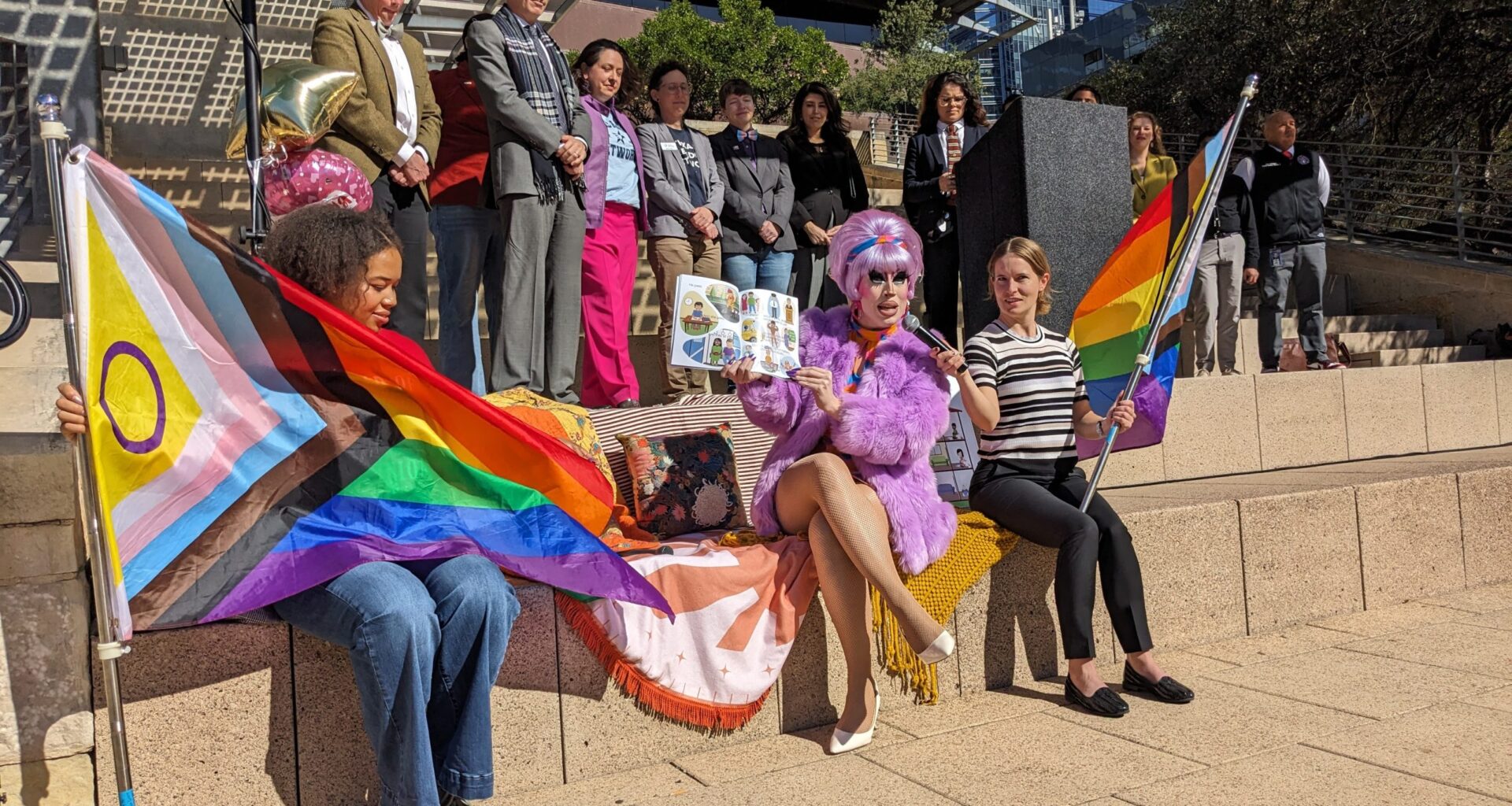
Council members José Velásquez, Vanessa Fuentes, and Zo Qadri joined Siegel and LGBTQ+ advocates for a press conference outside City Hall after the vote. Local activist Brigitte Bandit, dressed in a lavender ensemble, read from the children’s book Everybody Pees. The Council members and speakers from the Transgender Education Network of Texas, Equality Texas, and the Texas Freedom Network vowed to protect trans Austinites.
“We will not be complicit with hate,” CM Velásquez said. “Protecting our trans and nonbinary friends is not optional. We all need to show up every day to protect and defend them, however we can. And this is a call to male allies, Hispanic allies, Black allies: Use whatever privilege you have to protect our nonbinary and trans neighbors.”
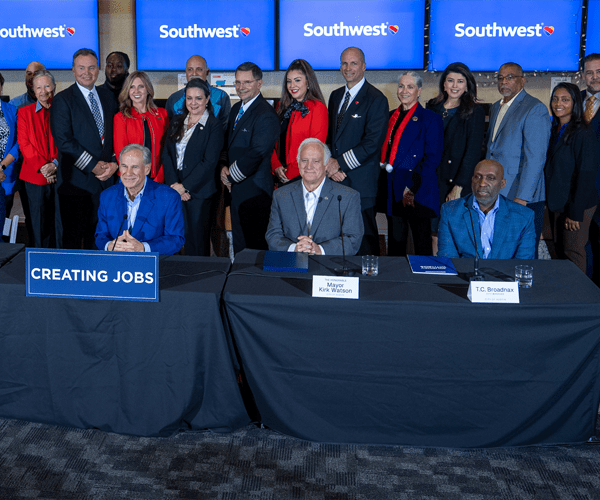 Gov. Greg Abbott, Mayor Kirk Watson, and City Manager T.C. Broadnax at a press conference at Austin-Bergstrom on Dec. 12 Credit: City of Austin
Council also approved an economic development agreement on Thursday to provide $5.5 million in incentives over the next five years for an expansion of Southwest Airlines at the city’s airport. As part of the expansion, Southwest will establish a new crew base at Austin-Bergstrom, including pilots, flight attendants, and managerial and support staff who, according to a press release from Gov. Greg Abbott, will make an average salary of $180,000 a year. Altogether, the expansion is expected to create 2,000 jobs paying at least $22 an hour and including health benefits for domestic partners and dependents. Southwest will receive $2,750 per hire and return 10% of the money to the city’s Childcare Assistance Reserve Fund, which helps provide child care for low-income Austinites.
The city celebrated the agreement in its own press release on Friday, saying the expansion will reduce disruptions at the airport, increase the number of direct flights, and improve the passenger experience in general. The release stated that the deal contains no tax abatements or automatic payouts. “All incentives are capped and tied to job creation and community benefits, ensuring the deal remains fiscally responsible and protective of taxpayer dollars,” it read.
The deal’s announcement occasioned a rare moment of public conciliation between Abbott and Mayor Kirk Watson, with the governor joining the mayor and Southwest executives in praising its benefits. Fuentes, whose district includes the airport, told the Chronicle she’s excited to bring more economic development to the city at a time when tax revenue is down and the city manager is warning about budget deficits. “Given the structural budget deficit we’re in, having this type of economic development in our city that will generate and expand our tax revenue is a good thing,” she said.
Council also approved seven contracts with homeless services providers, appropriating around $5 million in the short term, and potentially over $40 million in the next five years, for supportive housing projects coming online in 2026. The funding will help provide services at new communities overseen by The SAFE Alliance, Endeavors, and The Other Ones Foundation, among other groups.
Liz Baker, the executive director of The Other Ones Foundation, told the Chronicle that the city contracts were approved the same day that TOOF received a $50 million grant from the Texas Department of Housing and Community Affairs. The grant will help fund a major expansion of its Esperanza Community in far East Austin. Baker said the grant was the product of two and a half years of steady work and added that the contract with the city will cover about half of the costs of running Esperanza for the next five years.
Last Thursday’s meeting was supposed to be the final one of the year, but Council is expected to conduct a special meeting today, Dec. 18, to approve a new four-year labor agreement with the Austin Firefighters Association. In the updated agreement, the city will promise to maintain a minimum of four firefighters on all trucks sent to emergencies. In turn, the firefighters will drop their request for an election in May asking Austin voters to make four-person staffing mandatory by amending the city’s charter. The Chronicle will report on the new contract in next week’s issue.
This article appears in December 19 • 2025.
A note to readers: Bold and uncensored, The Austin Chronicle has been Austin’s independent news source for over 40 years, expressing the community’s political and environmental concerns and supporting its active cultural scene. Now more than ever, we need your support to continue supplying Austin with independent, free press. If real news is important to you, please consider making a donation of $5, $10 or whatever you can afford, to help keep our journalism on stands.