
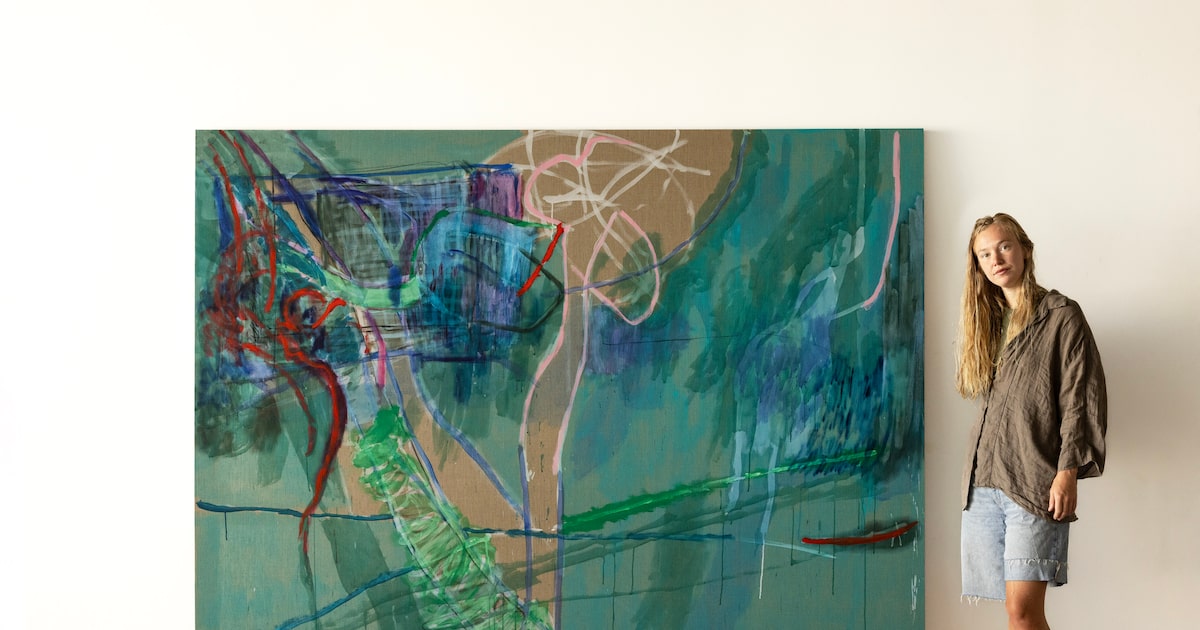
Pam Evelyn, a cool and confident abstract painter born in 1996 in Surrey, England, has come a long way in a short time. Having finished graduate school in London in 2020, she is already on the roster at Pace, a mega-gallery with eight showrooms on three continents. Her work, though, doesn’t reflect the art world’s bright lights, instead emerging from many long, solitary hours in the studio.
Her method involves long periods — sometimes years — working and reworking each canvas, so that the result shows evidence of many layers of activity, placing the viewer in something of the position of an archaeologist. Giving a preview tour of her new show at Dallas Contemporary, she recalled the working environments that gave rise to each work, from her parents’ garden (before she had a studio of her own) to successive stints in Cornwall, London and most recently Water Mill, Long Island, where she completed a residency this past summer.
“Salvaged Future,” Evelyn’s first major institutional show in the U.S., is yet another coup for Dallas Contemporary, the scrappy kunsthalle that does much toward keeping Dallas connected to the international art world. Its cavernous spaces are an excellent setting for Evelyn’s oversize canvases, which make one impression from a distance and then reveal more and more subtle details as a viewer moves closer to the wall.
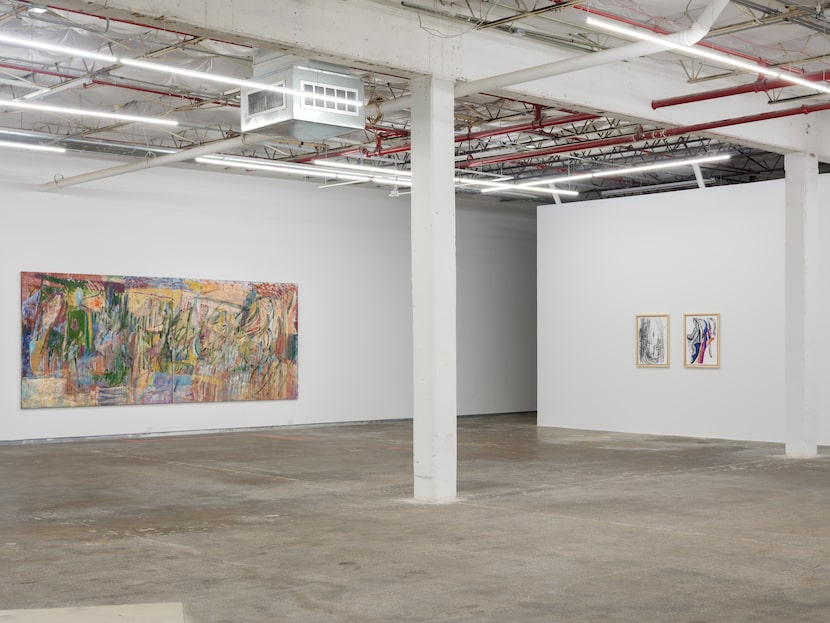
Installation view of Pam Evelyn’s “Civil Dawn” (2021), left.
Kevin Todora, Dallas Contemporary
News Roundups
Taking in all of the exhibition at an initial glance, one might detect resonances with mid-century painters who shared Evelyn’s combination of grand scale and hearty expression. There are hints of Matisse, Twombly, Diebenkorn, Johns and Marden, as well as Evelyn’s acknowledged connection to Lee Krasner, who in her day was based just down the road from the Watermill Center in the Hamptons (which hosted Evelyn over the summer).
Among the earliest works in the show, Civil Dawn (2021) was made in Evelyn’s pre-studio era. Offering the barest glimpse of a building seen through trees, the hints of this subject are swamped by a barrage of gestures that make up a separate, abstract layer hovering above the background scene.
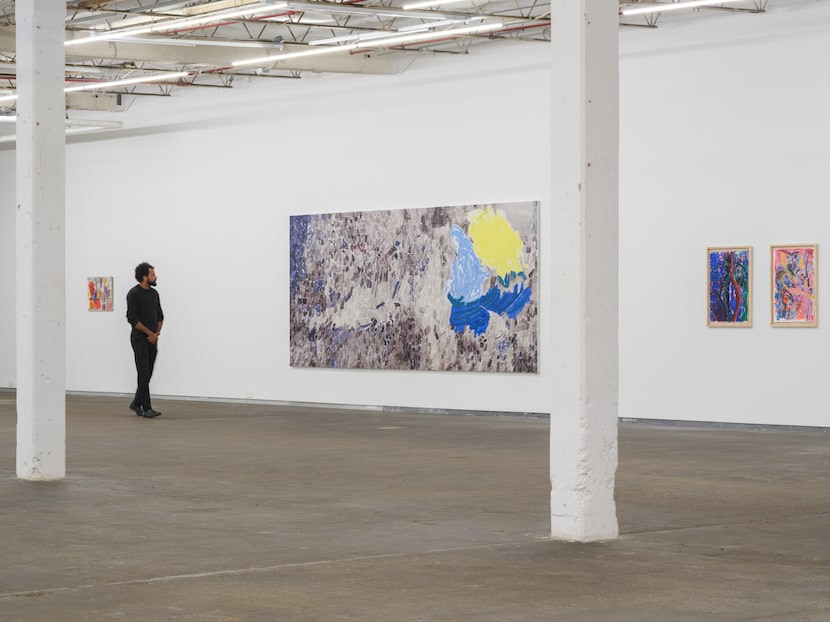
Installation view of Pam Evelyn’s “Mourning Greys” (2024), center.
Kevin Todora, Dallas Contemporary
Mourning Greys (2024), which dates from Evelyn’s stop in Cornwall, evokes the experience of nighttime rambles along the rocky shores there, faced with the infinite darkness of the sea. Following the tradition running from Paul Cézanne through Jasper Johns, Evelyn builds up a broad visual field from many individual marks, reticulated into a single expanse of gray.
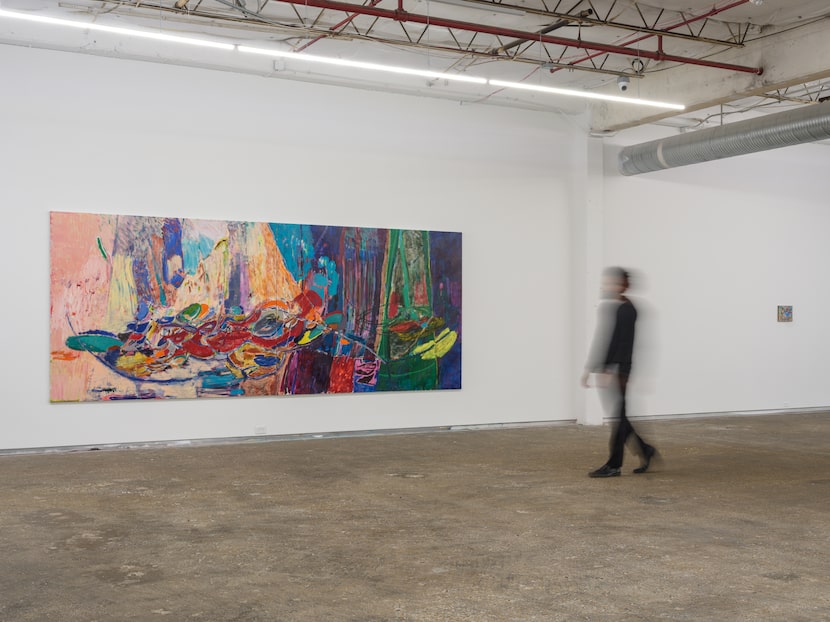
Installation view of Pam Evelyn’s “Medusa” (2024).
Kevin Todora, Dallas Contemporary
Another ocean-themed picture from around the same time, Medusa (2024) jumps back to the 19th century in its reference to Géricault’s famous spectacle of disaster. Evelyn’s abstract approach treats Géricault’s painting for its compositional rather than journalistic value, with her bloody reds and deep blues and greens suggesting a plate of fruit amid panes of stained glass.
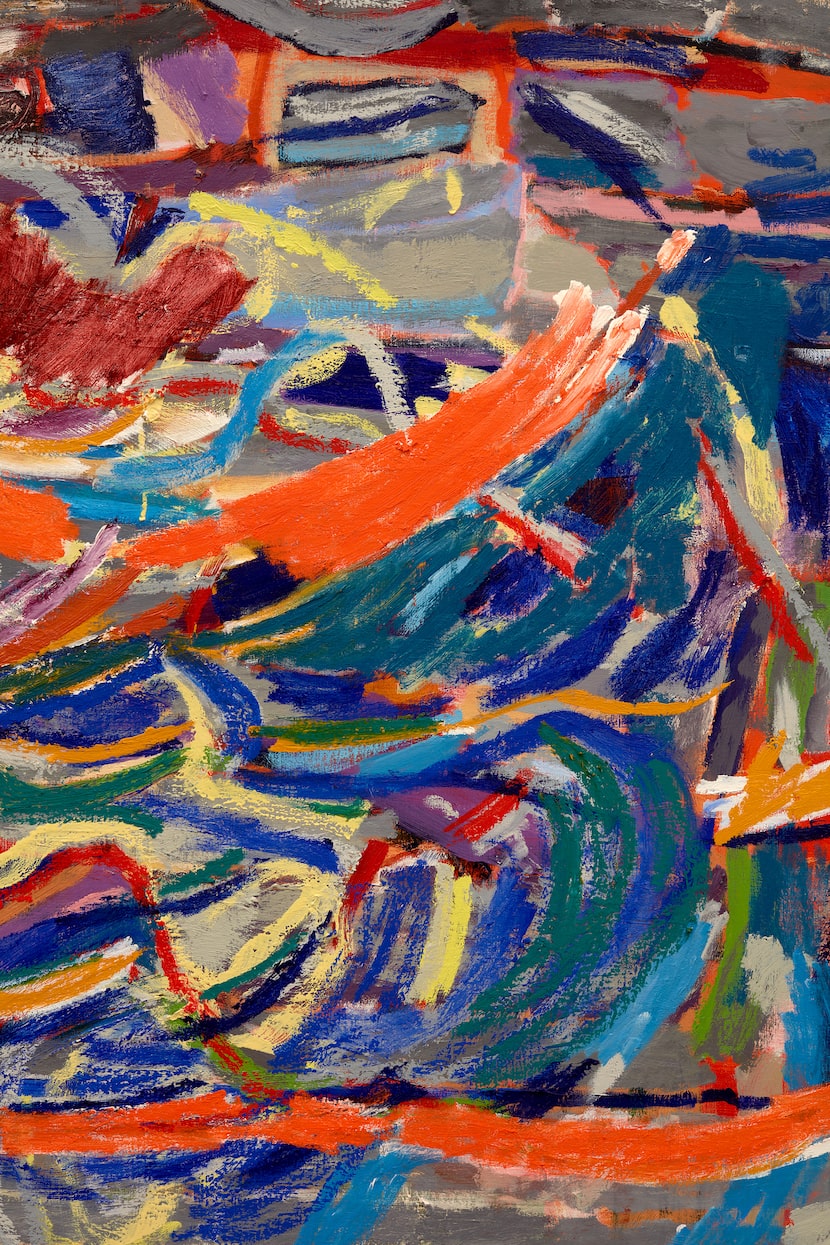
Detail of Pam Evelyn’s “Liaison” (2024).
Robert Glowacki Photography / © Pam Evelyn, courtesy Pace Gallery
Liaison, from the same year, presents a tapestry-like arrangement of long strands of color, some verging on Day-Glo, that climaxes in a series of tangles or disturbances toward its center. By comparison with Evelyn’s earlier works, each element of Liaison shows a more sharply defined edge and greater contrast with its neighbors, resulting in an overall crisper effect.
Among the most recent works, Watermill (2025), made during the eponymous residency, returns to a looser, more fluid approach, with more of the forms overlapping one another and dissolving into each other. Although the potato fields that covered the Hamptons in Krasner’s time have long since given way to megamansions, the memory of that generation of artists is still around; during her time there, Evelyn met people who had known Krasner and her irascible peers, Jackson Pollock (who was also Krasner’s husband) and Willem De Kooning.
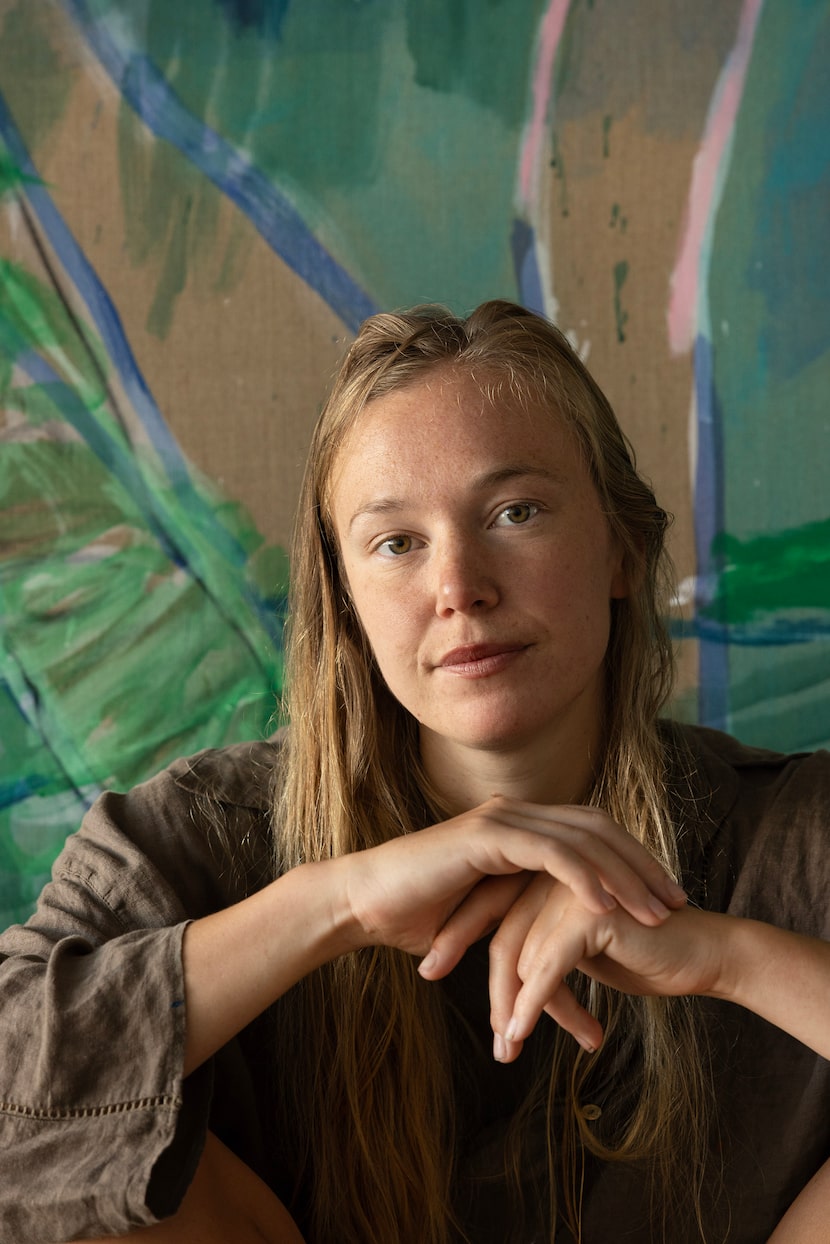
Pam Evelyn with her painting “Watermill” (2025).
Lucy Jansch / The Watermill Center
Despite the looming presence of such legends, Evelyn’s work does not appear overly intimidated or burdened by the past; instead, it seems self-possessed and deliberate. No doubt her slow, patient approach to painting helps keep everything in perspective (both visually and psychologically).
Out of all the contemporary work that has come through Dallas in the last year or so, abstract painting by women artists makes up a good deal of the highlights. A reason for this doesn’t immediately spring to mind, but as 2025 draws to a close, it’s something for which to be thankful.
Details
“Pam Evelyn: Salvaged Future” is on view through March 15 at Dallas Contemporary, 161 Glass St. Open Thursday through Sunday, 11 a.m. to 5 p.m. Free. 214-821-2522. dallascontemporary.org.
 How a jersey signed by cricket legend Sachin Tendulkar ended up in a North Texas home
Arun Agarwal grew up in India as a fan of Sachin Tendulkar. Now, he has a jersey signed personally to him by the famous batsman.
 Dallas artist Mary Vernon shows paintings with charming animals, vivid colors
The former SMU professor hasn’t slowed down at all since her retirement.
 Painting that introduced ‘Star Wars’ to the world fetches millions at Dallas auction
The painting first appeared in newspaper advertisements on May 13, 1977.