
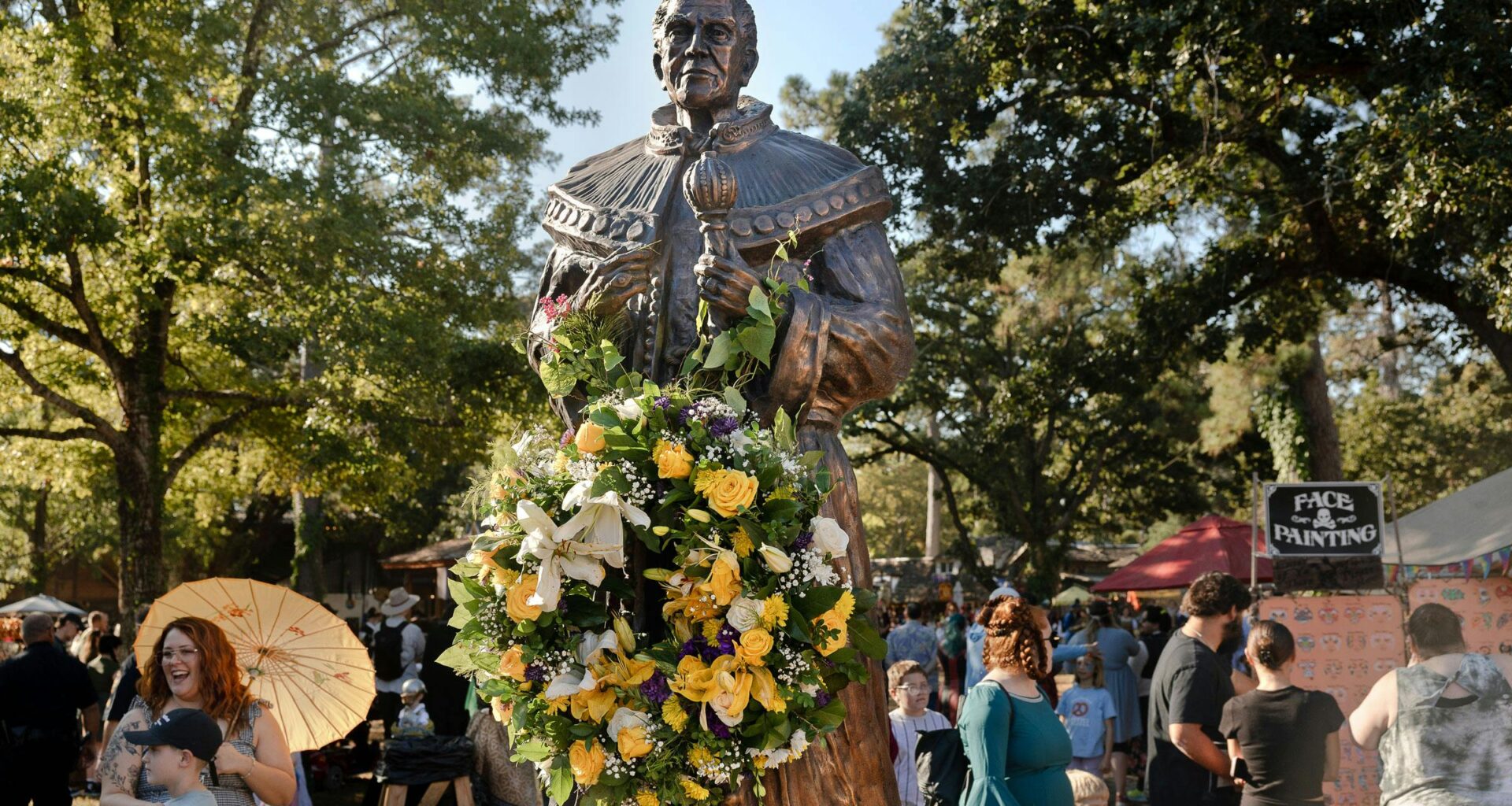
When a cannon boomed on a Saturday morning in October, marking the official start of another season of the Texas Renaissance Festival, knights, princesses, fairies, and Texans in T-shirts and shorts streamed through the gates of New Market Village, a faux sixteenth -century European realm. They rushed by a statue of the late King George, adorned with a fresh wreath. Those flowers were the only indication that this would be the long-running festival’s first season without its monarch, whose reign came to a tragic end earlier this year.
All across the land—approximately seventy woody acres about an hour northwest of Houston—life unfolded much like it had since George Coulam founded his kingdom more than five decades ago. Artisans peddled their wares, from glasswork to leatherwork, jewelry to weaponry. Vendors sold kettle corn, turkey legs, and all manner of fried fare. Children rode steeds wooden and real. Adults drank ale, mead, beer, and wine. Jousters competed in mock tournaments at the arena. Visitors played pretend and escaped modernity for the duration of a day pass.
At noon, the traditional daily parade of royals, jesters, and men-at-arms wound its way through the festival grounds to the sound of bells, whistles, and “huzzahs!” The horse-drawn coach leading the procession typically holds a sovereign. This year, however, the carriage seat was empty, save for a crown. It was another reminder of the missing monarch and a symbol of a question that’s hung over the community of festival vendors and loyal rennies: Who’s running the kingdom?
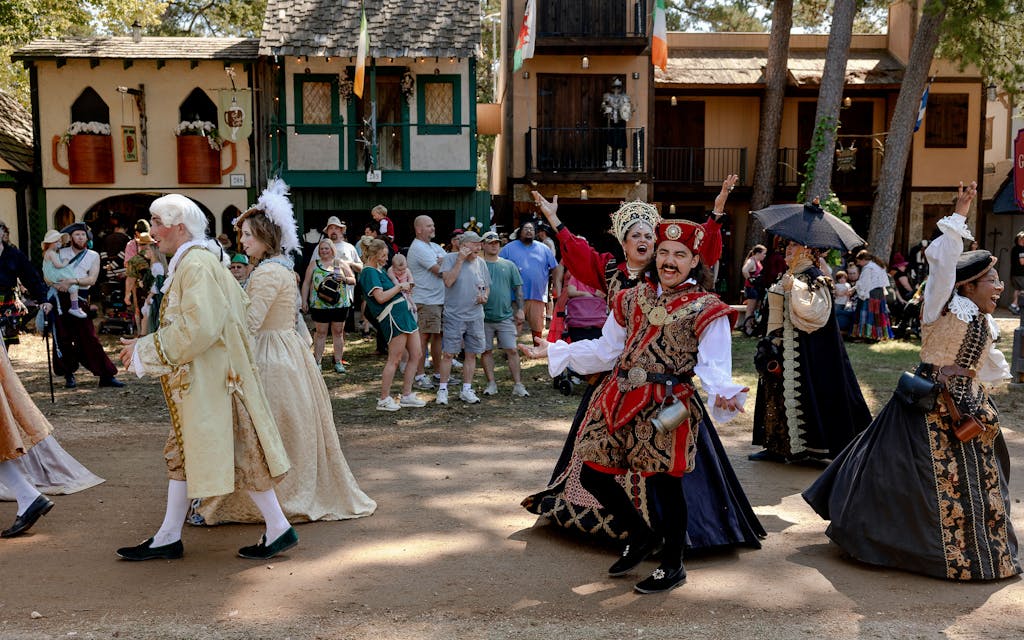 Performers cheer to the crowd as they walk through the fairgrounds in a parade.Photograph by Lexi Parra
For five decades, Coulam, an eccentric man known and revered as King George, lorded over the Texas Renaissance Festival—or TRF—with undisputed authority. But since he died by suicide at age 88 in May, following consecutive legal and political defeats, a tangle of lawsuits over ownership and revenue has left a power vacuum in the realm, prolonging a saga over the royal succession and raising concerns among his freedom-loving subjects.
The stakes are high when it comes to control of the festival, the largest of its kind in the country, based on attendance. During a typical season, which runs through November, roughly 500,000 people will visit these grounds; each will have paid up to $40 to enter for the day and likely a lot more to the four-hundred-plus vendors who set up shop here each fall. It’s big business—the biggest around, in fact—for the tiny, southeastern Texas town of Todd Mission, population 121, where Coulam served as mayor for decades. Last year’s attendance, boosted by the release of Ren Faire, an HBO documentary about the festival, as well as the event’s fiftieth anniversary, was the highest on record, with crowds packing the surrounding campground for the popular barbarian- and pirate-themed weekends. Those turnouts helped TFR bring in nearly $13 million in 2024, according to court documents filed in an ongoing legal dispute over ownership.
Profits and who’s pocketing them aren’t the only concerns percolating in the post–King George era. Some rennies, who flock to that very campground for several or all of the season’s eight weekends, worry that new leadership will interfere with the anything-goes atmosphere their community has cultivated. Under the old regime, drunken revelry combined with a low security presence to give these forestlands an air of lawlessness. That appealed to tight-knit and like-minded groups of rennies known for their all-night raves and sexual adventurousness. These self-organized clans set up camps throughout the eight weeks of the festival, playing risqué games like “naked Jenga,” organized by the Call of Booty clan, and hosting swinger parties, like Swing On By.
 A horse-drawn carriage carries a crown in honor of the late George C. Coulam. Photograph by Lexi Parra
 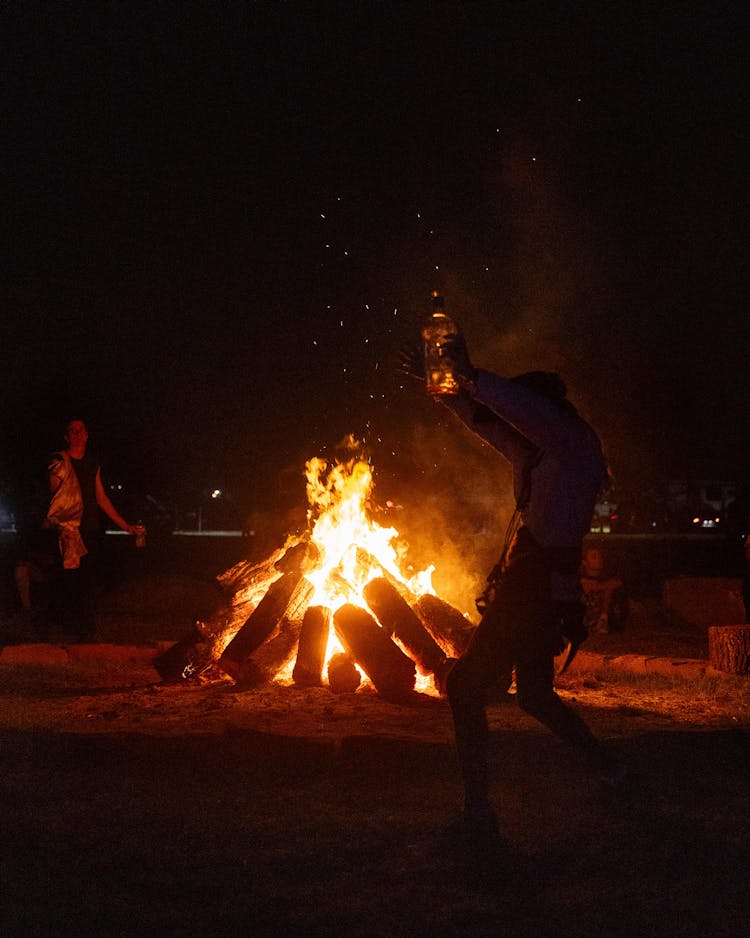 People gather around a bonfire after the end of the first day of the festival. Under new ownership, rules have been implemented to tame the activities that are infamous at the renaissance fair’s campground. Photograph by Lexi Parra
The bawdy, after-dark scene has become a mighty draw of its own—separate but intertwined with the daytime, family-friendly festival. Though the clans provide free entertainment for paying TRF campers, they have at times butted heads with festival management. In 2022, TRF attempted to disband the clans before eventually relenting and welcoming them back.
The clans’ fears of change ahead of the 2025 season were not unfounded. In late May, days after Coulam died, a new campground director announced rules that would interfere with long-standing traditions, including a ban on bonfires. Beginning in the early nineties, the nightly blaze drew people out of their tents to a central spot, where drummers, fire spinners, and dancers performed under the stars. This season, for the first time, festival directors announced they would prohibit the bonfire and fire dancing. The campground’s quiet hours and nudity ban were reiterated, and, combined with the new prohibitions, gave rennies reasons to worry they might finally be enforced.
“This is the death knell for the campgrounds as we know it,” a commenter wrote on an online forum where rennies shared their unease. “Oh boy, the Disneyfication has begun,” wrote another.
More importantly, a new pricing structure now required campers to pay hefty fees to reserve more than the 525-square-foot plot of land that comes with a camping pass. Previously, clan members reserved a site but were allotted any amount of land they were able to fill; with the new system, additional space now went for $2,500 per 2,500 square feet of additional land. The change infuriated clans that throw massive, free parties on large areas of the grounds, and whose members each typically pay $700-plus for season passes.
Amped-Up Shanties, a clan that has hosted the most popular rave for at least three years, withdrew; its leader, Waco mechanic Robert Passiatore, became an outspoken critic of the change, claiming the price increase would cost him $10,000 for the season. Several smaller clans, including groups by the name of Naughtyham, Clanless, and Smokey Bandits, also declined to host public parties this year. Ember Island, a clan of fire spinners who performed weekly for free in the campground, hosted just one fire-free party this season.
The new rules came in the wake of King George’s death and buzz about new owners taking over the festival. In late July, Jeff Baldwin, the longtime general manager and entertainment director of the fair (and a main character in the Ren Faire docuseries), was fired, fueling confusion about who, exactly, was calling the shots in the absence of the king. Turnover at the top of the organizational structure was common during George’s reign—one rennie compared it to the daily changing of underwear—and would later become the subject of a lawsuit brought by shareholders. But this year, staff shuffling added to the uncertainty among the clans.
In an email to Texas Monthly, a TRF representative wrote that discussions surrounding the campground changes “took place with George prior to his passing” and referenced “safety protocols” as a reason for reconsidering fire activities. TRF also said that the updated pricing structure for clans—referred to as “guilds” in the company’s more polished parlance—was meant to “meet that growing excitement” for camping by allowing more fans a “chance to stay onsite.” (The 2024 campground saw a record-setting total of nearly 73,000 campers.)
As clans prepared for the 2025 season, a new map of the campground wasn’t released until days before the festival’s opening weekend. Site approvals were also delayed. Fire spinners learned they would be banned from performing about a month and a half before opening. In late August, Passiatore compared the chaotic preseason decision-making that followed King George’s death to trying to “run a ship without a captain.” That the captain, who’d built the ship from scratch, left behind a smoldering legal mess made matters worse as the festival’s fifty-first season approached.
The Amped-Up Shanties leader claimed “no one is really in charge” and called the goings-on behind the scenes a “s— show” in a post on a rennie Facebook page. But he didn’t blame the new management. “The current employees are unable to make any real decisions based on the instructions left by a disgruntled dead guy,” he wrote. “George lost his fair, lost his mayor position, lost his way and most importantly his life. He pulled the plug at the bottom of the ship and is taking it down with him.”
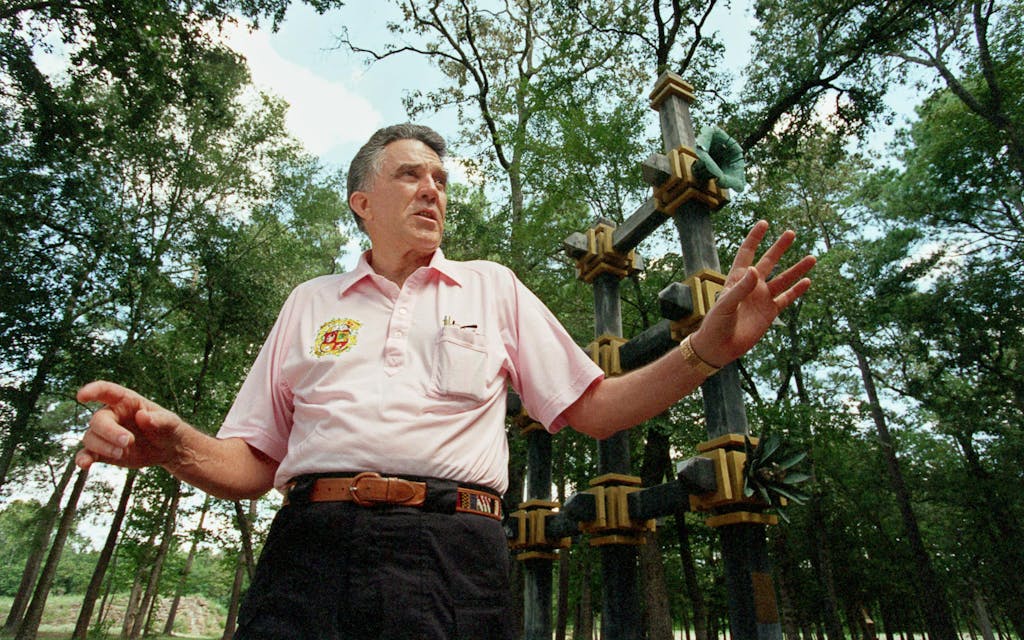 George Coulam at the entrance gates to his home in Todd Mission on September 7, 1999.John Everett/Houston Chronicle via Getty
George Coulam has been described as both a Willy Wonka–type figure and “a monomaniacal tyrant.” Raised Mormon in Salt Lake City, he discovered a passion for the Renaissance era through a love of art history. He earned a master’s degree in art in California and learned to make stained glass. He could yodel and was known to be a perfectionist, as well as a lothario.
He ran his first themed festival in Minnesota before arriving in Grimes County in 1974. In the coming five decades, he would turn 270-plus acres of East Texas forest into the Texas Renaissance Festival, a magical and lucrative kingdom, a fantasy land complete with a castle, a fairy garden, a jousting arena, a Greek village, and other sixteenth-century-styled surroundings where a cast of characters could make merry—and money too.
Coulam purchased land incrementally. By 1982 he had incorporated Todd Mission, the town where the festival operated and its employees lived, and where he had served as mayor until he was voted out of office in May. In the nineties, he continued buying up property, offering parcels to festival workers and vendors on generous terms: $100 down and $100 a month until paid off, according to one rennie who considered the deal.
In the beginning, Coulam made his money off ticket sales. Artist vendors weren’t required to pay him fees to sell their creations, and the king allowed them to build their own booths on festival grounds. With vendors’ profits available to reinvest, their booths got more elaborate and became the German-, Spanish-, Greek-, and Polish-style shops, taverns, and public houses, game parlors, and rides that give the sprawling fair an escapist quality. Coulam had final say in what the buildings in his realm looked like and who would receive annual permits to conduct business in New Market Village, which vendors helped grow through the decades.
 Tease of the Seas performers dance onstage with bubble machines at the fifty-first annual Texas Renaissance Festival. Photograph by Lexi Parra
  A dancer performs at one of the festival’s restaurants. Photograph by Lexi Parra
By the time Colum was nearing his seventies, he was thinking about succession. Court documents show he’d considered selling the festival several times, though a sale was never finalized; in 2006, for example, he entered into an agreement with a buyer, but the deal fell through. (Coulam took a subsequent court case to the Texas Court of Appeals and won, allowing him to hold onto the festival.) It was during this dispute, in 2008, that Coulam was diagnosed with early-stage Alzheimer’s; he would later write a book claiming he had cured himself of the disease through exercise, brain games, and diet.
In 2023, a post on TRF’s Facebook page stated that Coulam had decided not to sell the festival “after much deliberation.” Months later, he changed his mind. Once again, a sale to buyers with close ties to the festival was in the works, though it too would collapse. HBO’s three-part docuseries Ren Faire, released in June 2024, chronicled how that deal came together. In the show’s final chapter, Coulam draws up—then backs out of—a $60 million sale to a cohort of vendors known as the Greeks, operators of the festival’s Agora Village, and their financial backers.
The plaintiff’s attorney, Anthony Laporte, said his client, Canadian real estate developer and Greek financial backer Meril Rivard of Manitoba, had wanted to purchase the festival in order to protect it for future generations, including for the grandchildren he shared with Geoff Wilson, a longtime vendor and part of New Market Village’s Greek dynasty.
Andrew Winters, a founding member of Brigadoon, the festival’s oldest clan, told me why he felt confident about a Greek takeover. “The Greeks have maintained [the Agora village] inside the fairgrounds for decades. It’s one of the top attractions. So they have business savvy. Hopefully, they’ll want to keep things pure and keep things going in a natural direction that would stay true to the roots of the Renaissance,” he said. “Nobody wants the Disney atmosphere when it gets too commercialized and plastic.”
In a scene from Ren Faire, Coulam became increasingly agitated with an employee discussing closing costs for the sale that would have required him to hand over the festival, the campground, and the property where he lived—a total of 871 acres—to Rivard. “What you’re telling me right now is that the sale is going down the tubes right quickly,” he told the staffer.
A special clause in the agreement would have allowed the king to remain in his home, leasing it at a cost of one dollar per year, until his death. The gilded Stargate Manor, Coulam’s ostentatious residence on two hundred acres across from the festival grounds, was the sticking point that prevented the sale, according to Don White, a vendor with a long white beard and tie-dye Crocs who resembles the ceramic wizard figurines he’s sold at the festival since the late seventies.
The king “felt he got fast-talked into selling his house,” White told me. “That’s where he built his mausoleum; that’s where he invested a lot of money.”
In late July 2023 as the closing date approached, Coulam asked for amendments to the lease for Stargate Manor. Weeks later, on the day before the sale was expected to go through, Rivard visited the king. Coulam wanted an extension; Rivard refused, claiming a delay would interfere with the upcoming festival season. On August 8 that year, Coulam failed to show at the closing. Rivard soon filed a lawsuit, alleging breach of contract and requesting more than $22 million in damages.
At a later hearing, Coulam’s attorney argued that the king didn’t go forward with the sale because the buyers weren’t licensed to do business in the state at the time of the closing, though that wasn’t a requirement for the purchase, court records show.
On May 7 of this year, Grimes County Judge Gary Chaney ruled in favor of the plaintiffs, ordering Coulam to go through with the sale of TRF. The decision came just four days after the voters of Todd Mission had booted him from the mayor’s office after a gerrymandering scheme backfired on the incumbent. Of the 32 votes cast for Coulam and his opponent, city councilman Stephen Mensing, the king received just thirteen.
Two weeks after the court ruling, on the morning of May 21, Coulam’s body was discovered at Stargate Manor. His death was later ruled a suicide. Gayle Coulam, the king’s third wife and a close confidant, said the manner of death came as a shock, though he had discussed his end-of-life plans with her. “He told me years ago. He talked about, you know, ending his life if he ever got sick … But I did not know that he was getting that close.” she recalled. “That’s what he wanted, and that’s what happened.”

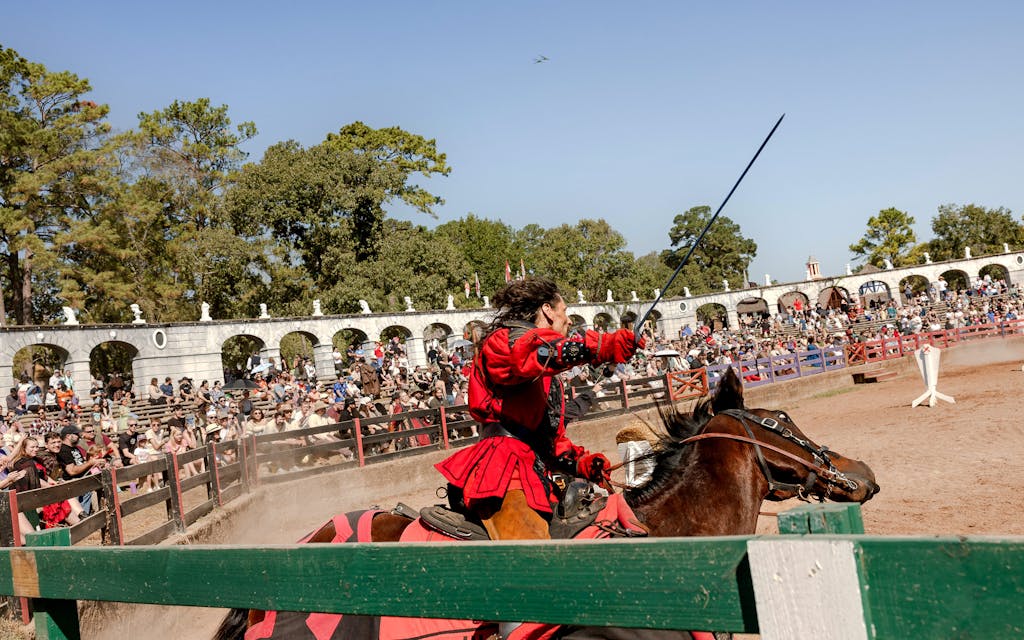 A “knight” rides his horse during a jousting performance at the main arena.Photograph by Lexi Parra
The king is dead, but the legal battle over his kingdom lives on. Having placed his holdings in a revocable trust, Coulam left explicit instructions detailing everything from an appeal to the judge’s ruling to how the festival should be run in his absence.
Coulam’s exact instructions have not been publicly disclosed. But in an email sent in December, a TRF spokesperson responded to a request for clarification on leadership, saying the board of trustees oversaw the 2025 festival season, with Ruben Torres serving as general manager. In probate documents, Torres is also listed as a trustee. The executor of the king’s estate, former festival groundskeeper and parking manager Jesse Trejo, now oversees the foundation’s legal affairs. At a memorial held for Coulam in October, the king’s ex-wife thanked Trejo for continuing the festival in George’s vision.
Some rennies believe King George “took the ship down with him” as a final, defiant act, a clan leader told me. It’s a narrative that fits neatly into the royal lore of a willful and particular monarch who picked a faithful foot soldier as his executor. Trejo—who is responsible for the festival’s stages, the “majority of the wedding venues,” and the magic garden, according to the 2025 program—spent time creating art with the king. “[Coulam] knew Jesse would do exactly what he told him to do,” White said. (Trejo later incorporated the king’s ashes into clay roses that he distributed to Coulam’s mourning friends.)
Three months and a day after Coulam’s death, Judge Chaney issued a judgment, finding that TRF and Coulam (now his estate) owe the plaintiffs $1 million in attorney’s fees, over $22 million in damages (the sum of the earnings in the seasons after the sale would have gone through), more than half a million dollars in interest, plus continuing interest at a rate of 7.5 percent, to incur until all of the above is paid off.
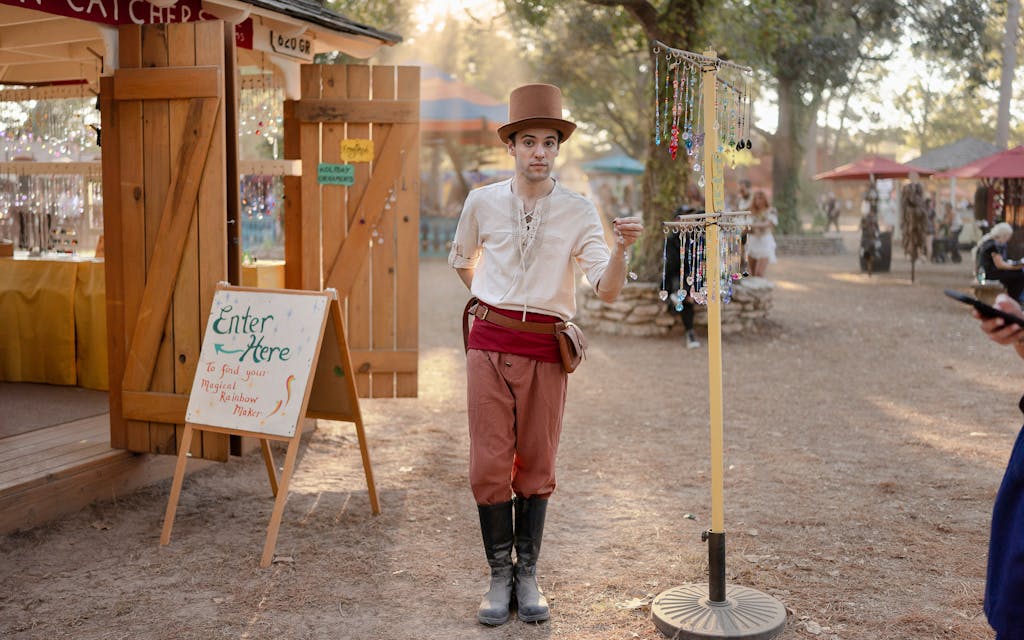 A performer sells crystal ornaments at a booth during the festival. Photograph by Lexi Parra
On November 24, the Monday before the final weekend of the 2025 festival season, TRF filed a notice with the First Court of Appeals in Houston. This year’s season is now over, but there’s no telling how long the appellate process will take. Until then, two court-appointed “special masters”—independent, third party attorneys from Huntsville and Houston—will oversee the business of the festival, ensuring that the day-to-day operations remain mostly unchanged. “All hail the special masters!” just doesn’t have the same ring to it.
Meanwhile, another legal battle rages on. In 2024, one year after the breach of contract suit was filed, eight festival shareholders—including vendors who had worked there for forty years—brought a second against Coulam and TRF for damages over the aborted 2023 sale. They alleged breach of contract, shareholder oppression, self-dealing and poor management by Coulam, breach of fiduciary duties, and fraud by nondisclosure. The plaintiffs included Wilson, of “the Greeks,” whose daughter is married to Rivard’s son.
In their response, attorneys for Coulam and TRF denied each allegation in the suit, arguing that Coulam had practiced sound judgement, had not oppressed his shareholders, and that he had not breached the 2023 sale contract for the same reasons stated in the ownership suit. On November 25, the judge in that case issued a docket-control order providing a timeline for the case—now being made against Coulam’s estate—to be heard.
People cheer during a jousting show.Photograph by Lexi Parra
By the time the fifty-first season’s opening weekend rolled around, outcry from the campground clans had convinced TRF to allow the bonfire tradition to continue, but with a caveat: festival staffers, rather than the rennies, would be responsible for stacking the wood. As dusk fell on Saturday, a smaller-than-normal pyre was lit in the center of the campground. It didn’t roar so much as hum, but the blaze once again invited revelers who weren’t quite done reveling to continue their party around its light. A few drummers pounded away in the rough circle around the fire, but the general atmosphere seemed more subdued.
Even if new rules were largely retracted or ignored, campers felt an increased TRF presence. Festival vendors set up in the campground’s central areas, encroaching on the after-dark scene that’s been independently run by rennies for decades. “I said it thirty years ago. I said, ‘They’re not going to stop until there’s a taco stand there,’” Andrew Winters, a founding member of the Brigadoon clan, quipped. He was only off on the details; a food truck was there, selling pizzas (starting at $22 per pie) and other modern fare.
Fifty yards away, naked Jenga (official name: Pirate Planks) carried on in the same manner and location as it had in years past. The ban on public nudity, it seemed, had also gone the way of the bubonic plague. The game, hosted by the twenty-year-old clan Call of Booty, features a knee-high stack of Jenga blocks, which volunteers can pull and restack as in the classic version. The nude twist, however, is that on each block a written number correlates with a sexual dare. Three men bared their genitals when one of them pulled a plank corresponding with the directive to “release the Kraken.” Women flashed their breasts to cheers that could be heard throughout much of the grounds; later the applause would be replaced by thumping dance music that continued past midnight, after designated quiet hours.
And so it seemed the decadence of the campground hadn’t completely faded, even if the party didn’t fully ramp up that weekend. On Monday morning, rennies returned to their keyboards and declared, “the energy of the campgrounds is gone.” (Long live the energy of the campground.)
Likewise, attendance numbers provided to vendors reflected a 20 percent drop in festival attendance during the 2025 opening weekend—from 49,534 in 2024 to 39,468 this year. Rennies debated the cause online. A leatherware vendor blamed a variety of factors including the Texas-OU game, ACL Festival, and Bayou City Arts Festival in Houston (all going on elsewhere that weekend), as well as general economic uncertainty. An uptick in prices—$22 for a turkey leg!—was the problem, according to one Redditor, who declared: “WE’RE BROKE.” Storms would deter some rennies over at least two subsequent weekends. Others thought last year’s attendance was inflated, thanks in part to the HBO docuseries and the milestone anniversary season. Indeed, an employee at a shaved ice stand said the turnout this year was “about average.”
“It feels ‘business as usual.’ Because I don’t think enough time’s passed for [new] things to come down the pipe,” said Winters, of the Brigadoon clan. Overall, 2025 attendance was roughly seven percent down from 2024 numbers, though the most popular themed weekends saw jumps in attendance, according to data provided to vendors.
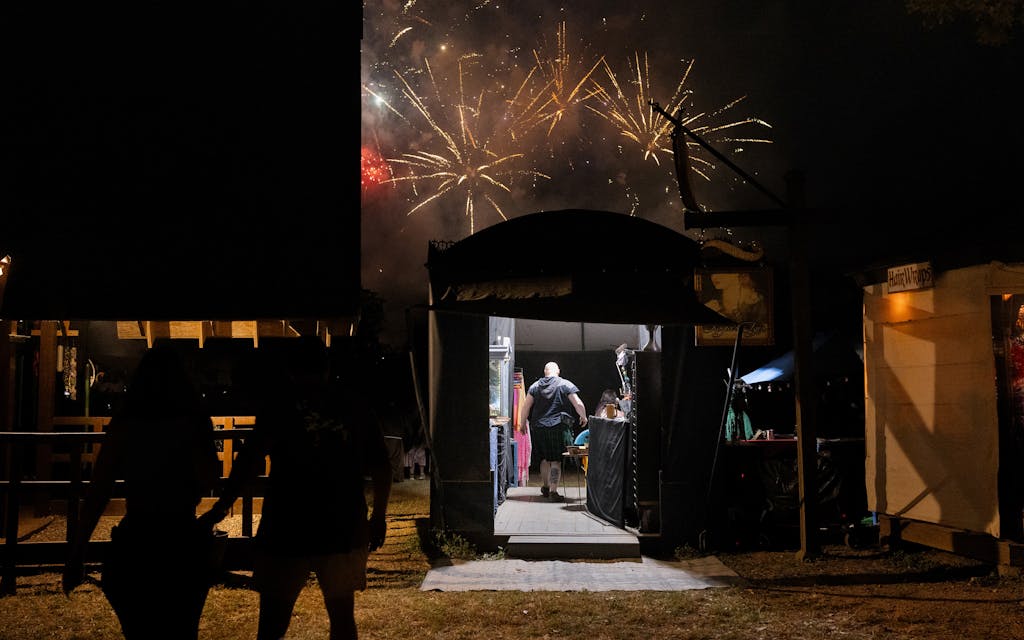 Attendees watch fireworks dedicated to the memory of the late festival owner, George C. Coulam.Photograph by Lexi Parra
This season may not be a reflection of what the future holds for the Texas Renaissance Festival. The fortune-tellers at Susie Star Psychic and Tarot Readers, booth F19, cannot see the outcome of the court cases, or what they will mean for the vendors, families, swingers, pirates, and princesses that return to Todd Mission every fall.
Of the prospect of new owners, “some people think it’ll be better. Some people think it’ll be terrible,” said White.
Whether the late king gets his way or the Greeks get theirs, both sides are fighting for the festival to go on for at least another fifty years. Nobody, it seems, wants the party or the profits to end. And so far it appears likely that it won’t. Campers’ protestations aside, the festival grounds themselves felt very much the same as any other year. Drummers drummed, partiers disrobed, a fire crackled. Rennies and newbies still sought an escape from their modern lives. As one scribe put it in a legal document, “there is but one non-fungible Ren Fest.”
Despite the premise of a Renaissance festival, time only moves in one direction. An era—of history, of a business, or of an ersatz sixteenth-century hamlet—can’t be suspended in amber. Change happens, many faithful vendors and TFR attendees told me, quoting Buddha or referencing their own decades-long experience with the ever-evolving event. But it appears, at least for now, that King George built a make-believe world so large and all-encompassing that it continues to turn even after his demise.
Read Next