
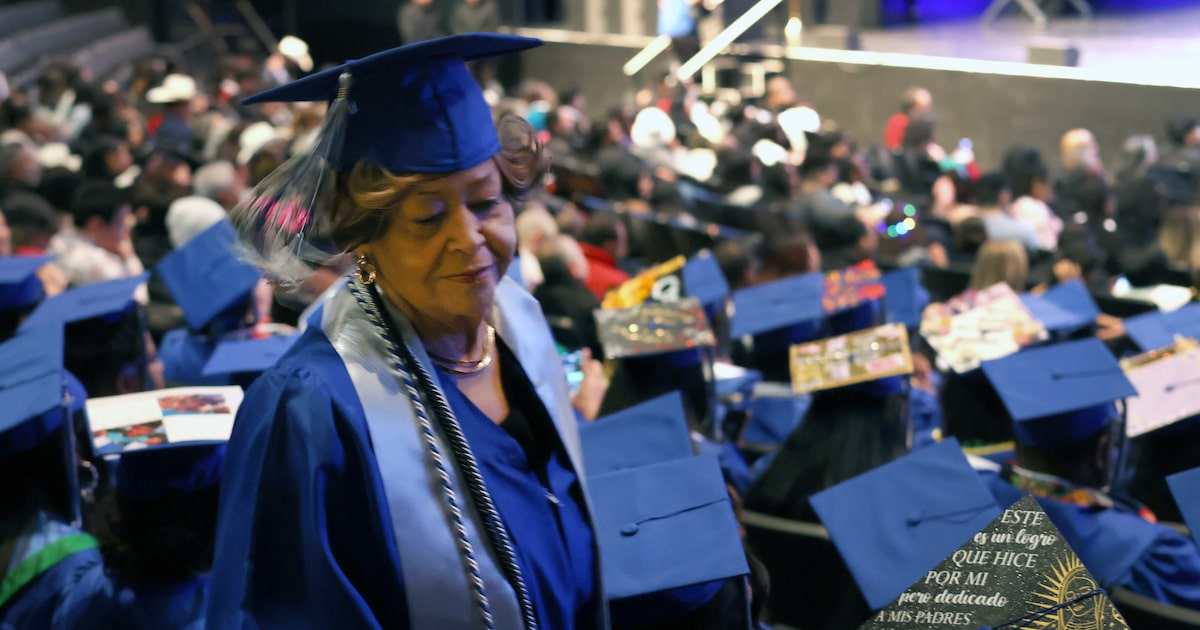
She wanted to go to the school on the corner.
The one just steps from her South Dallas home, so close she could hear the bell ring. The one with high ceilings and new textbooks that only welcomed white students. The one the Supreme Court said Black students like her were allowed to attend.
When Cheryl Wyatt tried to enroll at John Henry Brown Elementary in 1955, a principal told the 10-year-old to go home.
Dallas ISD refused to integrate its schools in the wake of the 1954 Brown vs. Board of Education ruling. So Wyatt’s family sued, making her one of 28 children represented in the first legal attempt to desegregate Dallas’ public education system.
The Education Lab
“My dad would tell us, ‘You all are just as important,’” she said. “But still, we had that feeling. We lived a life of separation.”
Wyatt, 81, will tell you she didn’t realize she was making history. She just wanted an education.
‘There’s education in everything you do’
An education means you get wise. You learn about life. You become a different person.
That’s what Wyatt’s dad, who dropped out of school in fourth grade, told her. Growing up, she watched him come home from work, scarf down dinner and drive to Lincoln High School, where he took night classes to earn his diploma.
In 2021, after a lifetime of working in salons, of raising two children, of cooing over her grandchildren, Wyatt wanted to be a different person.
She remembered a promise she made to herself in 2010 when she heard the University of North Texas System was opening a campus in southern Dallas. All of her brothers had gone to college, launching careers as a lawyer, a principal and a technician. For a long time, she wanted that, too.
“I read about it,” she recalled. “And I said to myself, ‘I’m going to that school.’”
Related

UNT Dallas, which was founded with a mission to make college degrees accessible and affordable for urban Dallas students, was close enough to her Duncanville home that she could drive to campus. In-state tuition was affordable, so Wyatt called Texas Southern University in Houston, where she spent three semesters before leaving in 1964, and asked for her transcript.
“The next thing I knew, I was in class,” she said.
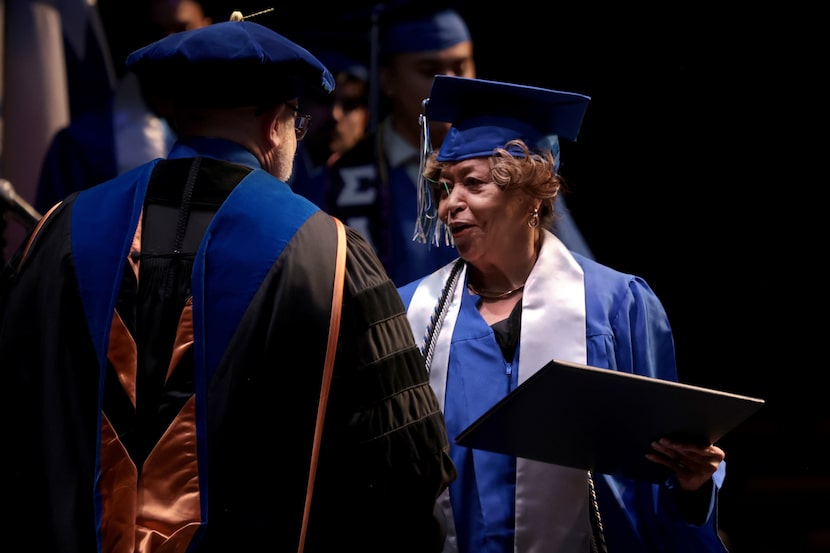
Cheryl Wyatt, 81, receives her college diploma from the University of North Texas at Dallas on Dec. 16, 2025.
Steve Hamm
She had planned to study grant writing. For 30 years she headed Alpha Chi Pi Omega, a national Greek organization for beauty professionals, and they always needed more money to sponsor their youth programs. Maybe she could help.
After she had completed the few grant-writing classes UNT Dallas offered, she wasn’t sure what she should major in. Her professors, including Robert Tinajero, an associate professor of English and rhetoric, nudged her to major in applied English, which focuses on building marketable language and communication skills.
“She’s not afraid to talk and give her opinions. She has so much experience in life that it was really great for the other students to hear her when she spoke up in class,” Tinajero said. “They and I learned a lot from her.”
Related

Wyatt took creative writing courses, wrote poems and short stories, and recorded a podcast about her life. She often sat in the front row and hardly ever missed class.
When she had back surgery in January, she didn’t take time off. Instead, her days blurred between her computer and bed: She would wake up, take her medication and log onto class. After a few hours, she’d stop to take a nap.
On campus, she tried to coax her young classmates to come out of their shells.
“I would always try to start a conversation and they would just answer, point blank, yes, no, yes, no,” she said. “It was kind of hard connecting with this generation. They don’t open up as freely.”
Wyatt took four classes with Tinajero, including one that explored social issues through the lens of hip-hop. Before the semester started, Tinajero recalled, Wyatt was worried she wouldn’t do well. She didn’t like to listen to rap music.
“When I heard rapping, I heard curse words. I had a negative impression of what rapping is,” Wyatt said. “But after that class, I learned that those artists are very intelligent … This was their way to express themselves.”
Her lived experience became lessons for Tinajero’s students.
“She was an 80-year-old analyzing Kendrick Lamar lyrics,” Tinajero said. “And while my other students have seen things, it’s mostly through them reading about it or learning about it on social media. To have somebody in class that’s actually lived through it was pretty awesome.”
For Tinajero’s new media class, Wyatt made a podcast about her experience in the 1955 lawsuit, recounting the crowded courtroom and the flashes of reporters’ cameras. She brought in a newspaper clipping with a photo of her and seven other plaintiffs, including her brother and twin sister.
“I know segregation was really not that long ago, but having someone who lived through it here among us in our class was just a stark reminder that this is something that affected and still has effects on people who are very much still alive today,” said Michelle McWhorter, 30, who took classes with Wyatt.
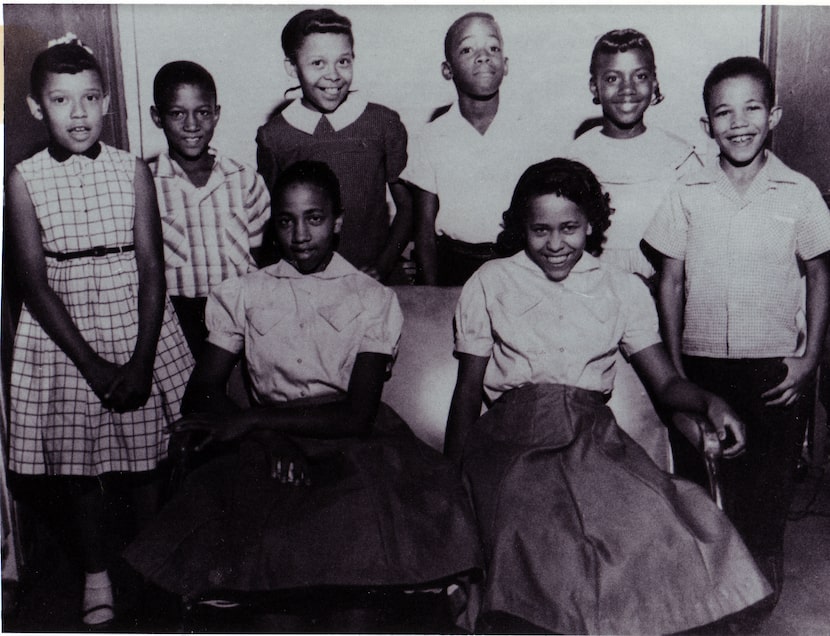
Eight of the 28 plaintiffs in the first desegregation lawsuit filed against Dallas schools were photographed in September 1955 at an NAACP meeting held to let the plaintiffs and their families get acquainted. Pictured are (back row, from left) Maudie Sims, Alonzo Nickerson Jr., Rosa Sims, Daurity Smith, Pamela Boson and Ronald Hurdle, and (seated) Carol Hurdle and Cheryl Hurdle. / Special to The Dallas Morning News
Special to the Dallas Morning News / Special to TDMN
At college, Wyatt started to see things — rap music, artificial intelligence, the joys of writing — in a new light.
“I know now that there’s education in everything you do, everything you learn,” she said. “The things that I knew before that I thought were negative, I see now as positive.”
This life, she realized, was what her dad had been chasing, driving off in the dark to night school. This was what he wanted for her when they walked to Brown Elementary’s doorsteps.
On the cusp of history
Wyatt’s 1955 lawsuit against Dallas ISD was short-lived.
Days after the NAACP filed suit, U.S. District Judge William Hawley Atwell dismissed it, saying the school district should be given more time to integrate, according to a 1988 Dallas Morning News article. Wyatt never attended a desegregated school in Dallas.
Related

The suit “began a succession of others, a series of lawsuits that put integration in the hands of the federal courts,” according to the 1988 article. In a similar case in 1957, the NAACP represented two Black children who wanted to attend a white school closer to their Dallas home. In 1970, Sam Tasby, a father of six children, filed a landmark lawsuit that brought a federal desegregation order against the district.
Related

It would take 48 years after Wyatt’s case for a district judge to declare Dallas ISD desegregated in 2003.
Wyatt said her father didn’t tell her back then that the case had been dismissed.
“My father taught us to not give up. Just stick with it,” she said. “Some people think that the first time you fail, you’re a failure. You just need to get up and shake yourself off and keep trying, because you’re going to win if you keep trying.”
Her brother, a lawyer who graduated from Texas Christian University and Thurgood Marshall School of Law at Texas Southern University, is living proof of that advice, she said.
“The same system that tried to keep him out of an elementary school eventually recognized him as a leader in the legal field,” Wyatt said in a podcast assignment. “What I now realize is that the progress you fight for isn’t for you. It could be for ones who come after you.”
‘Between what has been and what will be’
On Tuesday, Wyatt fiddled with the tassel on her graduation cap as she stood backstage at the Texas Trust CU Theatre in Grand Prairie. She worried she would cry crossing the stage and smudge her royal blue eyeliner, the same shade as the gown wrapped around her.
Two “Pomp and Circumstance” renditions and three speeches stood between Wyatt and the rest of her life.
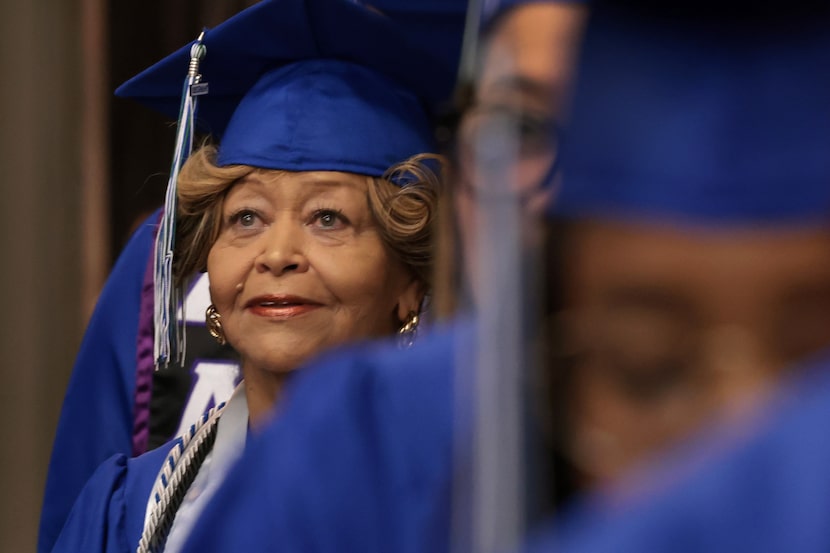
Cheryl Wyatt, 81, waits backstage before the start of graduation ceremonies held in Grand Prairie. Wyatt walked across the stage along with fellow graduates of the fall/winter 2025 graduating class from the University of North Texas at Dallas on Dec. 16, 2025.
Steve Hamm
UNT Dallas President Warren von Eschenbach introduced himself as a member of her “fan club.” She asked for a picture. He promised one on stage.
“Somebody with her story that’s come back to finish her degree shows you it’s never too late,” von Eschenbach said. “To be part of the early desegregation lawsuits against Dallas ISD and to now get a degree from the university started to serve the community. It’s poetic.”
Next week, there will be no classes, no midnight deadlines. She’s not exactly sure what she’ll do with her time. Maybe she’ll write advice columns for a senior citizen magazine: how to connect with estranged grandchildren or cope with family members who don’t understand your pain.
“I don’t think I’ve found the best of me yet,” she said. “I think there’s so much more to find once I get out and get my feet in the industry. I’ve got some good years left.”
Wyatt listened to the commencement speaker talk about how cold the day was, how winter has a way of making the world more clear.
“Commencement is a moment like that,” he said. “A moment of clarity, a moment of truth, a moment when you stand between what has been and what will be.”
On stage, Wyatt walked, slow and steady. She held the diploma by her chest and thought about her mom and dad. How they fought for her education. How they always wanted her to get her degree.
She didn’t cry. She clutched her diploma closer and thought about what comes next.
The DMN Education Lab deepens the coverage and conversation about urgent education issues critical to the future of North Texas.
The DMN Education Lab is a community-funded journalism initiative, with support from Bobby and Lottye Lyle, Communities Foundation of Texas, The Dallas Foundation, Dallas Regional Chamber, Deedie Rose, Garrett and Cecilia Boone, Judy and Jim Gibbs, The Meadows Foundation, The Murrell Foundation, Ron and Phyllis Steinhart, Solutions Journalism Network, Southern Methodist University, Sydney Smith Hicks, and the University of Texas at Dallas. The Dallas Morning News retains full editorial control of the Education Lab’s journalism.