
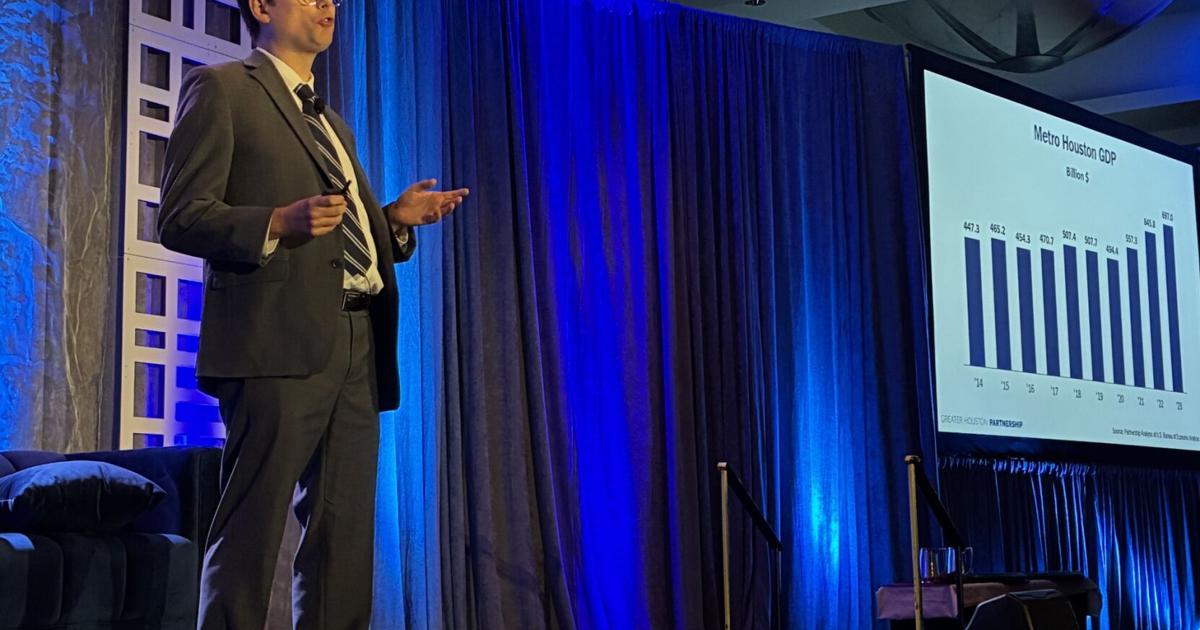
Despite headwinds such as a cooling labor market, geopolitical uncertainty and a new uptick in inflation, the Houston region’s economy is positioned to expand next year, albeit at a slower pace since the end of the COVID-19 pandemic, the Greater Houston Partnership’s chief economist told a group of business and political leaders.
The partnership projects the region to add 30,900 jobs in 2026, although some sectors will see a loss in jobs, with a record 3.52 million jobs by the end of the year, said Colin Baker, GHP’s manager of economic research. The projection for 2025 had been 71,500 new jobs.
Baker was the featured speaker at the partnership’s annual “Houston Region Economic Outlook” event, held December 11 in a filled-to-capacity ballroom at the Royal Sonesta hotel in the Uptown area. The partnership serves as the region’s main chamber of commerce. It was Baker’s first time on the annual event’s stage since the retirement last year of Patrick Jankowski, who had held the role for four decades.
Houston is comparing well in terms of economic growth with most of the other Top 20 metropolitan regions in the country, Baker said. One of the major drivers of that growth is the growing population into the region, he said. The region has added 1.3 million residents in the last decade, representing an increase of 20 percent, he said.
Houston is the second-fastest growing metropolitan area in the country behind Orlando, Fla., which has a much smaller population, Baker said. He noted that most people moving to Florida are mostly doing so to retire, whereas people moving to the Houston area are moving here for work.
Houston’s economic activity, as measured by what is called the Purchasing Managers Index, saw a slowdown in early 2025 in line with the national picture, but began to pick up again at about the midpoint of the year, Baker said.
Announcements of business expansions in the region, particularly among bioengineering and other types of advanced manufacturing, bode well in the years to come, he said.
“Unfortunately, our economy does not exist in a vacuum,” Baker said. Among the trends he noted that might hinder the regional economy next year are a slowdown in the national labor market; and a decline in the price of oil that will have downward effects on the petrochemical and related industries.
For next year’s outlook, Baker noted that the GHP uses to make projections differs from other models, and that it is based on economic data only going through August, before the recent government shutdown during which many data sets were not released.
The partnership projects modest national job growth, with a steady U.S. employment rate of near 4.4 percent with “sluggish hiring not resulting in broad layoffs.” Economic growth will remain stable, but with easing growth in Texas and nearby states in the second half of 2026.
Consumer spending will see steady growth in the year, even as inflation year-over-year will be near 3 percent, according to the partnership.
U.S. oil production will see a moderate decline in 2026, based on falling crude oil prices, while natural gas production remains steady.
Most sectors will see job growth in 2026, led by heath care, construction, public education, public administration, and professional, scientific and technical services, according to the forecast. Sectors that will see job losses include information, retail, oil and gas extraction, manufacturing and administrative support.
Find the full “Houston Region Economic Outlook” publication online at houston.org/publications.