
By Sheldon Munroe
Reporting Texas
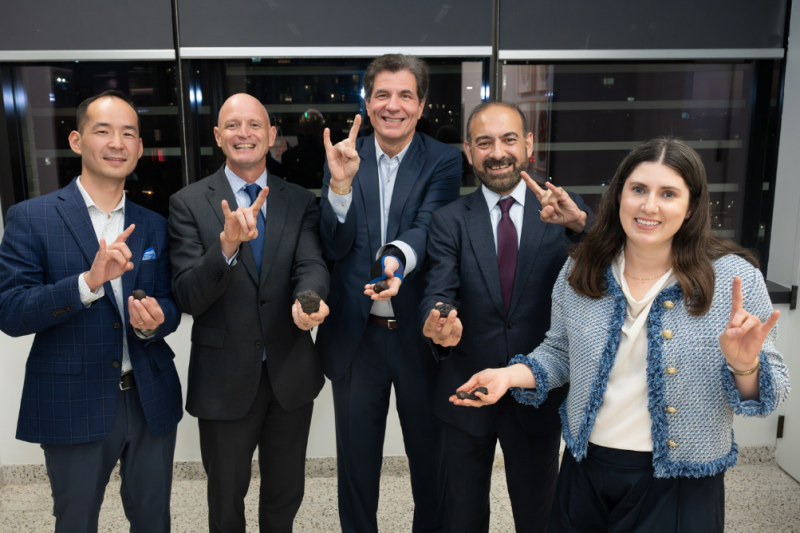
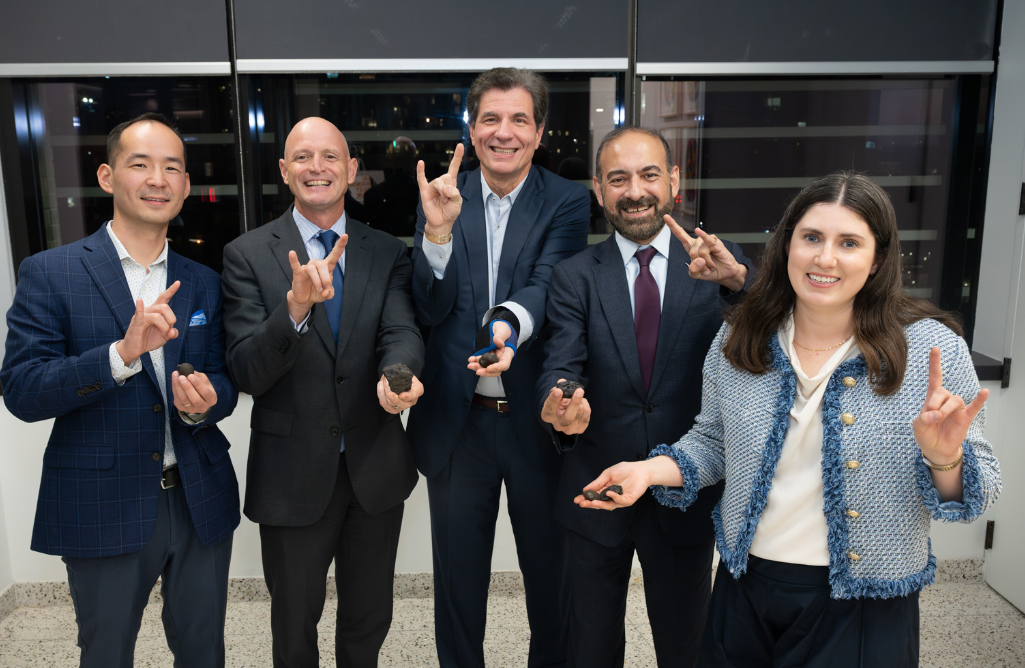
Keynote speakers from the Nov. 17 Rare Earth Mineral Forum pose with UT-Austin hosts. From left, Tem Tumurbat, JR DeShazo, Jose Fernandez, Dilawar Syed and Anna Scott. Photo by Thomas Meredith
With America facing mounting pressure to reduce its dependence on foreign rare earth minerals, Texas and the University of Texas are seeking a role in rebuilding a domestic supply chain.
The University of Texas at Austin has held two educational forums in the past five months, seeking a role in driving innovation and dialogue around critical mineral development.
“The central question is, how can we stimulate our own supply of these critical minerals?” JR DeShazo, dean of the LBJ School of Public Affairs, said at one of the forums.
Participants in the events said efforts to build American capacity are vital; the United States currently relies on foreign stockpiles for 12 of the 15 critical rare earth minerals required for technologies such as electric vehicle batteries and smartphones. While trade agreements exist with these countries, the U.S. does not want to depend on them.
The first event was hosted by the Jackson School of Geosciences over Aug. 13–15, followed by another on Nov. 17 at the LBJ School of Public Affairs. Both explored policy, research and technological developments at the forefront of the U.S. critical mineral race and came on the heels of research by UT science teams into developing more environmentally friendly methods of extracting rare earth minerals.
“A few years ago the critical minerals vulnerability of the U.S. was a theoretical exercise; we have seen how this is no longer a theoretical exercise,” said Jose Fernandez, who served as undersecretary of state during the Biden administration.
China poses a significant hurdle in America’s efforts to escape mineral dependence. Despite political and ideological differences — not to mention an ongoing trade war — the U.S. is still dependent on China for many essential rare earth minerals. Experts say that trade agreements and tariff pressure on other nations are unreliable long-term solutions and that the U.S. must develop its own methods for extracting critical rare earth minerals.
China has worked to become resource independent over the past decade. But its example has also become a cautionary tale..
“A reason why the People’s Republic of China has succeeded in rare earth mining and minerals is because they devastated the countryside. There has been an environmental cost,” Fernandez said
“Whether it is dredge mining, deep-sea mining or space mining, we have to do things responsibly,” said Tem Tumurbat, co-founder and managing partner of Nomadic Venture Partners .
The demand for critical minerals in the U.S. is skyrocketing. This demand is fueled by nationwide infrastructure expansions, green energy transitions and national security concerns. A huge demand is also coming from data centers.
The United States does have plenty of treasures underground and until the 1990s the U.S. was the world’s leading producer of rare earth minerals. Since that time, America has cut back on mining and processing.
Only 10 percent of the nation’s rare earth mineral and element supply now comes from domestic extraction, while roughly 78 percent of the supply comes from China. The U.S. has only four operational aluminum smelting plants, two copper refineries and only one aluminum refinery. Most minerals extracted domestically are still shipped overseas for processing before returning to the U.S. supply chain.
Rare earth minerals such as yttrium, samarium and neodymium are essential for the nation’s defense system including the F-35 fighter jets thermal barrier coatings, radar systems, visual displays and turbine blades. These are among the rare earth minerals that China has previously restricted exportation of, along with gallium, which the U.S. depends on China for nearly its entire supply.
Societal and environmental challenges pose significant hurdles to critical mineral mining, experts say.
“No one wants a copper mine in their neighborhood,” said Douglas Wicks, a program director at the Advanced Research Projects Agency–Energy.
But those minerals are increasingly important, he added.
“Minerals will be a driver for the green transition that is focused on reducing fossil fuels,” Wicks said.
Finding practical solutions amid growing industrial needs is becoming especially urgent in the Lone Star State. UT-Austin’s focus on the topic of rare earth minerals comes at a crucial time for the state, which has emerged as a hub for large-scale semiconductor and chip manufacturing by companies like Samsung, Texas Instruments, Infineon, GlobalWafers, NXP, X-FAB and Applied Materials.
Texas is home to 411 data centers, the second most nationwide, and a new $40 billion investment from Google will fund the construction of three more.
Semiconductor and chip manufacturing rely on such critical minerals as gallium and germanium. Both have seen exportation restrictions from China in past years. By 2030, the projected U.S. AI data center mineral demand is estimated to be 450,000 tons of copper, 175,000 tons of aluminum, 12,500 tons of nickel, 10,000 tons of graphite and 65 tons of gallium.
“The United States cannot actually succeed in the age of AI as a force to be reckoned with without having access to critical ingredients and imports that power our batteries, our devices, EVs, advanced defense equipment and chips,” said Dilawar Syed, an economic policy adviser and associate professor at the LBJ School.
The UT conferences have also focused on the promise of drawing resources from mineral waste. “We need recycling of critical minerals,” Fernandez said.
Currently, in the United States, it takes on average 15–30 years to open a new mining operation, from the idea and location to the start of the extraction.
“In the U.S. to meet demand, we would have to open at least 300 new mines in the next few years,” Tumurbat said.
By contrast, Tumurbat said, the time it takes to obtain permits to begin extracting the waste can be a span of months to a year. But many companies today have mountains of waste sitting on their balance sheets and want to offload them..
“There are billions of tons of material that have been mined historically that have incredible amounts of value, and we just need to develop technology to be able to process them,” Tumurbat said.
The two UT events also looked at a second approach to obtaining critical minerals: deep sea mining.
“It feels like we are at the beginning of a gold rush,” said Anna Scott, the CEO of Mithril Minerals, a Texas-based deep sea mining company “I have always wondered what a gold rush felt like, and I think I know now,” she said.
Deep sea mining involves sending mineral-extracting rovers to the bottom of the seafloor and siphoning up rocks that contain rare earth minerals.
These rocks have generated excitement, because research suggests there is a bountiful supply sitting at the bottom of the ocean. While there are many rare earth minerals the U.S. is in need of obtaining within these rocks, there are serious ecological concerns with getting them out of the sea.
These rocks can contain both light earth elements and heavy rare earth elements such as cerium, yttrium, europium and cobalt, and Scott said they are accessible.
“With any mining and mineral play there are, of course, consequences to this. One of the big consequences is, of course, the ecological consequences,” .
While companies such as Scott’s are trying to come up with ways of extracting these minerals that cause less harm, the unknowns are still troubling, Fernandez said.
“To be honest, no one really knows what the environmental damage will be,” he said.
On April 24, President Donald Trump signed the executive order titled Unleashing America’s Offshore Critical Minerals and Resources. The order aims to accelerate permits given to domestic companies to begin exploration and collection of deep sea minerals.
The order cites “unprecedented economic and national security challenges in securing reliable supplies of critical minerals independent of foreign adversary control.”
A team of researchers from UT is working to address the environmental impact of mineral extraction. The group includes experts from the departments of civil, architectural and environmental engineering; chemical engineering; and chemistry. They have created a mineral extraction method some experts are calling a breakthrough, compared with current industry methods.
Today, rare earth minerals are often extracted through a process called “solvent extraction,”which separates elements from complex ores using chemical solvents. The specific elements desired for extraction will be drawn into a liquid solution. While effective, this process causes substantial chemical and energy waste, as well as pollution.
In contrast, UT researchers’ new separation process involves the use of artificially designed membrane channels that are created to specifically extract certain rare earth ions. These artificial membrane channels replicate how cells naturally move ions therefore allowing only certain minerals to pass through. This mineral extraction technique produces far less waste than current methods, and if successfully applied to commercial use could help lead to a more dependable domestic supply of rare earth minerals. It has yet to be shown whether the transition from laboratory to large-scale business use will be practical or economically feasible, however.
While the experts at the UT events said efforts to secure minerals needed for the nation’s future are a step in the right direction, far more work both at the higher education, state, private sector and federal level is required.
“This is not a problem that will be solved overnight,” Fernandez said.