
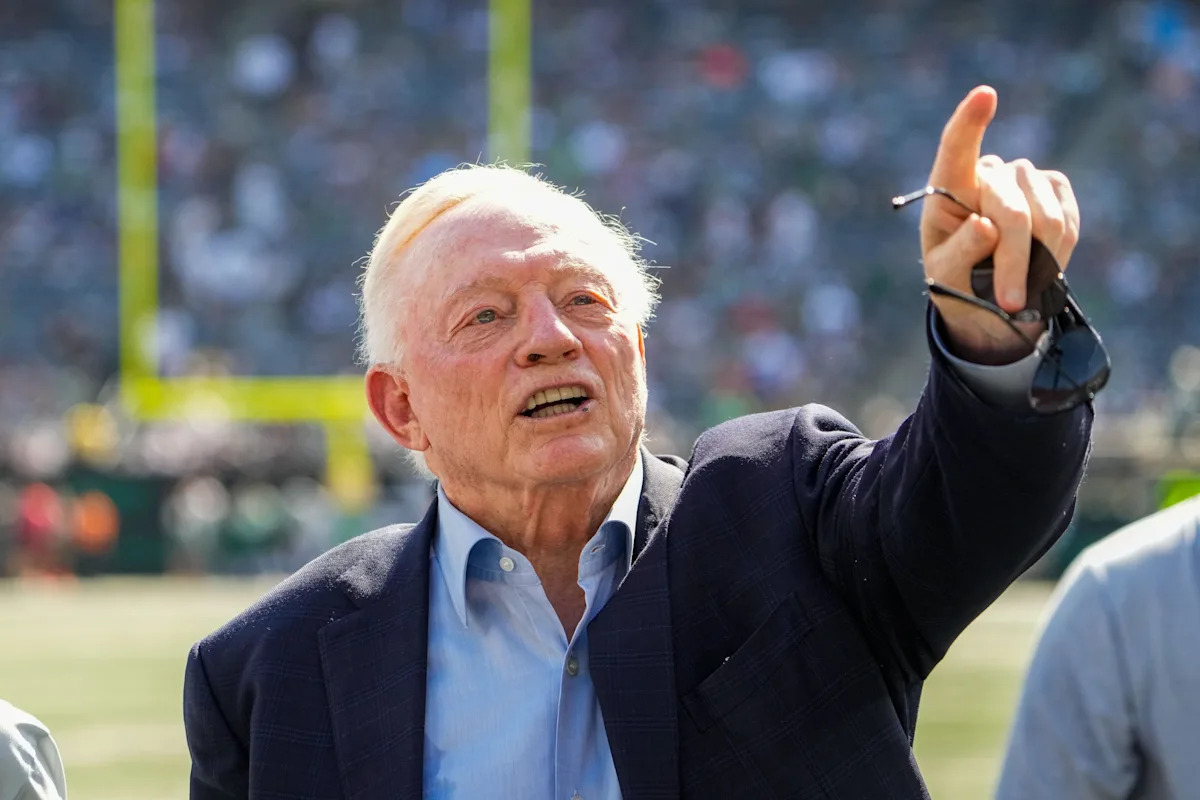
“The third Super Bowl that I had a chance to be involved in, I made a deal with the man upstairs and said, ‘If you’ll just do it for me, I’ll never ask again. This will be it. If you’ll let me win this third Super Bowl, I won’t ask again.’ I’ve been trying to re-trade that deal for the last 20 years.” — Dallas Cowboys owner Jerry Jones in a 2017 interview with NFL Network
Jerry’s man upstairs continues to hold that promise tight.
Advertisement
In 2015, 10 years without a Super Bowl became 20. And this weekend, 20 years became 30. At the hands of Philadelphia Eagles, no less — the defending Super Bowl champions, who have won two Lombardi Trophies since Jones first revealed his 1995 pact with a higher power during that NFL Network interview. That’s who locked the Cowboys out of any chance of a postseason shot on Saturday, thumping the Washington Commanders 29-18 and wrapping up their second straight NFC East crown.
That’s the outside-in way of looking at it. But the inside-out perspective? If Jerry is looking internally, it’s the Cowboys who knocked themselves out of the playoff race this season. All through myriad decisions and circumstances that created an offensive juggernaut requiring nothing more than a mediocre defense to carve a path to the postseason. But even mediocrity was a reach for the Dallas defense this season, which got torched again in a 34-17 loss to the Los Angeles Chargers on Sunday and has failed consistently enough to transplant defensive coordinator Matt Eberflus from the sideline to the coaching box for the remainder of the season. Jerry and Stephen Jones are now in their final analysis and head into an offseason of decisions that will shape the next several years for the franchise.
“I’m very disappointed that the way we’re structured and my role puts us here tonight,” Jerry Jones told reporters after the latest Cowboys loss. “I’m tremendously disappointed.”
With two games left, a multitude of futures are squarely in the path of some kind of dilemma, from Eberflus to cornerback Trevon Diggs, wideout George Pickens, defensive tackle Kenny Clark and potentially others. Some weighing and measuring will have to do with performance, while other debates will involve the 2026 salary cap and where to devote money. As it stands, the 2026 cap is significantly in the red for Dallas. The Cowboys rank last in the NFL, according to trackers Spotrac (-$36,562,869) and Over The Cap (-$47,919,066).
Advertisement
Those figures are without factoring in any extension for Pickens, who is slated to be a free agent in March and is expected to command more than $30 million in annual average salary in his next deal. This despite lingering feelings of apprehension among other front offices across the league over Pickens’ mercurial reputation while playing with the Pittsburgh Steelers prior to joining Dallas. The messy cap figures also include two players whose time in Dallas could be hanging in the balance: Clark, whose salary next season is a non-guaranteed $21.5 million that includes an $11 million mid-March roster bonus, placing a decision on his future on a similar timeline as Pickens; and Diggs, who is slated to make $14.5 million in base salary in 2026 plus another potential $1 million in bonuses. Diggs has come under significant scrutiny for both performance and availability issues.
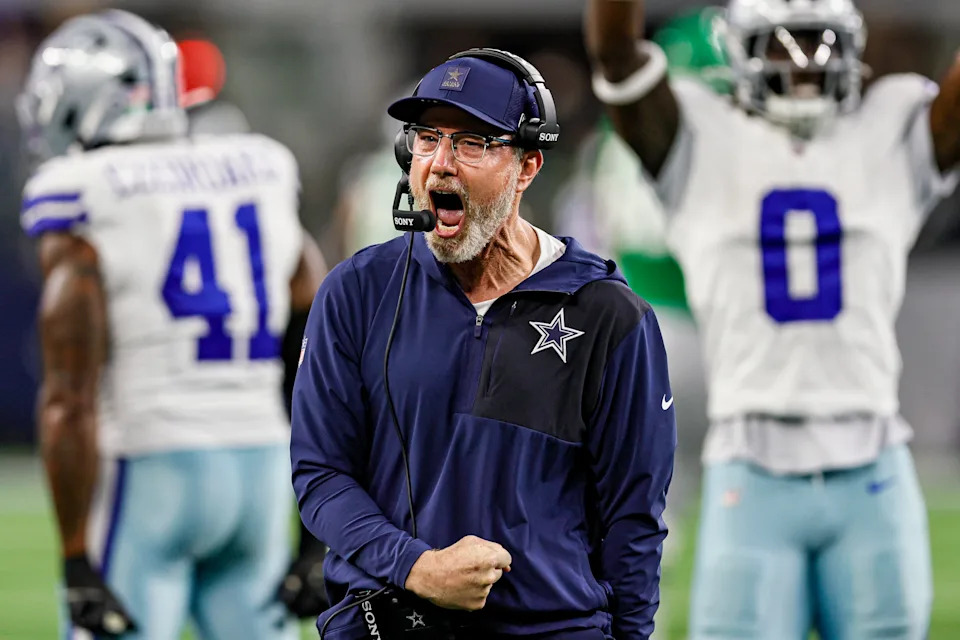
Cowboys defensive coordinator Matt Eberflus will be under the microscope for the final two games. (Photo by Matthew Pearce/Icon Sportswire via Getty Images)
(Icon Sportswire via Getty Images)
Despite the red, the Cowboys’ cap should be somewhat pliable, with the ability to restructure some of the heaviest contracts (such as that of quarterback Dak Prescott) or rework some others (such as Clark’s) to get some creative relief. Clark’s situation will be particularly interesting, given that retaining him at his 2026 salary would mean devoting a significant amount of assets along the defensive line, where defensive end Quinnen Williams and defensive tackle Osa Odighizuwa already have 2026 cap numbers of $21.75 million and $20.75 million, respectively. And if Dallas chooses to either release or trade Diggs, there would be negative cap ramifications that would depend on the scenario of his departure.
Beyond the money alone, some of these decisions could hang on what happens with Eberflus, whose unit has broken down repeatedly over the course of the season — particularly in the secondary. The embattled defensive coordinator’s explanation of his performance would be something along the lines of Diggs being a poor fit in a scheme that runs Cover 2, and the performance of fellow cornerback DaRon Bland regressing with injuries that plagued him right up to being placed on season-ending injured reserve this week. Not to mention not having a full season with Williams, a major trade-deadline acquisition, and budding impact linebacker DeMarvion Overshown, whose return to the field this season from injury didn’t take place until November.
Advertisement
Conversely, critics of Eberflus point to a perceived inability of his scheme being molded to fit Dallas’ talent base, an uneven pass rush for most of the season, some play-calling mistakes in big moments, and Jerry Jones’ own criticism that many opposing quarterbacks have seemingly seized on their games against Dallas to get themselves into a groove. Eberflus went to the coaching box with a focus on seeing if there could be a turnaround to be had with the change of vantage … and the Chargers 452 yards of offense — the third-most yards they’ve given up all season.
Jones told the team’s flagship station 105.3 The Fan last week that winning will be the priority in the team’s remaining weeks — despite the team’s ability to improve 2026 draft positioning by potentially losing games down the stretch. Dallas is currently projected to slot with the 13th overall pick and the Green Bay Packers’ selection, which is tracking at 21st overall, according to Tankathon.com.
“A win is very, very important in the NFL, and a win is important to me,” Jones told the station. “And a win does a lot of positive things. I don’t care when it happens. We owe it to that mirror and we owe it certainly to our fans that we want to walk out there and be competitive. We will not try [to lose] for draft position. We won’t be looking at anything like that. We’ll be out there playing football, and we’ll bring them to play. So that’s a long-winded way of saying we’ll play [competitive] football under whatever the circumstances are.”
Advertisement
The final two chances come Christmas Day at the Washington Commanders and Jan. 4 at the New York Giants. The playoffs are gone. The Super Bowl drought is now locked into three-plus decades. And all that is left now is an official beginning to the end of the 2025 season.