
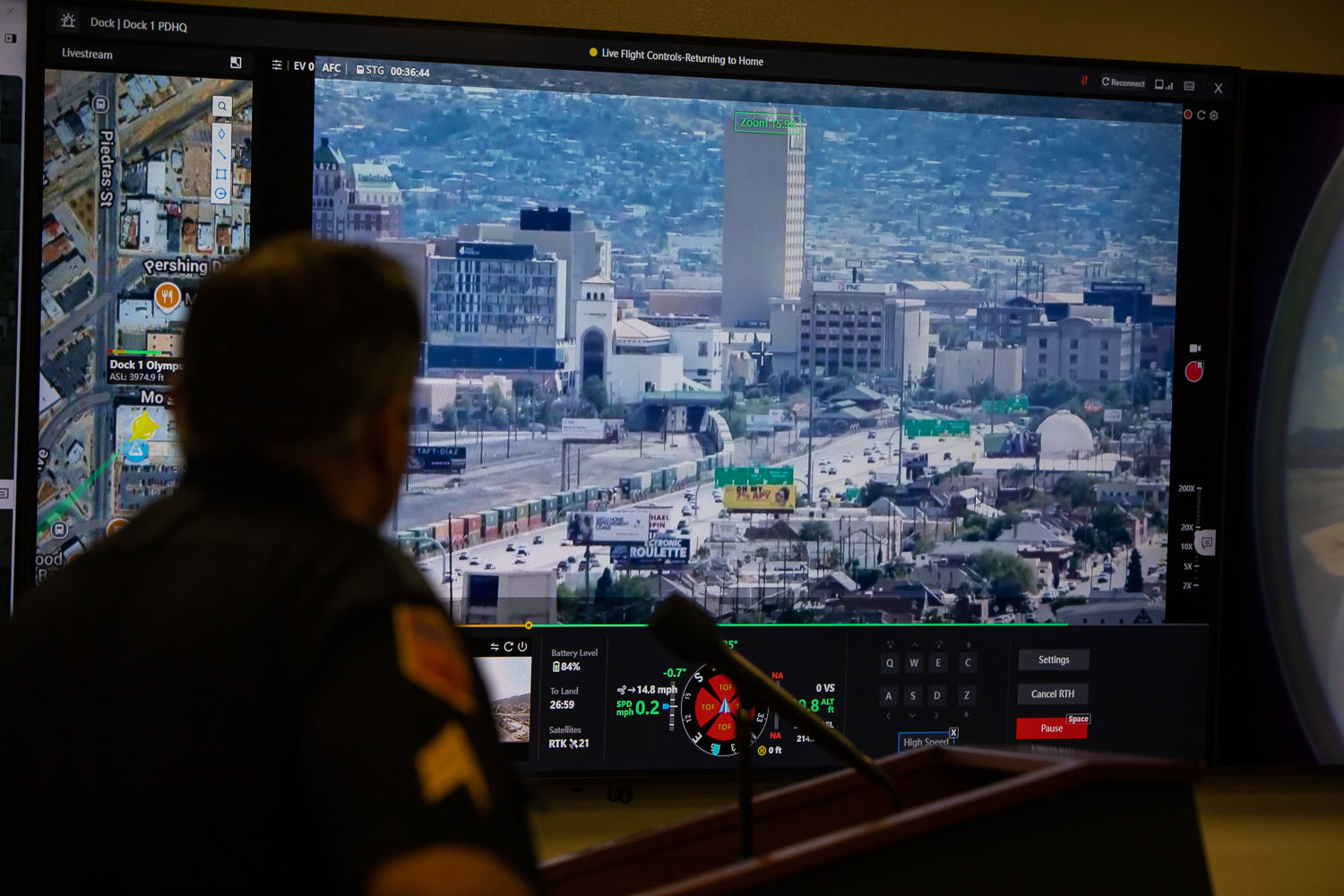
The city of El Paso’s drone program could be grounded from expansion under a new federal rule that blocks the sale of new foreign-made drones – including those produced by China-based DJI, the city’s supplier.
The Federal Communications Commission on Monday said it will ban new models of foreign-made drones from entering the U.S. market, stating that while the aircraft can enhance public safety, criminals and terrorists “can use them to present new and serious threats to our homeland.” The move follows a mandate in last year’s federal defense bill requiring a national security review of Chinese-made drones.
The FCC’s decision effectively prevents U.S. cities, agencies and private operators from purchasing or importing new drones produced in foreign countries, according to an FCC fact sheet.
The ruling could have implications for the future of the city’s drone program, as the airport as well as police and fire departments rely on DJI drones for some public safety operations and airport monitoring. The FCC’s new guidelines also broadly covers critical components, which could affect the city’s ability to repair its fleet already in use.
“At this time, the ruling does not require the city to immediately suspend existing drone operations. The city’s drone program remains focused on public safety, and we will continue to comply with all applicable federal guidance and requirements,” city spokesperson Laura Cruz-Acosta said in an emailed statement to El Paso Matters.
The guidelines do not prevent consumers such as the city of El Paso from continuing to use the drones they previously purchased, nor does it prevent retailers from selling models previously approved through the FCC’s equipment authorization process, according to the agency.
Acosta said the city has taken steps to safeguard data and will continue to monitor federal guidance and any additional actions that may be taken.
“We are also determining next steps to ensure the city remains in full compliance while continuing to support public safety operations,” Cruz-Acosta said.
City officials didn’t provide the amount it has spent on its drone program.
In September, city and airport leaders unveiled a drone program built around DJI aircraft, highlighting uses ranging from firefighting and search-and-rescue operations to runway inspections and perimeter monitoring at El Paso International Airport.
Through a partnership developed with DJI since 2018, the city in September said it operates 22 drone docks across El Paso and employs about 40 licensed drone pilots — roughly half of them working at the airport.
The airport sits next to Biggs Army Airfield at Fort Bliss, home of the 1st Armored Division and one of the Army’s major deployment hubs. Fort Bliss officials in September told El Paso Matters they were “assessing potential risks” of the city’s drone program near the installation.
In a statement Tuesday, Fort Bliss said it has been coordinating with city police on unmanned aircraft systems, or UAS, over the last few months and is grateful for the department’s work in keeping the community safe.
The installation and police department “have cultivated a positive relationship regarding Counter-UAS and UAS operations within the El Paso area that enables us to coordinate effectively with each other for the mutual benefit of our respective communities,” the statement reads.
The proximity of Fort Bliss to the airport has drawn scrutiny from a bipartisan group of federal lawmakers who have raised concerns that Chinese-made drones could be used for surveillance or data collection near sensitive military installations.
DJI Technologies, which has repeatedly denied the allegations, in a general media statement said the firm is “disappointed” by the FCC’s ban, adding that while the company was not singled out, no information has been released regarding what information was used in the determination.
Related
LISTEN: EL PASO MATTERS PODCAST