
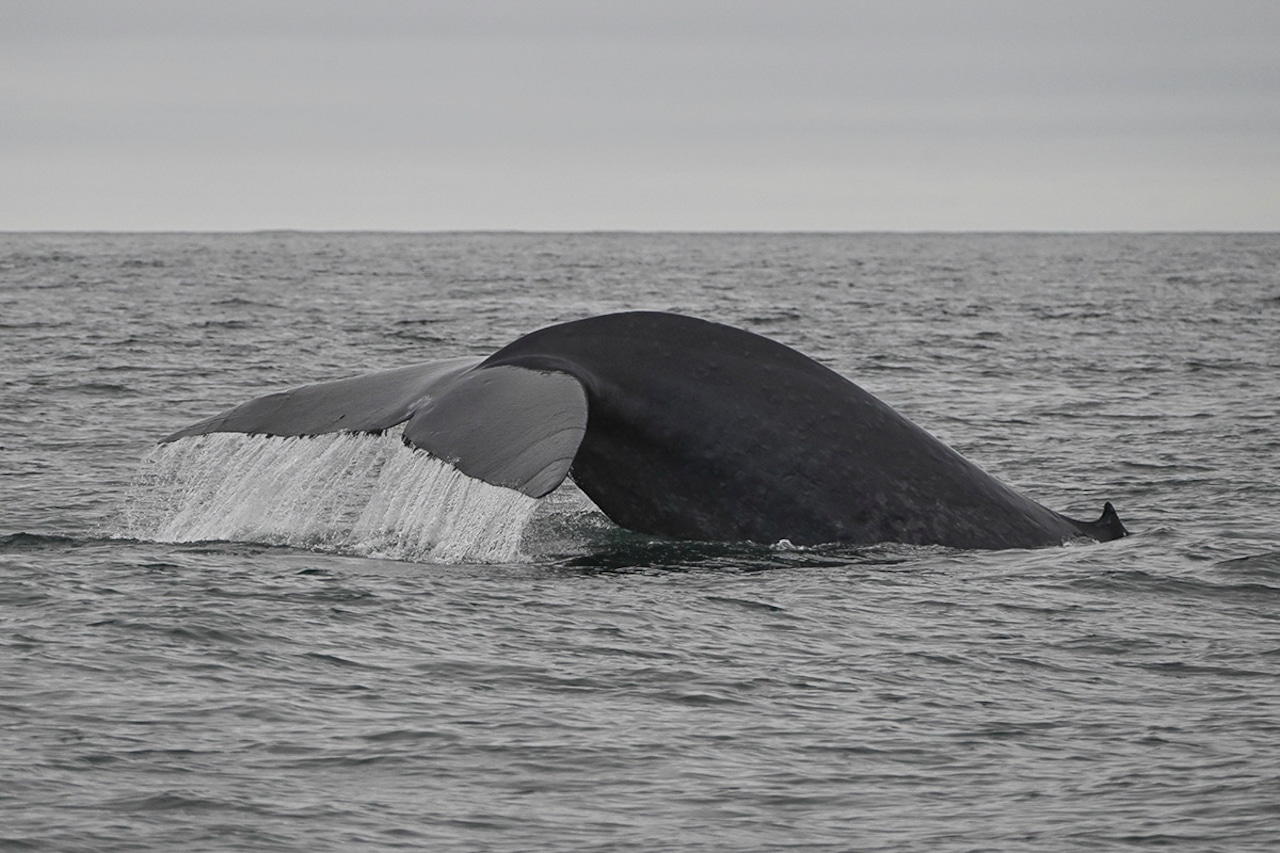
Whale biologist Carrie Newell spotted four blue whales feeding about 3 to 4 miles offshore from Depoe Bay, Oregon on June 27 — an exceptionally rare event in the state’s coastal waters.
Newell, founder of Whale Research EcoExcursions, was alerted by local fishermen over the radio who reported “big blows” offshore — spouts reaching upwards of 30 feet into the air.
Only blue whales, the largest animals on Earth, are capable of producing such towering spouts.
Newell launched her vessel and used a fish finder to locate krill bands, dense swarms of the tiny crustaceans that blue whales feed on exclusively.
At a depth of 222 feet, she located four whales. One appeared emaciated, with visible scapulae — possibly due to a large parasitic infection, as seen in the photos. Calm ocean conditions helped the spouts rise even higher than usual, making for dramatic viewing.
Blue whales are not typically seen so close to Oregon’s shore. According to the Oregon Department of Fish and Wildlife, they are usually found at least 10 miles offshore, if at all.
Of the 80 species of whales, dolphins and porpoises worldwide, only 10 regularly occur in Oregon waters, including gray, humpback, minke, sperm and blue whales, as well as orcas and several dolphin and porpoise species.
Newell has studied marine mammals since 1992 and is one of the few experts with firsthand experience tracking blue whales in Oregon. She worked with blue whale acoustics off California in the 1990s and has seen blue whales off Oregon only a half dozen times in the past three decades.
She said most people never see blues because most people don’t go more than a mile out.
The June sighting likely reflects favorable feeding conditions. Krill blooms may have formed earlier than usual, possibly due to seasonal upwelling that brings nutrient-rich water to the surface. Climate shifts may also be influencing where blue whales find food.
“There’s some really, really interesting stuff going on with blues right now,” Newell said.
During the June encounter, the whales mostly stayed about 100 yards away. At one point, a blue whale surfaced much closer. When that happens, Newell said, boat operators are required to stop moving and remain still. “That was like, whoa,” she recalled.
Newell continues her research during public whale watching trips, where she collects photo IDs using a high-speed Nikon mirrorless camera with a long lens and logs GPS, time, water temperature, depth and the presence of krill or fish using her fish finder.
The day after Newell saw the blues, a fin whale — the second largest species on Earth — was spotted by Dockside Charters, another whale touring organization based out of Depoe Bay.
Newell has seen fin whales about eight times off Oregon, only slightly more frequently than blue whales. Fins are often mistaken for blues due to their size and shape.
“Fishermen will say, ‘I saw this huge dark whale, looked like a black submarine with a dorsal fin two-thirds down its back, about 70 feet long,’” Newell said. “And I’ll say, ‘Yep, that’s a fin.’”
Unlike humpbacks and grays, fin whales rarely show their flukes, and blue whales only sometimes do. Both species are far more common off California, where krill is more abundant.
Newell’s long career includes teaching whale biology at Lane Community College and Oregon State University, and conducting research in the San Juan Islands. While at OSU, where she specialized in gray whale studies, she worked with Jean-Michel Cousteau — son of Jacques Cousteau — on the 2006 PBS documentary “Gray Whale Obstacle Course,” joining Cousteau’s dive team off Depoe Bay.
Blue whales are the largest animals to ever live, reaching lengths of 110 feet and weights of up to 190 tons — about the size of a Boeing 737-100 and nearly 100 tons heavier than the largest known dinosaurs.
Despite their size, they feed only on krill, consuming up to four tons a day. If they don’t get enough, their bones, like the scapula, can become visible beneath their skin.
The Eastern North Pacific population of blue whales numbers between 3,000 and 5,000. They migrate annually from tropical calving grounds off Mexico and Central America to feeding areas along the U.S. and Canadian west coast, including occasional appearances off Oregon.
To spot a blue whale, look far offshore for a blow that rises 30 feet or more. The animals have a broad, flat head with twin blowholes, a small dorsal fin set far back, and a tail fluke up to 25 feet wide. Their calls can reach 188 decibels— louder than a jet engine — and be heard more than 1,000 miles underwater.
For more information about blue whales check out the Cascadia Research Collective.
–Mark Graves, The Oregonian/OregonLive
Sources: Carrie Newell, Whale Research EcoExcursions; Oregon Department of Fish and Wildlife
MORE:
If you purchase a product or register for an account through a link on our site, we may receive compensation. By using this site, you consent to our User Agreement and agree that your clicks, interactions, and personal information may be collected, recorded, and/or stored by us and social media and other third-party partners in accordance with our Privacy Policy.