
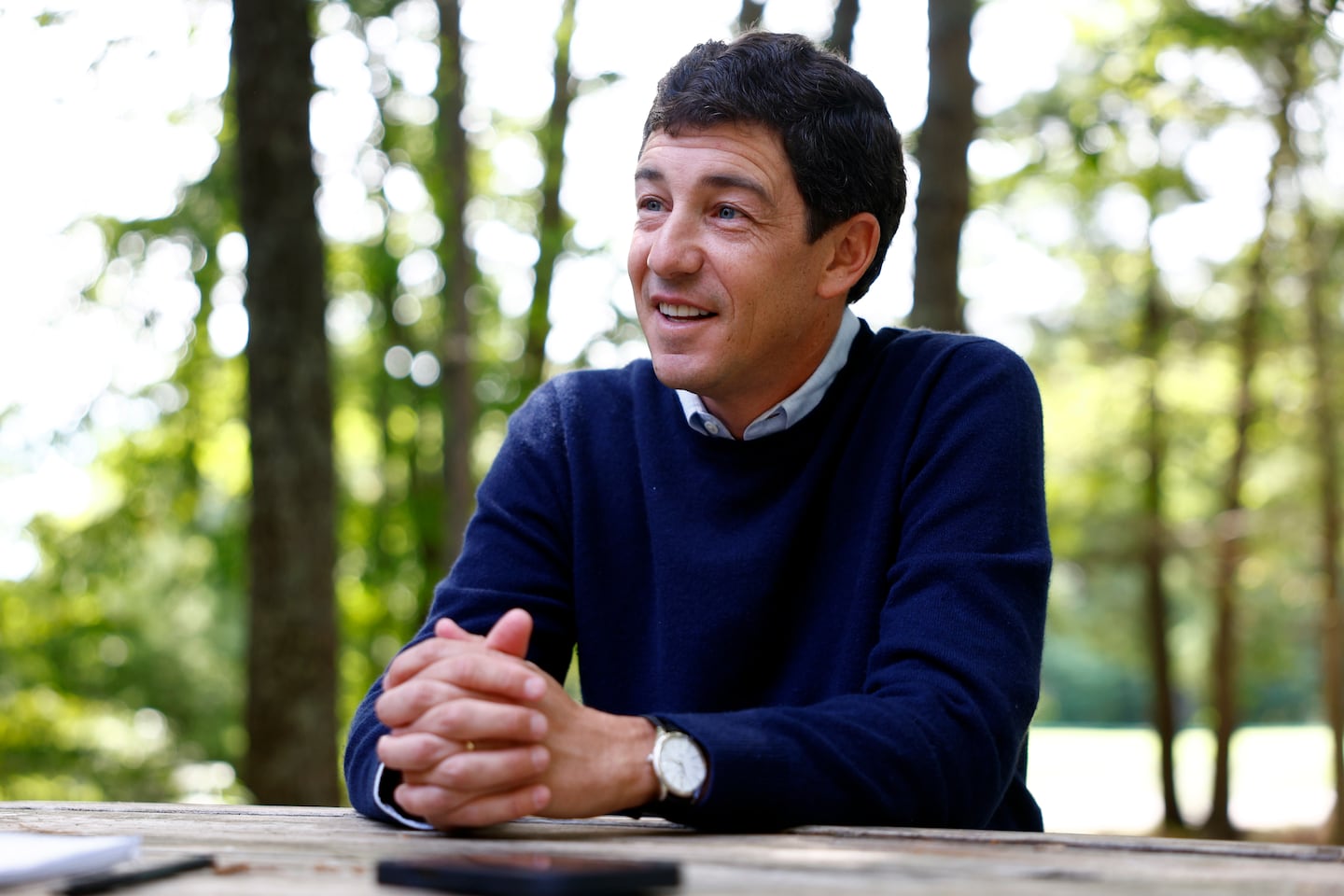
The San Diego native, husband to a Dartmouth graduate and father of three boys, exuded a calm but determined focus speaking with the Globe at a picnic table not far from TPC Boston’s ninth green at the FM Championship on Thursday.
The conversation has been edited lightly for clarity.
Q. It’s your first visit to TPC Boston, what’s your early impression?
A. This place is off the charts. I played in the pro-am yesterday. It was hard, firm, fast, but stunning.
Q. How much golf do you play?
A. I’m a golf nut, always have been, ever since I was a little kid. So when I was younger, we played golf at the local muni, the executive golf course. We didn’t belong to a country club, we started playing at a place called Rancho Carlsbad — we called it the “cow pasture.” There wasn’t a blade of grass on the golf course, and all of the greens looked like domes. Eventually we graduated to a slightly larger executive course called Lake San Marcos, for like, nine bucks. We could play unlimited golf in the summertime. So my buddies and I, our moms would drop us off and they’d pick us up at sunset. The love affair has continued ever since.
Q. You were with Topgolf and PGA of America before this. Was this a job that you pursued or did they come find you?
A. They called me, and to be totally honest with you, it was a job that I wasn’t certain whether I was going to take. There are two reasons for that. One, I have a wife and three boys, 6, 8, and 10, who I’m crazy about. And the demands on this job, while it’s an incredible honor, are very real. We got past that as a family, and I’ll tell you, six weeks into the life adventure, not just for me but for them, it has been worth it.
The second reason is, as an outsider, I genuinely wasn’t sure just how successful the LPGA can be. And I’ll tell you, six weeks in now, I am wildly optimistic about our future.
Q. You’ve spoken about your LPGA vision having four pillars — building trust, increasing visibility, drawing more fans, and building a solid financial foundation. That’s a challenging quartet of goals. Are you tackling them all at once or one at a time?
A. I see just an incredible amount of opportunity. Maybe some might refer to some of those things as challenges, but I see an incredible amount of opportunity in front of us. I think everything starts with trust. If our players, if our sponsors, if our partners trust us and where we’re going, they’ll lean in. And we’ve got some proof points, which I’m sure we’ll talk about. We sold our first tournament, which is a really important tournament to the LPGA, the Founders Cup, we’re taking that to Menlo Park, it’s a multiyear deal.
We have a massive global consulting firm that’s showing up to help us do a piece of research on what our fans tell us, both positive and negative.
Q. Is that a new initiative?
A. Brand new, and that’s the result of a preexisting relationship that was rooted in a deep level of trust. We had a donor step up and make a seven-figure gift to our foundation so that we can continue funding programs like girls’ golf. These have all happened in the last six weeks. All that’s rooted in trust.
I think the fans and visibility — Megan Khang, a Boston native, had this amazing comment [Wednesday], she basically said to New Englanders, “Just come see us.” She’s right. When I took our boys to their first LPGA event, they fell in love, and now they want to watch golf on the weekends, women’s golf on the weekends. The more we can do to give people exposure, the faster they’ll fall in love.
Q. Media deals are part of that exposure, but how about social media and telling stories there?
A. Storytelling is critical. Here’s how I think about it. Think about a Venn diagram with the highest-performing athletes in one circle, the most-marketable athletes in another circle, it’s the folks in the center — we need to create stars out of those women, and hopefully as fans hear their stories and those stories resonate, they’ll continue to tune in, week in and week out, to watch their favorite players.
Q. You can’t authentically create a star, can you, in terms of performance at least?
A. Think about some of your favorite athletes in any sport over the course of your life. There was a combination of those two things. Generally, they weren’t just great athletes, or they weren’t just super interesting personalities, it was the combination of the two that made them so special. It’s our job to identify who those players are and then work with them on a plan to bring those stories to life.
Q. In North America and worldwide, women’s sports is riding a wave — it’s “not a moment, it’s momentum,” right? Where do you see the LPGA on that wave?
A. I think we’re on the precipice of having our breakthrough moment in a really sustainable way. People love our athletes. We just need more people to get exposure to them. And when these athletes become household names, I think what you’re seeing in the WNBA is totally possible for us to have, that kind of breakthrough.
Q. What will it take to follow through on that vision? Is it getting the women’s stories out there? And their talent?
A. What I’m learning is there is no single silver bullet solution, but brick by brick we will get there. So storytelling is a part of it, building into existing associations. We don’t do enough to talk about the colleges that many of our athletes went to, and those colleges already have built in fan bases. We should be tapping into that.
We have 34 events on the schedule. Every one of those sponsors has a platform and a megaphone. We should be leaning into those megaphones in order to expand the reach of the LPGA.
As you think about the quality of the broadcast, we’re lucky to have partners in the Golf Channel who, week in and week out, are looking for ways to elevate the quality of what shows up. My point in mentioning all these things is it’s not just one thing but the culmination of lots of little things that will ultimately get us there.
Q. Is there a women’s league or not just a women’s league, somewhere you can point to and say, “I like how they’re doing it, they’ve done it and this is something we can emulate”?
A. I’ll give you a great example: The WNBA and what [commissioner] Cathy Engelbert has done. She’s leaned into their partners. So now, when you watch commercials on television, often times when you see an NBA player, you see a WNBA player right next to him. One of the ways fans learn about the personalities of athletes is commercials on television. Let’s showcase ours.
Q. The WNBA and NBA have a very close relationship — there’s a lot of investment from the NBA. With the PGA Tour, is there room for more collaboration or a partnership or do you have to do your own thing?
A. Let’s go back to something we talked about a minute ago. I see an unbelievable amount of opportunity in front of us at the LPGA, and the only way we will capture it is by tapping into partners, anybody who’s willing to help us. We can’t wait to have the conversation, and that includes the PGA Tour.
Q. They’ve done a lot of innovation, some of that’s maybe a reaction to LIV and obviously they have TGL and then there’s their new Futures Committee — are they in their own silo or can the LPGA be there, too? Are you thinking of innovating in a similar way or can you join forces and innovate?
A. I think there’s a lot in the question you just asked. Take it any way you want. Yes, innovation is critical to any organization. If you’re not innovating, you’re dying. You know, it’s no different at the LPGA. I think innovations like Topgolf and TGL are critical to growing the game.
If you look at research from the National Golf Foundation, women and girls are the primary engine of growth right now in the amateur game in the United States. Topgolf plays a huge part in that there are more people playing golf off course at places like Topgolf than there are playing on course for the first time in the history of golf. Those things are huge assets to us. If we can tap into that momentum, our tour will certainly benefit.
Q. Is there anything else, like baseball using a pitch clock, anything just obvious that you’d like to see?
A. Totally. Here’s one thing I give the NFL and Major League Baseball enormous credit for. What they’ve recognized is that their primary business is entertainment. If you had told the world five years ago that in extra innings you’d start with a runner on second base, or that there’d be a pitch clock, or that something called a “torpedo bat” would be a thing, the purists would have said, “No way.” And guess what? These things have been introduced, and it’s working. Attendance is up. Viewership is up.
If you had said a handful of years ago in the NFL that the NFL would rethink the kickoff rules and then an extra point would go from 2 yards away to whatever it is now, 15 yards away, the purists would have said, “No way.” But they’ve leaned into the importance of entertainment. We have to do the same here.
Q. Any concrete ideas?
A. I’ll save the concrete ideas for now, but know that we’re working on a few things.
Michael Silverman can be reached at michael.silverman@globe.com.