

As an orthopaedic surgeon, Dr Vonda Wright treats women who are “frail” and “broken”. One was standing at her sink when her hip fractured. Many of her patients are struggling in later life with incontinence, immobility or memory problems. “As women right now,” she says, “we spend the last 20 — sometimes 30 — years of our lives dying.”
Fuelling this suffering is society’s revulsion towards female ageing, including the conviction that as we get older it’s normal for body and mind to crumble. This breeds a “learnt resignation”, Wright says. But she says that if we prioritise mobility, muscle-building, flexibility and hormonal health, it doesn’t have to be that way — and she’s determined it won’t be.
We don’t always help ourselves. Wright sees many “underfed, under-proteined” women. They say, “‘I drink my coffee in the morning, I’ll have a salad at lunch, I may not eat till 2 or 3,’” she tells me, speaking from her clinic in Orlando, Florida. “Our body needs a lot of protein to build muscle. Women have been taught our whole lives, in my generation, to be this big” — Wright pinches thumb and forefinger together — “and the fact is, you have to feed yourself to age well and not to become frail.”
Wright, 58, is impressive. She’s founding director of the Performance and Research Initiative for Masters Athletes, a longevity specialist and recently gave evidence to America’s Food and Drug Administration (FDA) as part of an expert panel on menopause and HRT. She looks robust and fabulous, with jet-black hair, manicured nails. In her new book, Unbreakable: A Woman’s Guide to Ageing With Power, she talks of regaining her “badassery”. It’s hard to believe it ever left.
• What I wish I’d known about my body when I was younger
And yet while her early forties were steel-wrought — triathlons, 19 per cent body fat — the perimenopause hit hard. “At 47 I thought I was going to die,” she says. Her brain was foggy. Her body hurt. She was weaker. “I had back fat hanging out of my bra.”
Well, no longer. Wright has rebuilt herself and so can we all. Unbreakable is a galvanising, meticulously detailed, science-based call to arms — powerful arms — for all women.
Keep moving to shield against the “time bombs” of ageing
Exercise helps defuse the “time bombs of ageing”. Conversely, being a long-term couch potato increases the risk of 33 chronic diseases, such as heart disease, stroke, atherosclerosis, lung disease and metabolic syndrome, Wright says. This is known as “sedentary death syndrome”.

Perform fewer reps with heavier weights
GETTY IMAGES
“There is not an organ system in our body that is not affected by mobility,” she says. Flexing biceps or squatting doesn’t just build muscle, it produces chemicals that help build brain tissue and promote insulin sensitivity.
As for the ageing “time bombs”, they include DNA damage such as telomere shortening — according to Wright just six months of aerobic activity lengthens telomeres, which protect our genetic data. Another is “inflammaging”, chronic low-grade inflammation contributing factors for which can include stress and menopause. For Wright, structured cardio and resistance training, plus an anti-inflammatory diet, are the answer.
• I’m 55, eat well, don’t smoke and exercise. Yet I also have osteoporosis
The third bomb? Dysfunction of the mitochondria. These “power plants” of our cells convert food into energy and if they’re in poor shape, metabolic problems follow. But running, swimming and cycling help create new mitochondria. Another time bomb is cell senescence, where damaged “zombie cells” contribute to inflammation. Just 12 weeks of moderate aerobic exercise can decrease their numbers and improve macroautophagy, our cells’ self-cleaning mechanism, Wright says.
Understand the musculoskeletal syndrome of menopause
In a recent paper Wright defined “the musculoskeletal syndrome of menopause”, joining the dots for the 70 per cent of women who suffer from a host of apparently unrelated symptoms, including joint stiffness, muscle loss and fat gain. Muscle, Wright says, is “the engine that drives your health span”. Not only does it help regulate blood sugar and metabolism, it churns out hormones that protect brain and heart, and helps keep bones strong.
Menopause ratchets up muscle loss (and increases inflammation). “Oestrogen plays a critical role in muscle health and muscle protein synthesis,” Wright says.
Our bones, tendons, ligaments and cartilage are similarly affected by oestrogen’s decline. So less oestrogen in say, cartilage, and women suddenly suffer far more arthritis than men, Wright says. As for bones, they don’t just hold us up, they secrete the hormone osteocalcin, which helps the brain by increasing neurotransmitter production, and aids insulin sensitivity and glucose regulation. Oestrogen is critical for bone and women experience a “precipitous drop in up to 20 per cent of bone density in the five to seven years surrounding menopause”.
• Am I fit for my age? Exercises for your 30s to your 70s
Wright is a big fan of HRT for osteoporosis prevention but it’s not a cure-all, she says. To become strong, she says, “You still must invest in the physical, the nutritional, the social.”
Flexibility is crucial — but Pilates should be the ‘garnish’
Wright prescribes exercise using the acronym FACE (Flexibility and mobility; aerobic capacity; ability to carry a load; and equilibrium and foot speed). Maintaining flexibility should be a “several times a week” practice: stretching helps combat the effects of ageing on tendon and ligaments. Otherwise, she says, “our joints lose mobility, our tendons and ligaments get tighter. It’s why we see people shuffling down the street instead of striding”.
While regular yoga, Pilates and barre improve muscle endurance and prevent stiffness, Wright adds that “they do not create any significant lean muscle mass gain or absolute power”. She describes Pilates as — gulp — “garnish”. “I’m not saying ‘give it up, people’,” she says. “I’m saying, ‘It’s never going to be enough.’”

Even 10 to 20 jump repetitions a day can increase strength
GETTY
Jump around
Jump training (or plyometrics) increases our power, speed and athleticism. Wright says that springing up forces us to use our fast-twitch muscles, which decline with age, and then it “forces us to land”. This signals to the body to build more bone. Some midlife women avoid jumping, often because of pelvic-floor trouble, “But pelvic floors can be retrained”, Wright says.
You don’t have to leap onto a 24in box (as Wright does). Skipping or hopscotch is great, and just 10 to 20 jump repetitions a day can increase bone mass and strength. As a convert to the joys of midlife jumping, I tell Wright that it’s amazing to feel springy as opposed to leaden. “I love that you said that,” she exclaims. “There’s a certain ableness that comes from ‘I can run up those stairs! Getting over this barrier is nothing because I’m jumping!’ It’s mind and body.”
• HRT: what every woman needs to know now
In midlife don’t HIIT it too hard
Too much high-intensity interval training (HIIT) in midlife is counterproductive, Wright says. A 2021 study found that while two to three HIIT sessions per week improved volunteers’ health, when they increased it to five their mitochondria produced less energy, plus they developed impaired glucose tolerance.
In midlife you’re prone to injury from overuse. Plus, Wright says, “because it’s hard, you’ll elevate your cortisol every day”. It can lead to issues such as elevated blood sugar and higher blood pressure. When midlife women tell Wright they exercise daily but are gaining weight, this is often why, she says.
Wright describes exercise in terms of zones one to five, “with zone one being very little effort and zone five being as hard as you can go”. She recommends that 80 per cent of your cardio training is in zone two — you’ll know you’re there if you could manage a phone call, talking in full sentences, but the other person would be able to tell you were exerting yourself.
The remaining 20 per cent of your training should be in zone five. This ratio is great for “metabolic flexibility”. But most people “work in the middle” — around zones three and four, she says. As well as raising cortisol, “It’s not as efficient at maintaining metabolic flexibility. And it doesn’t really recompose their body.”
For her zone two exercise Wright walks on a treadmill at an incline of 5 per cent, at four miles per hour for 45 minutes. Then, “I punch the button up to 11. And I’m just going as fast as my short legs will carry me and not fly off the back.” Try also, bike, rower, sprints, battle ropes — whatever “jacks your heart rate up.” (This is called SIT — sprint interval training). Do this for 30 seconds, then recover over two minutes, and repeat up to four times. With your doctor’s blessing, of course.
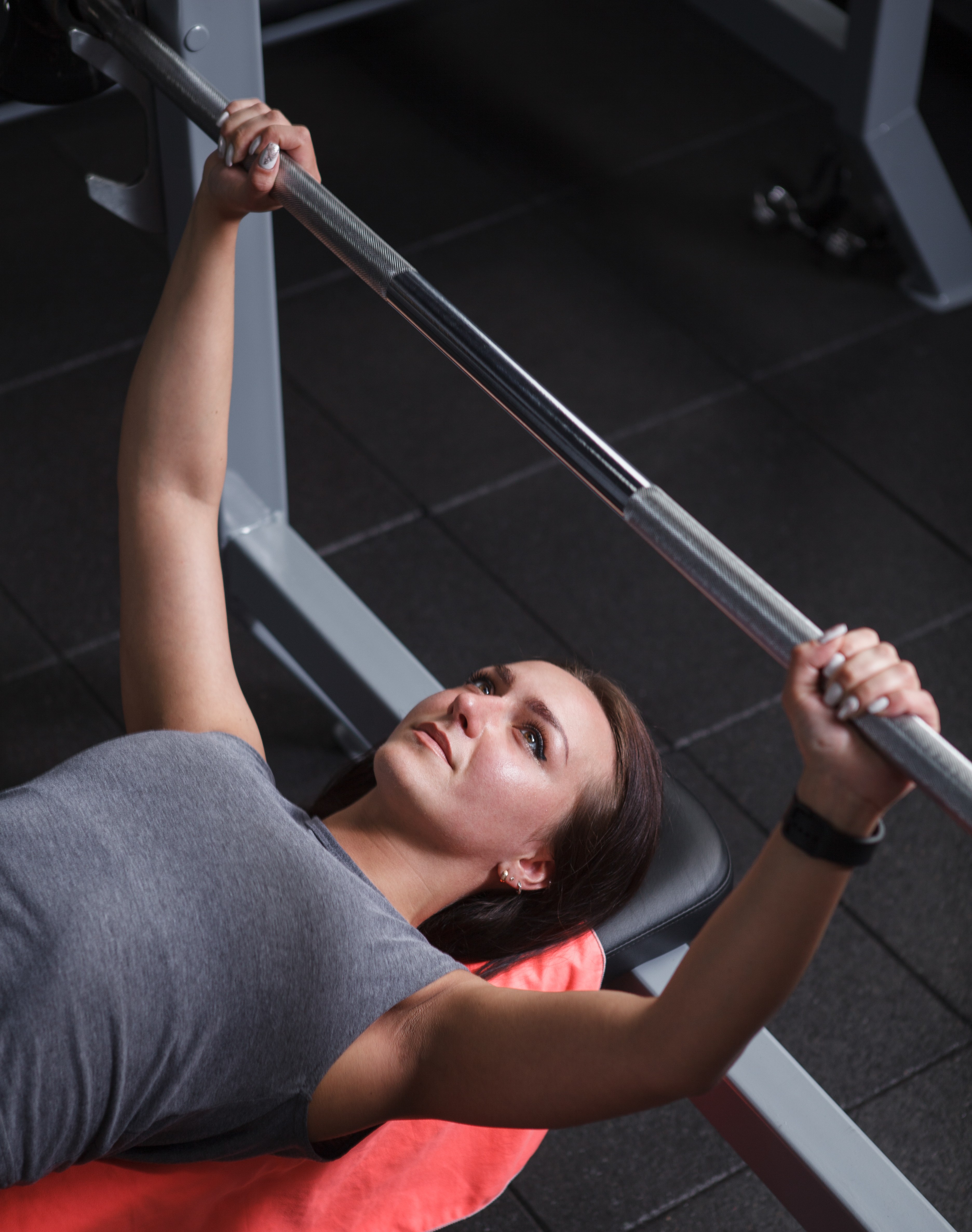
Bench presses: try four sets of four reps using higher weights
GETTY IMAGES
How to lift for power
“I don’t lift weights to look good in my little black dress,” Wright says. “The goal of the way I prescribe lifting is strength — to be able to pick up my 40-pound grandson or to put things away without having to ask the neighbour to come help me, for God’s sake.” Also, “Power to get up off the floor and power to catch myself so I don’t land on the floor.”
• The 7 best exercises to keep your bones strong
This is surely what we all want but will 20 biceps curls with 5kg weights do it? “There are many ways to lift. None of them are wrong. But what is our goal?” Wright says. “Well, if our goal is to build endurance — carry a backpack up Machu Picchu or something — then do exactly what you said: lift the lightest possible weight, the most possible times.” She pauses. “That is not my goal as a midlife woman and beyond.”
To age with max badassery, she says we should do lower reps of higher weights — for example, with bench presses she’d prescribe four sets of four reps. You work almost to failure, meaning, “We could lift a fifth bench press — but we cannot lift six.”
It’s a learnt skill and can take nine months to grasp. “Once we learn to lift heavy, and we feel comfortable, that’s when we can add speed to our lifts,” she adds — so doing a squat, “We go down slow, 1, 2, 3, then we explode up”. This builds power.
Technique is crucial, so it’s worth going all in. “This isn’t the time to ask for a new purse for Christmas again,” Wright says. “Let’s invest in a trainer.”
Unbreakable: A Woman’s Guide to Ageing with Power by Vonda Wright is out now (Vermilion, £20)