
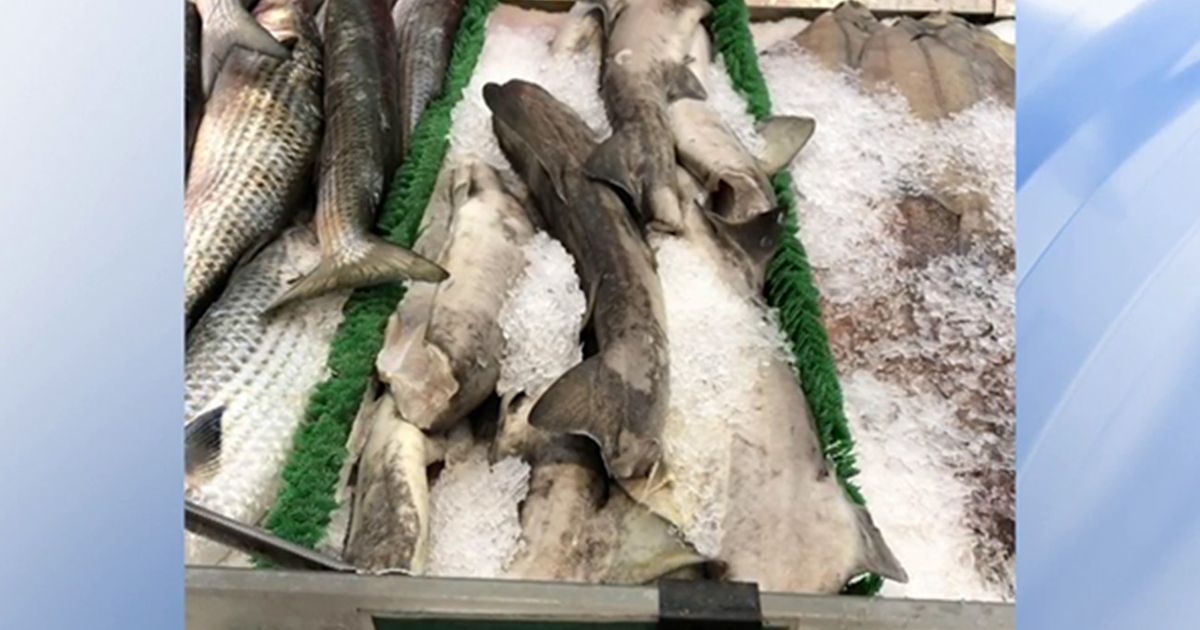
CHAPEL HILL, NC — Research published on Wednesday out of UNC Chapel Hill shows that sharks sold at local grocery stores included endangered species, and other species considered not safe for human consumption. The researchers hope their findings will lead to legislative action to tighten state laws around seafood labeling.
Savannah Ryburn, a recent PhD graduate from UNC who is the lead author of the study, said the issue is twofold: Some of the sharks purchased by students in the class she helped teach were mislabeled as the wrong species of shark, and, oftentimes, the shark was labeled only as “shark,” which she says is too generic.
“It doesn’t give consumers the choice for what they’re actually going to consume,” Ryburn explained.
The research was completed as part of a class project at UNC, where students were asked to go to area grocery stores and purchase shark. The students then DNA tested more than two dozen samples of shark.
“We found multiple critically endangered species, three to be exact,” she continued. “The scalloped hammerhead, the great hammerhead, and the taupe shark. We also found species that are incredibly high in mercury that are recommended not to be consumed by humans, which are the larger hammerhead sharks, and then also that could endanger people who are pregnant with the high mercury content, like dogfish.”
John Bruno, a UNC professor, explained that mislabeling and generic labeling are not issues with sharks alone. He hopes state lawmakers will enact legislation to require more precise labeling of all seafood.
“We would really like to see all seafood labeled specifically to species, so the consumers at least know what species they’re buying when they purchase seafood,” he said. “The second is, it needs to be accurately labeled.”
It is unclear where in the process, from ocean to store, the mislabeling occurs.
WRAL Investigates previously worked with Bruno’s class to test sushi purchased at local grocery stores and restaurants. Then, the DNA test also showed some of the sushi was not what it was labeled as, and some, not even advertised to contain shark, came back as endangered shark, too.
“During that sushi experiment, we found scalloped hammerhead shark in the sushi, which was very surprising,” Ryburn recalled. “Because usually sushi isn’t labeled as having shark in it. It’s concerning to see that it’s not only being generically labeled as shark and sold at the seafood counters, but it’s also being completely mislabeled in dishes that are being served to people, and they have no idea that they are consuming shark.”
WRAL Investigates contacted state House and Senate leadership to ask if they would consider proposing legislation to strengthen seafood labeling laws, but has not yet received a response.
“It’s very concerning going out and buying something to eat as a consumer and not actually knowing what you’re going to consume,” Ryburn said.