

New federal data shows Mainers’ incomes rising more slowly than in the rest of the country, even as regional inflation outpaces the national rate.
That means the state’s residents are seeing steeper price hikes for housing, energy, groceries and clothing than other parts of the U.S., but with less additional money to pay for them. Although Mainers are being particularly squeezed, earnings are still keeping pace with climbing prices here.
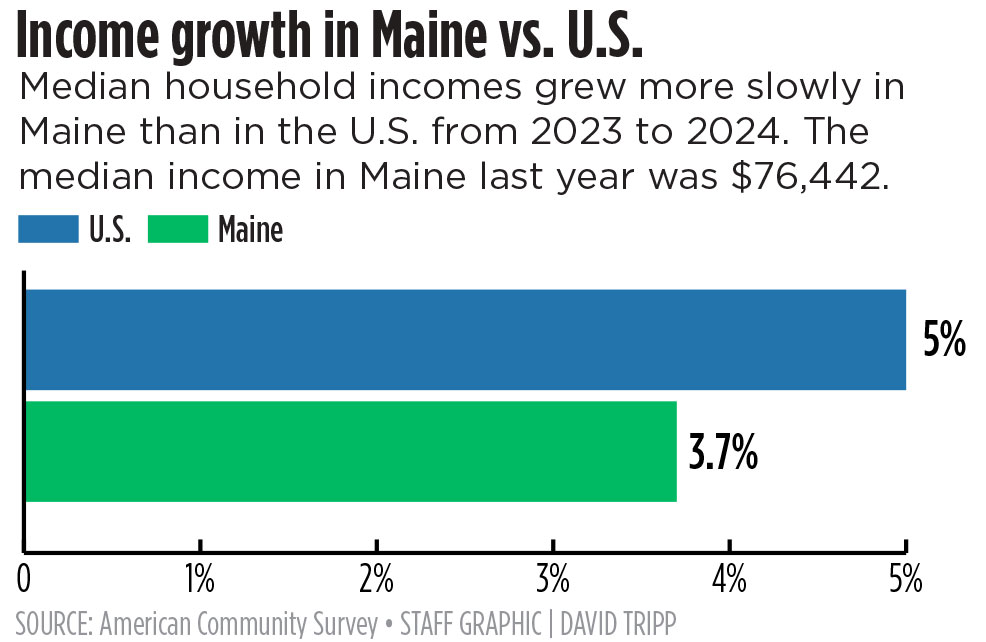
The median household income in Maine was $76,442 last year, up about 3.7% from $73,733 in 2023, according to the results of the latest American Community Survey, released by the Census Bureau on Thursday. The national median household income rose about 5%, from $77,719 to $81,604.
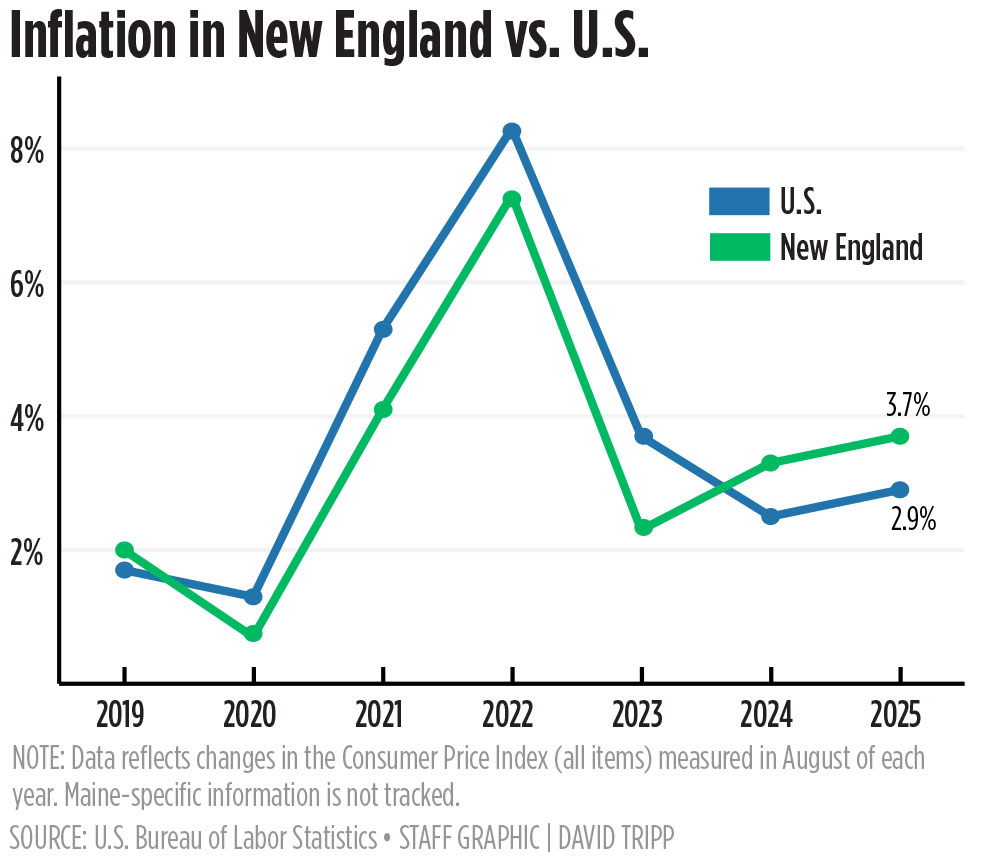
At the same time, inflation in New England has been higher than the rest of the country since 2023, according to data from the Bureau of Labor Statistics (which does not track state-level information for Maine). Consumer prices in the region rose about a percentage point more than the national figure each of the last two years. From 2023 to 2024, the increase in New England was 3.3% compared to 2.5% nationally. Both have risen since then.
Accounting for inflation, Maine and 20 other states saw no statistically significant change in income from 2023 to 2024, according to the Office of the State Economist.
Office spokesperson Sharon Huntley noted that Maine’s older population means relatively fewer people are earning wages, and the state generally has smaller household sizes, partly because of older adults living alone. That can skew the median income, which represents the middle of all households.
“The largest contributor to inflation recently has been shelter, and housing prices have continued to increase faster in Maine than in much of the U.S. as we continue to be challenged by an imbalance between supply and demand for housing,” Huntley wrote in an email.
Patrick Woodcock, president of the Maine State Chamber of Commerce, partly echoed that sentiment. He said the consumer price index, which is used to calculate inflation, is largely driven by factors like labor availability and the costs of housing and energy, which are already pain points in Maine’s economy.
“The housing issue has continued to really put pressure on CPI, and that erodes disposable income. And the Northeast has really continued to have an acute housing shortage,” particularly in Maine, he said.
Home prices fell slightly in July, the latest month for which data is available, with the median sale price ticking down to $419,950, according to the Maine Association of Realtors. But with a 5% year-over-year price hike, statewide home value increases far outpaced the national average of 0.3%.
“Yes, it is a kind of slowing (the) housing market,” Woodcock said. But any decline in values “really has not occurred at the level that we’re seeing nationally.”
MAINE AS AN OUTLIER
Woodcock pointed to Maine’s lower-than-average labor participation rate, which measures the number of working-age people employed or seeking employment compared to the total population.
Maine saw 59.9% participation in July, the lowest in New England, according to the latest available data from the Federal Reserve Bank of St. Louis. Meanwhile, the national rate was 62.2%; neighboring New Hampshire saw 66% participation.
James Myall, an analyst with the Maine Center for Economic Policy, said it is important to distinguish between median income and average earnings from wages, rather than supplemental sources like Social Security or retirement benefits. Wage earners contributed to just under three quarters of all Maine households in 2024.
Average household wage earnings went from $97,997 in 2023 to $104,743 the following year — a roughly 6.9% jump, the survey shows. The survey does not include the median figure for wages, and the mean growth is not necessarily evenly distributed among earners.
“My takeaway from it is that the labor market in Maine is still pretty strong and people who are able to take advantage of that are doing relatively well,” Myall said. “But then, I think, you’ve got a group of folks who aren’t able to take advantage of that labor market in that same way.”
Myall said the retrospective data appears to reinforce beliefs that last year’s economy was “doing pretty well,” though core costs like rent and groceries still meant tightened belts and higher stress for many Americans.
But underwhelming job creation and rising unemployment, coupled with the long-awaited impacts to prices of President Donald Trump’s tariffs, could mean a weaker economic outlook in the longer term, he said.
“Unsatisfying as the 2024 economy might have felt, I’m worried that (2025 and 2026 are) going to feel even worse,” Myall said. “We’re at a real risk, I think, of folks being squeezed at both ends.”
MINIMUM WAGE UPPED
Matt Schlobohm, executive director of the Maine AFL-CIO, which represents more than 40,000 workers in the state, said residents are feeling price hikes in “big-ticket” items like housing and tuition, while also getting pinched with day-to-day purchases like gas and groceries.
“I think of it as like an inflation sandwich,” Schlobohm said. “We are a paycheck-to-paycheck state, and a lot of people are struggling.”
Beyond measuring current inflation, the consumer price index carries direct effects for things like Maine’s minimum wage and Portland’s allowable rent increase each year.
Also on Thursday, the Maine Department of Labor announced a new minimum wage for 2026: $15.10, up from the current $14.65. That figure is pegged to the federal cost-of-living index and must grow at the same rate (rounded to the nearest 5 cents).
About 5% of Maine’s wage-paid and salaried workers made less than $15 per hour last year and will see their wages rise with the minimum, the department said. But Schlobohm said the new minimum could also create pressure in the overall labor market and help drive up wages for those making a little more.
“A lot of workers that we all rely on will see a slight uptick, an increase in their pay,” he said.
Portland rent hikes are capped at 70% of the annual consumer price index change for the Greater Boston Metro Area. That means increases will be capped at 2.2% in 2026, down slightly from this year’s 2.5%.