
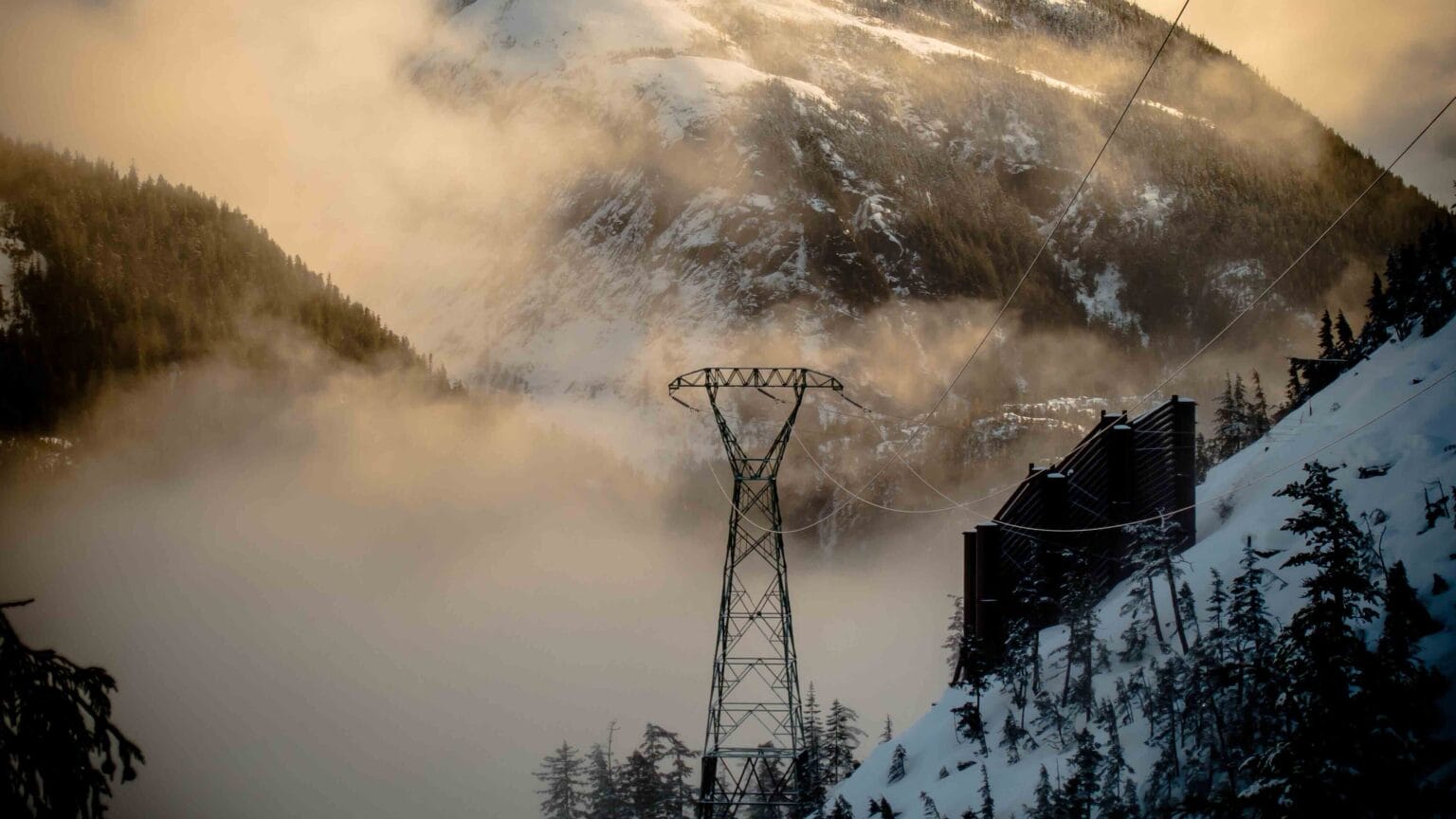
A tower and avalanche diversion wall on the Snettisham transmission line. (Photo courtesy of Mike Janes/AEL&P)
Juneau might lose its ability to say that its electricity is created entirely by renewable hydropower if the Alaska Industrial Development and Export Authority, or AIDEA, prevails in a lawsuit over the ownership and sale of renewable energy credits created by the Snettisham Hydroelectric Project, which currently supplies two-thirds of Juneau’s electricity.
Renewable energy credits, known as RECs, are much like carbon credits. Utilities that burn fossil fuels can buy them to say they’re powered by renewable energy, allowing them to claim carbon emissions reductions.
But, once sold, the utility that generates the renewable power — in this case Alaska Electric Light & Power, or AEL&P — could no longer claim it produces entirely renewable energy. The City & Borough of Juneau, along with businesses and nonprofits that use this power, would lose the claim too.
Randy Ruaro, the executive director at AIDEA, said selling the credits is a way for the state to make money.
“Frankly, it was an oversight, I guess, by previous AIDEA staff and employees to recognize that this opportunity was out there,” he said. “But once it came to our attention, we’re obligated to take steps to create and generate revenue for AIDEA and for the state of Alaska treasury.”
Exactly how much revenue the agency could make is unclear. On the open market, RECs are priced at anywhere from $1 to $700 per megawatt hour. Snettisham produces roughly 281,000 megawatt hours annually and AEL&P estimates the credits would sell for between $281,000 and $421,500.
Although the dispute comes down to who gets to say what — in essence, a matter of reputation — the impact of selling the credits could be financially detrimental for those who use the claim in Juneau.
Steve Behnke is a founding board member of Alaska Heat Smart, a nonprofit that’s rolling out a program to install 6,000 heat pumps in homes across coastal Alaska. He also leads Renewable Juneau, a nonprofit that advocates for clean energy.
“Renewable Juneau and Alaska Heat Smart have created the Alaska Carbon Reduction Fund, which raises money by saying that we’re using this nice clean hydroelectricity, a renewable resource, to put heat pumps in low-income Juneau homes, saving them 50% on their heating bills, and demonstrating a reduction in carbon emissions,” he said.
The program is funded by a $38.6 million dollar federal grant. Behnke said that if AIDEA is allowed to sell the credits outside of Juneau, then local nonprofits would lose their claim to renewable power, making them less competitive in seeking grants that score project applications based on clean energy.
Robert Barr, Juneau’s deputy city manager, echoed Behnke’s concern.
“I certainly understand (AIDEA) wanting to bolster their bottom line, but in this case, they’re doing that at our expense, and that is certainly frustrating,” Barr said.
Barr called the sales proposal short-sighted and said AIDEA didn’t consult with the city before starting the process.
Greens Creek Mine, the largest silver mine in the country that’s located near Juneau on Admiralty Island, runs partially on surplus hydropower supplied by Snettisham through an agreement with AEL&P. Hecla, the company that owns the mine, claimed a 38% decrease in greenhouse gas emissions between 2019 and 2024. Last week, Hecla filed a complaint against AIDEA, asking the Regulatory Commission of Alaska to determine that AIDEA doesn’t own the renewable energy credits and therefore can’t sell them.
On Thursday, AEL&P filed a lawsuit against AIDEA alleging the same thing. Although AIDEA owns the Snettisham Hydroelectric Project, it long ago sold the power generation rights to AEL&P.
In the court filing, AEL&P asserts that any renewable energy credits created at Snettisham should belong to the utility, not AIDEA.
Most states have laws governing how renewable energy credits are created, traced and transferred. The Alaska Legislature considered a bill a few years ago that would have done that, but it didn’t make it out of committee, leaving it unclear how renewable energy credits work here.
Alec Mesdag, the CEO of AEL&P, said the utility looked into the credits a while ago and decided not to pursue selling them.
“It’s been something that has just provided substantially more value than what we would obtain by selling the RECs to someone who doesn’t live here at all,” he said.
Mesdag said the credits make more sense for energy grids that have a mix of power generation. Utilities buy and sell them to meet renewable portfolio standards set by state laws — but Alaska doesn’t have one of those laws either.
Now it’s up to the Alaska Superior Court to decide whether Juneau’s only operating electric utility owns the renewable energy credits that until now, local businesses and nonprofits believed they could claim. The court issued a temporary restraining order on Friday preventing the sale of RECs until the issue can be discussed in court. A hearing will be held Sept. 18.