
COLUMBUS, Ohio — Ohio gives away more than $12 billion a year in tax breaks — revenue the state chooses not to collect — yet those breaks rarely face the same scrutiny as spending on schools or health care.
The list includes everything from the quirky “Bambi exemption” for building deer enclosures to basics like no sales tax on food or prescription drugs. It even stretches to the “Les Wexner credit” on conveyor belts.
In all, Ohio has 177 tax exemptions, credits, and deductions, according to a new report by Policy Matters Ohio, a left-leaning, non-profit policy research group.
“This is an enormous amount of revenue,” Policy Matters Ohio research director Zach Schiller said. “No one is saying it should all be eliminated. We’re saying some of it is special interest breaks that are not necessary.”
And on that point, Republican leaders in the legislature agree.
Big ticket breaks
While Ohio’s tax breaks are estimated at more than $12 billion this year, the report projected they would cost $16.4 billion in the 2026–27 budget period.
The vast majority of that — about 95% — comes from the top 10 breaks.
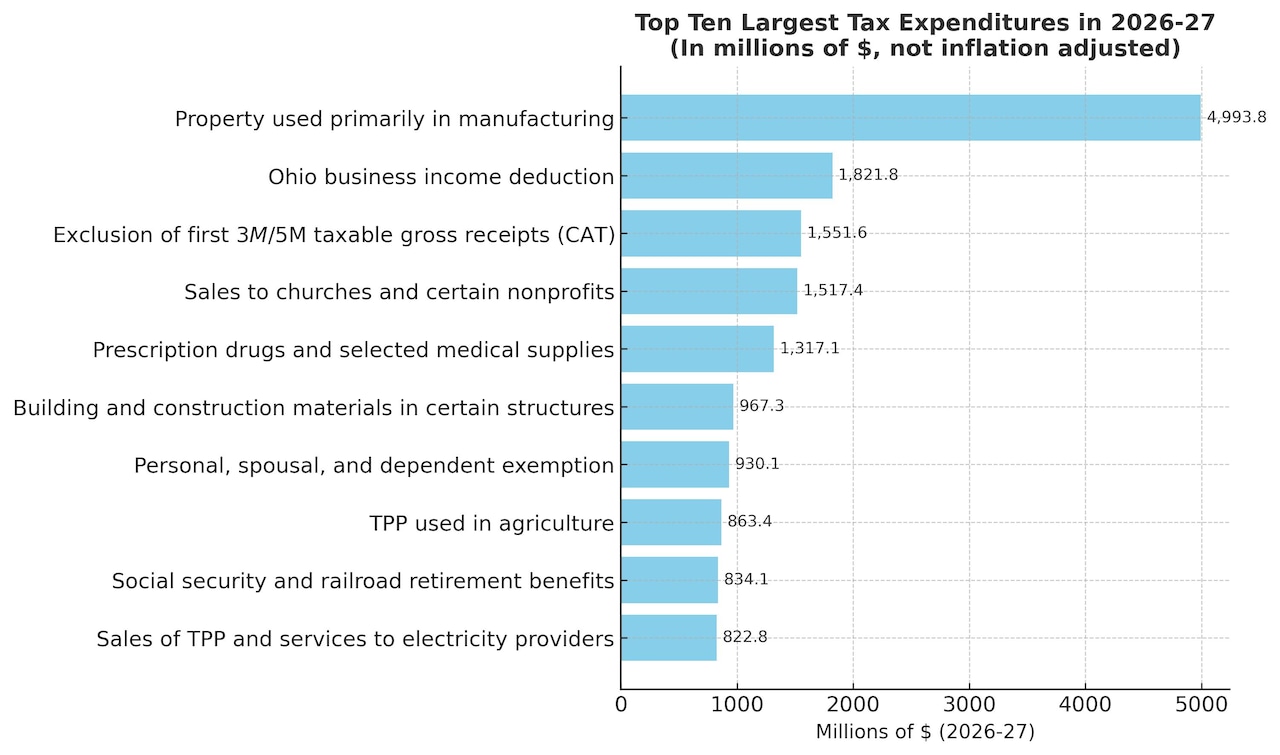 These are the top ten largest tax breaks in Ohio’s 2026-27 budget. Figures come from the Ohio Department of Taxation’s fiscal year 2026-27 Tax Expenditure Report.Anna Staver
The top three tax breaks make up about half the total, and all of them go to businesses.
The largest is a tax exemption for property used in manufacturing, worth nearly $5 billion over the next two years.
Before 2005, local governments could tax businesses on the value of the physical stuff inside their buildings — things like machinery, furniture, and supplies. Those levies, known as tangible personal property taxes, had long been a funding source for public schools.
Lawmakers scrapped the tax and replaced it with the Commercial Activity Tax, or CAT. The idea was to create a more business-friendly system while still keeping schools whole.
“It never brought in anywhere close to as much as the tax it replaced,” Schiller said.
Now, it’s worse.
In the 2023 budget, lawmakers raised the threshold so only companies with more than $6 million in annual Ohio sales owe the tax, up from $1 million, and scrapped the minimum payments smaller businesses once made.
Those changes turned the CAT exclusion into Ohio’s third-largest tax break, costing more than $1.5 billion.
A 56% increase from $960 million, Ohio chose not to collect during the last budget cycle.
“Business,” Schiller said, “is paying a much lower share of the overall freight than it did decades ago.”
The quirky carve-outs
Not every tax break runs into the billions. Some are smaller, more unusual, and have caught the eye of lawmakers in both parties.
One is the so-called “Bambi exemption.” Originally created to cover building materials for certain facilities, it was broadened in 2011 to include captive deer, horse barns and even fish farms.
A 2018 analysis by the National Conference of State Legislatures noted that Ohio was the only state in the region with this kind of carve-out.
There’s also the “Les Wexner credit.”
It was created in 1994 when the clothing retail magnate and founder of L Brands operated massive warehouses with extensive conveyor systems.
Companies that shipped part of their products outside Ohio didn’t have to pay sales tax on that equipment, a carve-out that Schiller said directly benefited Wexner’s operations.
The legislature also did something similar for Avon Products in 2008. According to a report from Policy Matters Ohio, the company got a “sales-tax break on machinery, equipment and software purchased for the warehouse, saving the company at least $3.47 million.”
Other breaks are more familiar.
Ohio’s back-to-school sales tax holiday, once a three-day event for school supplies, is now two weeks and covers most goods people buy.
The state exempted children’s diapers from sales tax in October 2023. That decision costs Ohio about $19 million per year.
It’s not that all tax breaks are bad. But every tax break granted by the state is a choice that confers a benefit to groups or individuals while forgoing incoming revenue that could benefit all.
Ohio forgoes more than $1 billion by not taxing prescription drugs and selected medical supplies. We also give up hundreds of millions by exempting Social Security benefits and by allowing couples to file their taxes jointly.
But whether a tax break is a public good or a special-interest perk often depends on who you ask.
Sen. Jerry Cirino, a Lake County Republican and chair of the Senate Finance Committee, tried to eliminate the sales tax exemption for newspapers in the latest budget.
Gov. Mike DeWine vetoed it.
Budgetary changes
In the latest budget, lawmakers limited or repealed nine tax breaks worth $325.5 million.
That included capping the “vendor discount,” which had let big retailers pocket millions just for sending sales taxes they are required to collect to the state on time, and ending smaller carve-outs like exemptions on refrigerated vending machines and call center services.
They also tried to scrap the sales tax exemption for data centers, one of the state’s fastest-growing breaks.
Policy Matters estimated it will cost nearly $290 million or more if new projects move forward during the next biennium.
“In many cases, the exemption amounts to as much as $1 million for each data-center job created,” according to the report.
Cirino said the industry doesn’t need the help.
“I was very much in favor of eliminating that,” he said. “Data centers have a lot of great reasons to come to Ohio. This tax exemption shouldn’t be one of them. I don’t think we need this to be competitive.”
DeWine vetoed the measure.
House Speaker Matt Huffman, a Lima Republican, told reporters he’s considering overriding that veto and that many of these companies already benefit from generous property tax abatements.
Who is watching the store?
Cirino and Schiller don’t agree on much when it comes to taxes, but both say Ohio needs a more public, permanent way to review which tax breaks make sense — and which don’t.
Until four years ago, Ohio was among the majority of states with a formal review process.
We created the Tax Expenditure Review Committee in 2016, which was supposed to regularly evaluate costs, benefits, efficiency, and whether they changed business behavior.
But the promise of oversight quickly fizzled.
The committee reviewed just 15 sales-tax breaks, and in eight cases, no one showed up to testify in support.
“They should have been truncated or eliminated,” Schiller said. “They certainly shouldn’t have been continued without any changes.”
But they were.
Lawmakers eliminated the committee in the 2022-2023 budget.
Cirino said every tax break should come with an expiration date.
“If they are worth continuing, they need to be re-justified,” he said. “I think it would take the heat off lawmakers locally.”
In the end, both men are calling for the same thing: treating lost revenue with the same scrutiny as state spending.
If you purchase a product or register for an account through a link on our site, we may receive compensation. By using this site, you consent to our User Agreement and agree that your clicks, interactions, and personal information may be collected, recorded, and/or stored by us and social media and other third-party partners in accordance with our Privacy Policy.