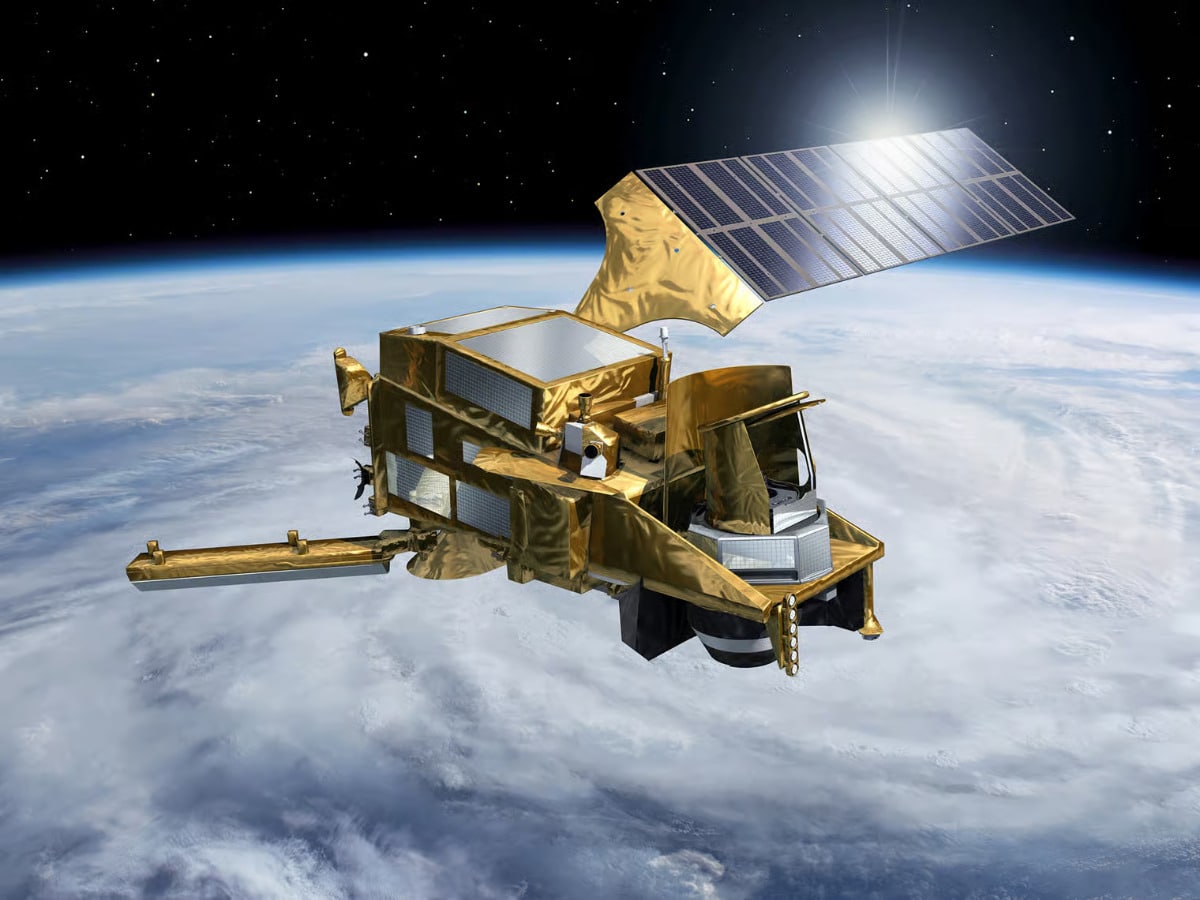
Europe’s newest weather satellite, Metop-SGA1, is now in orbit—and it promises to transform how we predict the weather and monitor climate change. Flying more than 800 km above Earth, this second-generation satellite will work in tandem with its predecessor, Metop-C, to deliver more precise, stable, and continuous observations. For Eumetsat, Europe’s weather and climate data agency, it’s a major step forward.
After its successful ride on Ariane 6, Metop-SGA1 went through the standard early orbit sequence: separation from the rocket, deployment of solar panels, propulsion activation, altitude control, and orbital maneuvers. Now under Eumetsat’s control, the satellite is preparing for full operation. Within a year, most instruments should be active, though they’ll phase in gradually.
And here’s a first: Metop-SG satellites are designed with controlled reentry, thanks to triple fuel reserves. That means they’ll never become space junk—a first for this class of spacecraft.
Tonight, we ushered in a new era of weather and climate monitoring.
Europe’s first MetOp Second Generation, MetOp-SG-A1, weather satellite – which hosts the Copernicus Sentinel-5 mission – successfully launched aboard an Ariane 6 rocket from Europe’s Spaceport in French Guiana… pic.twitter.com/PNEUcfNQfj
— European Space Agency (@esa) August 13, 2025
Why Metop matters
Launched in 2006, the original Metop-A introduced IASI, the first operational infrared hyperspectral sounder. This instrument revolutionized forecasting by providing 8,000 channels of data on temperature, humidity, and wind. Today, Metop satellites contribute to about 25% of the global reduction in forecast errors, more than any other single satellite mission.
The new generation, Metop-SG, is built to push those advances even further.
What’s new in Metop-SG
According to Paul Counet, Director of Strategy at Eumetsat, the upgrades are significant:
The 3MI polarimetric imager, a first-of-its-kind optical instrument for measuring aerosols and cloud properties.
Two microwave imagers: MWI for precipitation and ICI for detecting ice clouds at extremely high frequencies.
IASI-NG, the next generation of the groundbreaking infrared sounder, now capable of detecting pollutants and trace gases that were previously hard to measure.
Together, these tools provide an unparalleled look at the atmosphere, from UV to thermal infrared.
Read about the mission in our article https://t.co/YfEOxlPmhj
— Copernicus ECMWF (@CopernicusECMWF) August 13, 2025
How this changes forecasts
The synergy between Metop-C, Metop-SGA1, and their advanced instruments creates a more complete picture of Earth’s radiative balance—the energy exchange driving global weather. These satellites don’t just monitor temperature and humidity. They track air quality, aerosols, greenhouse gases, volcanic ash, and dust, providing data critical for both day-to-day forecasting and long-term climate science.
With Sentinel-5 on board, Metop-SGA1 will map carbon dioxide, ozone, water vapor, and other trace gases at unprecedented resolution—down from 40 km to just 7 km.
That level of detail matters. It helps scientists refine weather models, understand atmospheric chemistry, and connect air quality to human health and the impacts of climate change.

Rémy Decourt
Journalist
Born shortly after Neil Armstrong’s first steps on the Moon in 1969, my journey into space exploration has been entirely self-taught. A military stay in Mururoa sparked my formal education in space sciences, and early sky-watching experiences in an astronomy club ignited my passion. I founded flashespace.com, transitioning from sky observation to a deep interest in space missions, satellites, and human and robotic exploration. Since 2010, I’ve been part of Futura’s editorial team, covering space news and working as a freelance writer with extensive international field experience in space-related sites.