
The project started last year and has enrolled 61 households so far, with a goal of eventually reaching 120 homes. For now, the study is only enrolling Clayton, Cobb, DeKalb, Fulton and Gwinnett county residents, like Tessa Horehled.
Horehled lives in a 100-year old home in Westview, a few miles west of downtown Atlanta, and has asthma, a condition that can be exacerbated by extreme heat and poor air quality. With an infant at home, too, she said she decided to participate to understand her “baseline” exposure.
The project started last year and has enrolled 61 households so far, with a goal of eventually reaching 120 homes. For now, the study is only enrolling Clayton, Cobb, DeKalb, Fulton and Gwinnett county residents, like Tessa Horehled.
Horehled lives in a 100-year old home in Westview, a few miles west of downtown Atlanta, and has asthma, a condition that can be exacerbated by extreme heat and poor air quality. With an infant at home, too, she said she decided to participate to understand her “baseline” exposure.
“I’d love to … use it as something to keep in mind when I’m making decisions,” she said. “Like, do we want to take a bike or drive here?”
“I’d love to … use it as something to keep in mind when I’m making decisions,” she said. “Like, do we want to take a bike or drive here?”
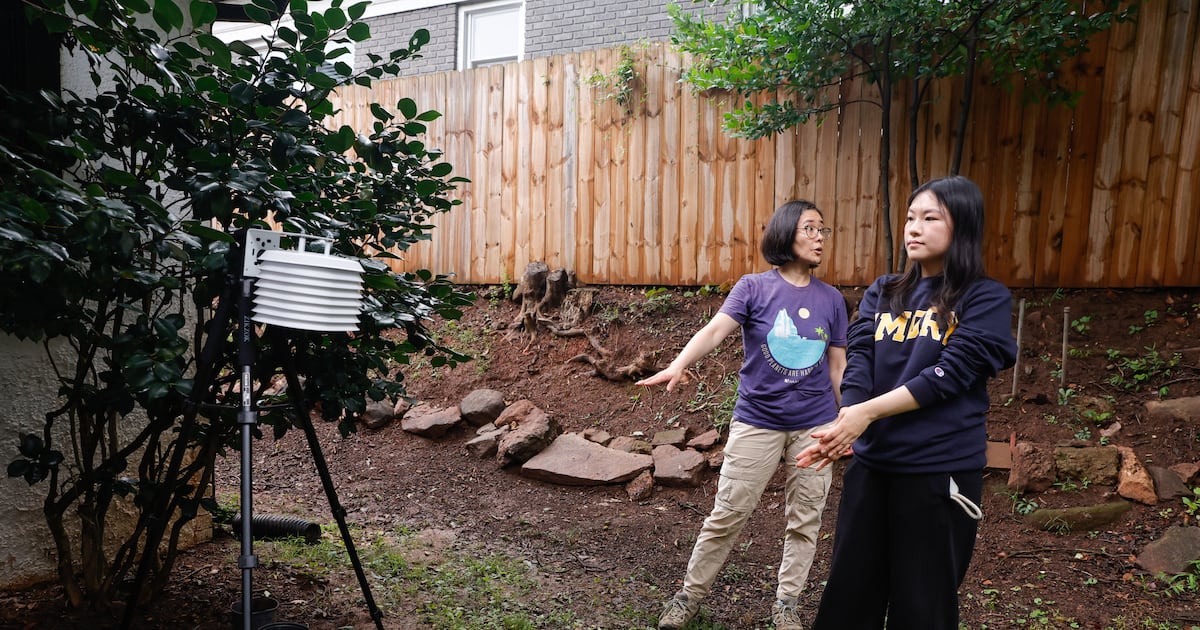
On a Tuesday in August, Emory environmental science professor Eri Saikawa and public health associate Jiyoung Hwang, installed sensors at Horehled’s home to begin gathering data.
To document outside heat and humidity, Saikawa and Hwang unfurled a tripod-mounted sensor in her backyard. Inside, they had Horehled place another monitor in her bedroom. Combined, the heat and humidity readings are used to calculate the heat index, Saikawa said, a measure of what it actually feels like inside and outside the home.
“We have a lot of data on the ambient temperature, but we don’t really know what’s indoor and what’s personal,” said Saikawa, the project’s lead researcher. “And for extreme heat, personal exposure is very important.”
On a Tuesday in August, Emory environmental science professor Eri Saikawa and public health associate Jiyoung Hwang, installed sensors at Horehled’s home to begin gathering data.
To document outside heat and humidity, Saikawa and Hwang unfurled a tripod-mounted sensor in her backyard. Inside, they had Horehled place another monitor in her bedroom. Combined, the heat and humidity readings are used to calculate the heat index, Saikawa said, a measure of what it actually feels like inside and outside the home.
“We have a lot of data on the ambient temperature, but we don’t really know what’s indoor and what’s personal,” said Saikawa, the project’s lead researcher. “And for extreme heat, personal exposure is very important.”