
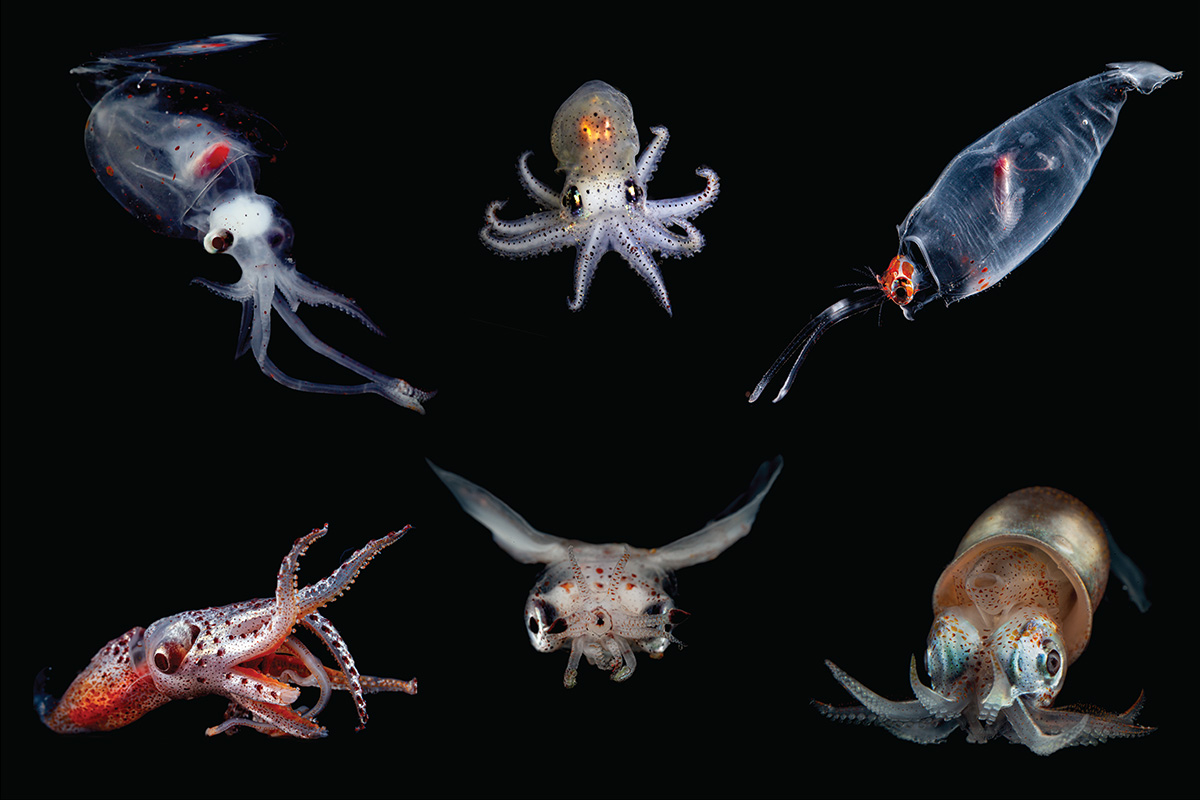
The Pacific Islands Fisheries Science Center recently archived more than 700 fish and squid specimens at the Smithsonian Institution’s National Museum of Natural History. Science Center researchers collected the specimens during research surveys. This collaborative effort will support genetic research efforts for generations and help scientists better understand and sustainably manage marine species in the Pacific.
Collaboration
In June 2025, Dr. Matt Girard, a zoologist and visiting scientist from the Smithsonian, collaborated with NOAA’s Dr. Jonathan Whitney and research scientists from the Pacific Islands Fisheries Science Center in Honolulu. The center houses a vast collection of marine specimens, including fish and cephalopods, collected over decades through research surveys and NOAA’s Observer Program. To support long-term preservation and enhance genetic reference libraries, the Smithsonian offered to take custody of select specimens from the collection.
Smithsonian’s Dr. Girard (center) teamed up with Dr. Jonathan Whitney and PIFSC Scientists to prepare samples to ship to the Smithsonian’s National Collections for archiving and genome sequencing. Thanks to NOAA Fisheries scientists Joe O’Malley, Andrea Schmidt, Nan Himmelsbach, Jim Ruzicka, Johanna Wren, Phoebe Woodworth-Jefcoats, and Ryan Rykaczewski, as well as to volunteers Bruce Mundy, Cassie Ka’apu-Lyons, Bob Humphreys, and Hollings scholars Emma Scott-Wellman and Ligaya Manalastas, for their invaluable help in preparing specimens. Credit: NOAA Fisheries/Emma Scott-Wellman
Specimens Taken to the Smithsonian
The collection included:
NOAA Fisheries staff, interns, and volunteers carefully processed, preserved, and packaged the specimens. They then shipped them to the Smithsonian. Many have already been cataloged into the National Collections and will serve as the genetic standard for their species in our region.
Photos of common prey fish, collected during NOAA Fisheries surveys. High quality images of freshly caught animals provide a valuable reference for the future, complementing the preserved specimen, which will lose color and look dead. Credit: NOAA Fisheries/Jonathan Whitney
Advancing Genetic Reference Libraries
Along with preserving the physical specimens, Smithsonian scientists will sequence more than 600 tissue samples and make them publicly available to create genetic reference data. This work is part of a larger effort by NOAA Fisheries, the Smithsonian, and NOAA’s National Systematics Lab to build a comprehensive DNA reference library for species found in the U.S. Exclusive Economic Zone.
Dr. Matt Girard takes a tissue sample from a fangtooth fish. DNA will be extracted from that tissue and used to sequence the genome, which will be released on public databases. Credit: NOAA Fisheries/Jonathan Whitney
These genetic libraries are crucial for modern research tools like environmental DNA and metabarcoding. These techniques detect species by analyzing tiny DNA fragments that animals leave behind. There have been significant increases in the incorporation of eDNA tools into marine surveys in the last decade as the potential of this data source is realized. eDNA can detect the presence of species even when the individuals are not “seen” (i.e., visually sighted, caught, or heard). This can increase the accuracy of fish and protected species distribution maps, and shed light on hidden parts of marine ecosystems.
eDNA can also be used to estimate a species’ abundance, an important input to stock assessments. Metabarcoding techniques can be used to identify prey items in a predator’s stomach, which inform food web studies that are an essential part of ecosystem models. Accurate species identification from an eDNA or stomach sample requires well-developed specimen-based genetic databases to compare new genetic information against.
By expanding these DNA reference libraries, we are laying the foundation for improved marine biodiversity monitoring and sustainable fisheries management.
Filling in Data Gaps
The collection significantly improves genetic data coverage for fish and cephalopods (squid and related species). Until now, only one-third of fish and 1 percent of cephalopod species recorded in the Hawai‘i region had a genetic reference sequence linked to a specimen in a museum collection.
By adding 267 squid specimens from lancetfish stomachs and another 408 fish and squid specimens from the 2024 cruise, scientists are filling major gaps. These samples will be sequenced and provide gold-standard genetic references for most North Pacific fish and cephalopods. These libraries provide the information needed to identify fragments of DNA to species.
Specimens are carefully processed and packaged for transport from Honolulu to the Smithsonian’s National Museum of Natural History in Washington, D.C. Credit: NOAA Fisheries/Jonathan Whitney
A Team Effort with Lasting Impact
This project involved many Science Center team members and volunteers. One volunteer was Bruce Mundy, a retired former NOAA Fisheries employee who dedicated hundreds of hours to organizing the wet archive. He coordinated with museum partners and prepared historic specimens for 33 years in Honolulu. Early-career interns also gained valuable hands-on experience identifying specimens and supporting the archiving process.
Looking ahead, we hope to involve Smithsonian scientists directly in future fisheries oceanography research surveys. Collecting fresh specimens aboard research vessels will help deepen understanding of the Pacific’s forage fish and squid communities. These are key components of regional marine ecosystems and sustainable fisheries management efforts.