
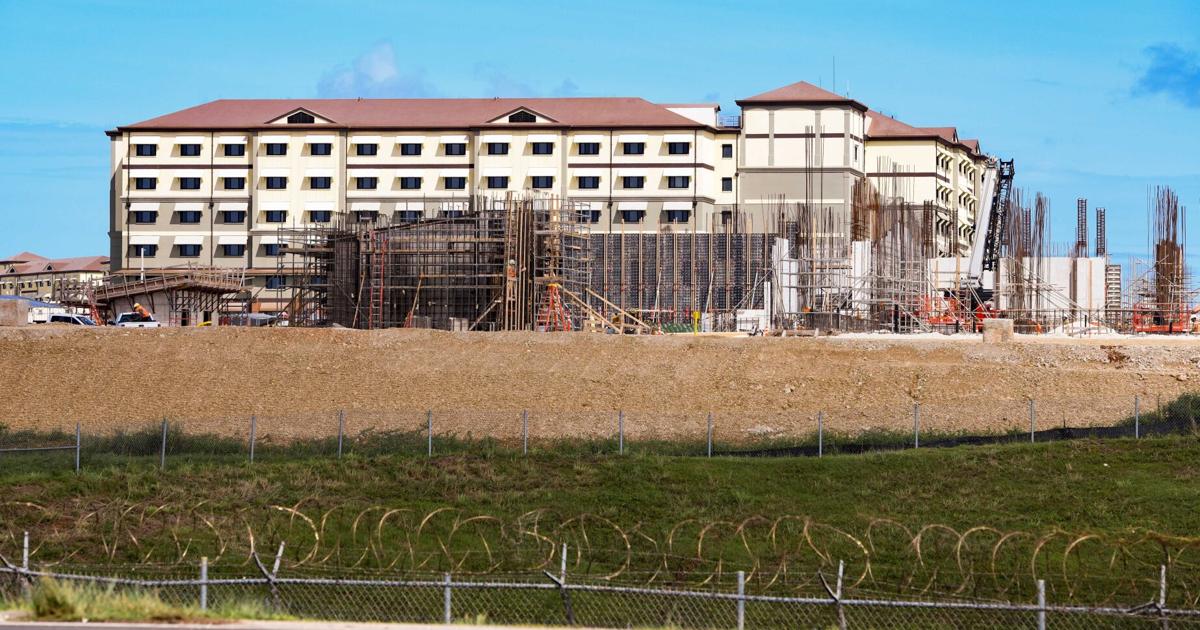
With billions of dollars in annual military spending pouring into Guam, experts said the island needs to focus on training and retaining talent, keeping money here, and charting a course for how the local economy will sustain itself moving forward.
A panel of public and private sector representatives spoke about how the military buildup is shaping the local economy during day two of the Guam Defense Forum on Thursday.
The forum was hosted by the Office of the Governor at Dusit Thani Guam Resort.
Adelup has estimated $5 billion in military construction for Guam over the next three to five years, while missile defense plans have been estimated to cost $8 billion.
The military has been awarding huge contracts for constructions projects on Guam.
Too reliant?
A full one-third, 33%, of Guam’s gross domestic product relies on defense spending, said panel moderator Melanie Mendiola, director of investment education and guidance at BG Investment Services.
“Defense held us up during the pandemic,” Mendiola said, adding that she believed the island was over-reliant on military spending.
But no one on the four-member economic panel agreed with the notion that Guam was too reliant on buildup dollars on Friday.
“Defense spending is…peaking, and it will transform itself and become a mainstay of our economy,” said Roseanne Jones, PhD, professor of economics and dean of the School of Business and Public Administration at the University of Guam.
But Jones said she saw firsthand at UOG how talented young people were finding new opportunities to make money for themselves and their families.
She said Guam could leverage tax revenue from the buildup to improve strong sectors like financial services, telecommunications, or advance areas like cybersecurity, transshipment, or industrial development.
Tax revenue, strategic location
If the large amounts of tax revenue provided by buildup spending dried up, public services would likely take a hit, Guam Chamber of Commerce board chairman Tae Oh said.
“Not only that, right now, our tourism economy isn’t exactly where we want it to be,” said Oh, vice president of Vantage Advertising and PSI Holding LLC.
But Oh said he believes the private sector could find ways to improve.
“There’s a lot of innovation, and there’s a lot of potential that Guam has with the strategic location we have. I think that we’ll eventually figure out a way to revive our economy,” Oh said.
Tina Garcia, administrator of the Guam Economic Development Authority, also pointed to advantages in the island’s location.
“Guam being positioned as the first U.S. soil closest to Asia provides an opportunity there and vice versa,” she said.
Garcia said the Leon Guerrero-Tenorio administration has been looking to build on that opportunity by exploring agriculture, aquaculture, “smart farming” transshipment, and pharmaceutical production.
Free college
Guam Community College President Mary Okada said GCC is working “around the clock” to train students and connect them with employers who want to hire.
Okada floated the idea of using increasing tax revenue from defense spending to provide two years of free college to students.
“Everybody’s going to need a job, so maybe we should provide that opportunity to them, either in the form of expanded dual credit so that they can graduate from high school with a certificate or an associate’s degree or something similar,” Okada said.
At the same time, students needed to be more prepared for the jobs that are opening up, and focus on science, technology and math at a younger age, the GCC president said.
Local students are oftentimes unprepared by the time they get to college, she said.
“We shouldn’t be waiting to address those issues when they walk through our door,” she said. “We need to address them a lot sooner.”
Workforce limitations, economic models
Economist Jones pointed to difficulties in keeping up with local employment demands with a population of just 167,000 people.
“We are a small community, and we run an international airport, we run two hospitals, we have a thriving business community, we have a local government, we have a federal government, we have federal services,” Jones said.
Guam is filling all those immediate needs with the best talent that it had, she said.
It wasn’t always a perfect fit, but everyone “gives it their all” and is getting trained and developed by the organizations that hire them, she added.
Jone also said the island needs to have a plan for how to advance local students’ abilities, and capitalize on federal dollars coming in.
She pointed to the city of Huntsville, Alabama as one economic model Guam could follow.
Huntsville, with a population of about 230,000 people, turned around a World War II chemical, developed an aerospace enterprise, and now has a $27 billion economy.
“That didn’t happen without some federal investment, usually through defense spending,” Jones said, adding Guam needs to plan beyond just the dollars flowing in.
H-2Bs, brain drain
Chamber chairman Oh said Guam won’t be able to meet the immediate demand for skilled jobs in the short term, but has to be able to do it long-term.
He said the military and associated industries are taking lots of local talent but he didn’t see it as them “stealing” from the private sector.
“The fact is, the demand is very high right now, and we need to understand that,” Oh said.
Guam won’t be able to meet that entire demand for skilled jobs like engineers and survey technicians on its own, and needs to look at opportunities to bring in more H-2B and H-1B laborers to fill in.
“Eventually, I think we need to get to a point where we can fill that with local labor, and also with local talent,” he said.
Guam has a “brain drain” issue, Oh said, and needs to instill in kids the idea that they can come back and work on the island.
“There’s a lot of talent, don’t get me wrong, but I think what’s important is instilling in these K to 12 individuals that there’s great opportunities coming back home,” he said.
Oh said he is one kid who grew up locally, went off-island to get trained as an engineer, and came back. He said he continues to encourage his friends to come back home.
Affordable housing
On the housing front, the government should consider investing in public utility infrastructure so developers could skip the high cost of installation and build more affordable homes.
“For a normal developer, instead of costing $200,000 to build a home, it might cost $500,000,” Oh said.
GCC’s Okada pointed to training and skills to keep residents on Guam.
“People are leaving because opportunities exist elsewhere,” Okada said. “So if we can create the local capacity, not just in the government sector, but in the private sector, and provide them with wages that they can sustain their families—I think that’s a benefit for all of us here.”
Keeping money local
Panelists also spoke on the need to keep defense dollars circulating in the local economy.
According to economist Jones, for every dollar in defense spending for Guam, only about 75 cents is retained on the island.
Leakage of that money was due to the cost of bringing in supplies from off-island, and due to an inability to meet demand with the local workforce.
Oh said keeping money is the most important thing to think about as the economy goes forward.
“We could have many companies come here and do a lot of the jobs here that we need. But if all that money is going outside the island, I don’t think that’s really improving the conditions for Guam,” Oh said.
GEDA’s Garcia said beyond just tax collections, the island has to measure factors like housing affordability, health care, education and environmental impacts to see how the buildup is actually affecting progress.