
MONTREAL — We are entering the first preseason games of Montreal Canadiens training camp this week, with four games in six days starting Monday evening against the Pittsburgh Penguins.
While this is an opportunity for the Canadiens to evaluate some younger players who don’t have a real chance to make the club this fall, it is also when three of the training camp battles will start to play out in live action.
Now, two of those battles don’t really appear to be battles at all.
While Kaapo Kähkönen could technically push Jakub Dobeš for the backup goalie job, it does appear to be Dobeš’ job to lose instead of a real battle. The way Kähkönen’s contract is structured – a one-way deal at $1,150,000 a year, right at the limit of the amount a team can bury in the AHL, and at a guaranteed dollar amount that would make him less appealing for a claim in the event he hits waivers – suggests that the plan for the organization was to have Kähkönen help mentor Jacob Fowler in Laval.
Perhaps Kähkönen can change that plan with how he plays over the next two weeks, but it would be a high bar to clear for someone who played just one NHL game last season.
The same dynamic appears to be in place in the battle for the No. 6 defenceman spot. Arber Xhekaj has been given consistent reps alongside Alexandre Carrier, while Jayden Struble has had less of a solid footing there. A lot of the scrimmages had rotations on defence because there were an odd number of them on each team, but when Xhekaj was sent out to start a scrimmage with Carrier, that decision was made for a reason.
On top of that, Xhekaj has looked outstanding in the early stages of camp, much lighter on his feet, quicker and making good decisions with and without the puck. Of course, we’re talking about scrimmages here, but Xhekaj has looked noticeably different.
“The thing I like about Arber is he constantly wants to get better, and I think that’s the most important skill you need to have if you want to play for a long time,” Martin St. Louis said. “You can see it, I can see it with my own eyes right now, he’s worked on stuff. And it’s paying off.”
This doesn’t mean Struble is out of the fight; he just appears to be chasing right now. It also doesn’t mean whatever’s decided for opening night is set in stone. Still, it seems Struble has a higher bar to clear.
“I just have to play hockey and play the best game that I can,” Struble, who was slated to play alongside Adam Engström later that evening, said Monday morning. “That’s all I’m focused on. Like this game tonight, just take every shift, play hard. The next game, do the same thing. Every practice, do the same thing. Then wherever I’m at at the end of camp, I am.
“I started not in last year, I ended up in, then I was out. If you think too much about it, it just gets you nowhere.”
The primary battle to monitor this week is the right-wing spot next to Alex Newhook and Zack Bolduc, because it is truly a battle. To say any one candidate has a leg up on another would be false.
Owen Beck began camp in that spot but was replaced on that line by Joshua Roy at practice on Sunday. Oliver Kapanen is another strong candidate. Samuel Blais and Joe Veleno could also fill that spot, but neither has taken reps with Newhook and Bolduc. Then there’s Vinzenz Rohrer.
Rohrer has stood out just about every time he’s been on the ice, dating back to rookie camp. Like Beck and Kapanen, he is a right shot who plays centre in Zurich and could therefore help Newhook on faceoffs. He has decent speed, but he has shown himself to be highly competitive with a motor that does not quit. If Rohrer gets cut by the Canadiens, he would be heading back to Zurich for his third season in the Swiss NL, the final year of his contract. But he also signed an NHL contract with Montreal this summer.
We have some precedent for this situation. It fits with where Kapanen found himself a year ago, when the Canadiens kept him out of camp and sent him back to Timrå of the SHL on Nov. 6. Could they consider something similar with Rohrer? If he continues playing the way he has, it seems like a possibility.
“It’s a battle,” Kapanen said Sunday. “Everybody wants to take that spot in the lineup, and I’m one of them.”
Power play takes shape
Last year in training camp, we did not see the power play practice on the ice at all. St. Louis had other things he wanted to work on and establish, particularly defensively.
This year, with a lot of that work having been done over the course of last season, we saw the power play get to work Sunday, and the units showed an incredible amount of balance. There will be a healthy competition with two units composed like this. It allows St. Louis’ desired forward lines to stay together and gives each unit multiple dangerous options to score.
One unit has Lane Hutson at the top, Cole Caufield, Bolduc and Nick Suzuki in the middle, and Juraj Slafkovský at the net front/goal line. The other unit has Noah Dobson up top, with Patrik Laine, Kirby Dach and Ivan Demidov across the middle and Brendan Gallagher at net front.
Bolduc was one of the most dangerous power play options with the St. Louis Blues from that bumper spot. His ability to score from distance is a serious asset that should create space for Caufield, in particular, to operate. And the other unit seemed to flow through Demidov on the right half-wall at practice Sunday, giving him four right-shot options to choose from for one-timers.
In theory, at least, these units should give the Canadiens the most dangerous power play they’ve had in years.
“I feel like I have a lot of flexibility; we have more talent,” St. Louis said Monday. “It’s a puzzle, and there’s more than one way to do it. We’re trying to put guys in situations where they’re most likely going to be, and we’ll figure out that puzzle as we go.”
The way the units are currently formed represents an ideal world for St. Louis, seeing as they would make it easier to transition out of a power play to five-on-five because the top two forward lines remained intact. But St. Louis was clear that results will ultimately dictate where this goes.
“Would our first unit be better if we had guys from different lines and they give us a better chance to win? Then we’ll go with that,” he said. “But for sure, it would be ideal if you had two units that don’t scramble all the lines, and they’re all happy with the spot they’re in. That’s ideal. But I’m approaching this knowing that might not be what happens, and I’m ready to have conversations with the players and sell them on this or that. I know they all have spots they would prefer to be in, but that’s a coach’s job.”
Demidov’s high standards
Following that brief first power-play practice on Sunday, Demidov was asked what he thought of his role and how his unit looks.
It was a general question, more far-reaching than that one practice.
But to Demidov, it was far-reaching in a different way. He didn’t like how that practice went.
“I think we have something that we can improve,” he said Sunday. “We’ve got to be better next time.”
Again, we’re talking about practice here. In training camp.
“Yeah, I know, but still, we’ve got something we need to work on,” he said. “So we’ll see.”
By all accounts, this is how Demidov is. Meticulous, intense, serious about improvement and standards. It’s a good sign for a player entering the NHL on a full-time basis.
“Having been around him all summer, he’s a perfectionist,” Carrier said Sunday. “He’s an unparalleled worker. He just had one practice, obviously it won’t be perfect. But it shows how much he wants to always improve.”
Demidov says he has not set any specific expectations for his rookie season. He is not thinking about the Calder Trophy or a certain number of goals or points.
“I just play well, help our team win,” he said. “That’s my expectation, I think.”
Pivotal year for Slafkovský
We spoke to Slafkovský for the first time at camp on Friday, and a very serious version of him stepped in front of the cameras.
Slafkovský is often joking around with the media, and maybe he will as camp and the season go along. But on this day, he meant business.
He has clearly grown tired of talking about what he needs to do to take another step in his career, the physicality and pace he needs to bring with consistency. He’s talked about it plenty.
He wants to show it more than talk about it.
“I want to be myself, I want to dominate this league, I want to dominate the games, I want to be able to pull the games our way,” he said.
Coming out of the 4 Nations Face-Off last season, he said he wanted to play more like Ottawa Senators captain Brady Tkachuk, which doesn’t jive with wanting to be himself. He’s determined not to think that way anymore.
“For sure, I feel like I should focus on myself,” he said. “Obviously, you can take away some stuff from other player’s games. Maybe that was a bad thing to say after 4 Nations, I don’t know. I just came from the beach, I wasn’t thinking that much about stuff in interviews.”
Then he laughed. Some of that humour leaked out.
Slafkovský desperately wants this October to be different from his first three starts to the season, much like the Canadiens want to avoid the slow start that plagued them a year ago. Perhaps one could lead to the other when the regular season begins Oct. 8 in Toronto.
“We focus here on starting the season like it would be the first playoff game,” he said. “That’s what we want to do, that’s how we want to play all 82 games.”
A little window into skill development
Canadiens director of hockey development Adam Nicholas spent all summer skating with whoever wanted to participate at the team’s suburban training facility, and he is heavily involved in training camp. Every practice has time reserved for Nicholas to work on skill development.
Here is a little window into the details that go into that.
On Sunday, Nicholas was running a very basic drill where a player in the high slot passes to a teammate against the wall at the hash mark, takes a return pass, turns and shoots on net.
Couldn’t be simpler, right?
At one point, Nicholas stopped the drill and demonstrated why it’s important for a player to fully rotate his feet towards the middle of the ice as he takes the pass and prepares to shoot. That way, they present a threat to pass it across the ice or shoot, creating some unpredictability in their next action. Otherwise, without that rotation, they are telegraphing the shot.
As soon as they restarted the drill, most of the guys were doing that rotation with their feet before shooting, taking instruction and immediately applying it on the ice. Others, however, did it a couple of times and then reverted to shooting without the rotation.
At this level, these are the details and coachability that sometimes differentiate NHL players from non-NHL players.
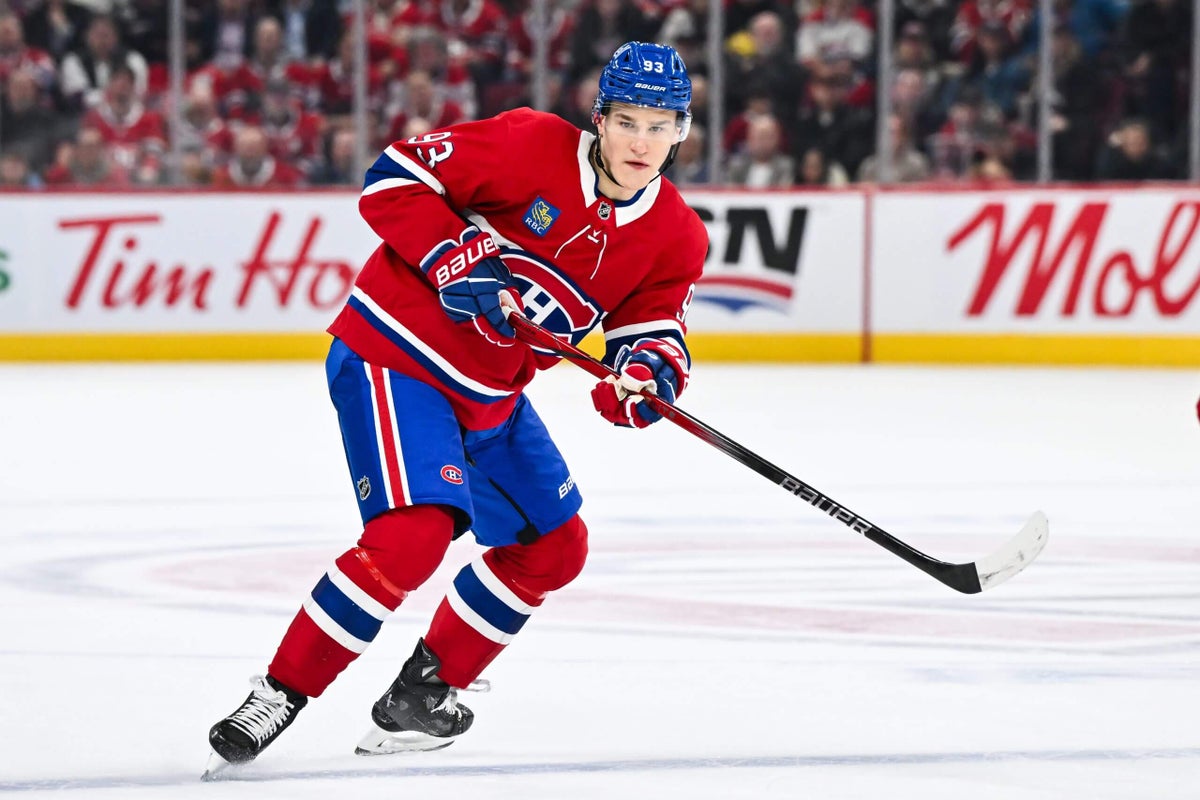
(Photo of Ivan Demidov: Minas Panagiotakis / Getty Images)