
A rare Martian meteorite, NWA 16254, is providing scientists with a groundbreaking look into Mars’ volcanic past. This discovery has revealed complex volcanic processes and new clues about the planet’s mantle and crust, offering fresh insights into Mars’ magmatic evolution and thermal history.
A Unique Martian Meteorite
The meteorite NWA 16254, belonging to the gabbroic shergottite group, stands out not only for its rare chemical signature but also for its unique two-stage crystallization history. Researchers from Chengdu University of Technology, led by Dr. Jun-Feng Chen, studied the meteorite’s composition in detail, revealing a fascinating record of Mars’ geological processes. Unlike other meteorites, NWA 16254 exhibits significant geochemical depletion, marking it as a rare specimen that provides a deep look into the planet’s volcanic and mantle history.
Tracing Mars’ Volcanic Past
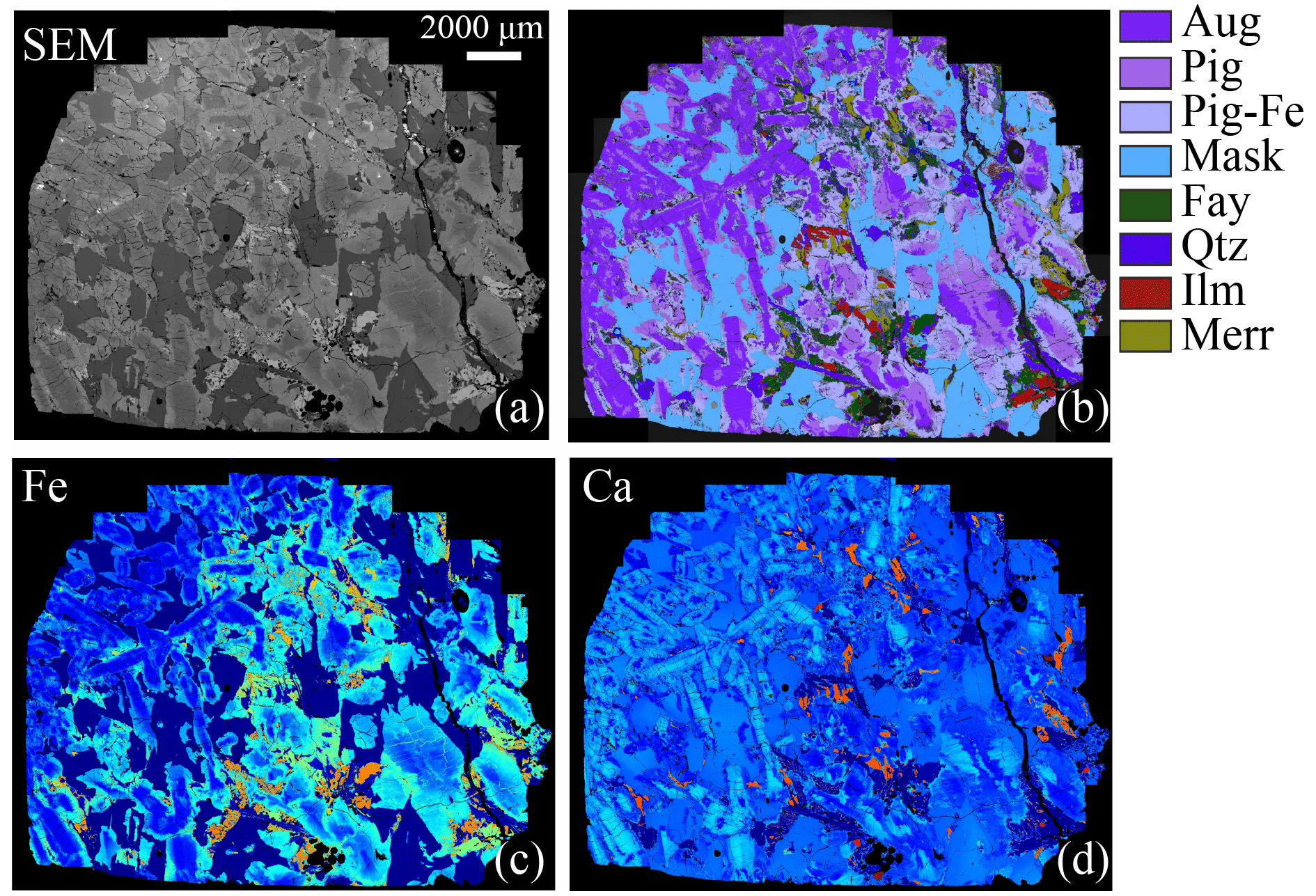
Through detailed mineral maps and chemical analyses, the scientists uncovered a two-phase cooling process in the formation of the meteorite. The study showed that at depths where the pressure ranged between 4.3 and 9.3 kbar, magnesium-rich pyroxene crystals formed first. This marked the earliest phase of the rock’s development. As the molten material rose to shallower depths (less than 4 kbar), it cooled more slowly, allowing iron-rich pyroxene rims and plagioclase to develop. This slow cooling process left behind a coarse-grained texture, preserving the record of repeated melt extraction from an ancient, depleted mantle source.
A Closer Look at Mars’ Redox Conditions
One of the key findings of this study was the meteorite’s geochemical depletion, which is evidenced by the lack of light rare earth elements (LREE). The low oxygen fugacity (fO2) of NWA 16254, measured at IW−1.0, aligns it with the rare QUE 94201 meteorite, suggesting that both rocks may share a common source.
The gabbroic texture of NWA 16254 indicates that it underwent slow cooling in crustal chambers, offering a rare glimpse into Mars’ deep volcanic processes. The sustained reducing conditions during crystallization, suggested by the Ti3+-bearing ilmenite assemblages, challenge current models of Martian volcanic evolution and bring new understanding to the planet’s redox history over billions of years.
Credit: Planet
The Hidden Secrets of Mars’ Mantle
This new discovery raises important questions about the heterogeneity of Mars’ mantle and its long-term evolution. The presence of low fO2 levels and the complex cooling history in NWA 16254 suggest that Mars may have experienced a much more intricate volcanic and mantle history than previously thought.
Future geochronological studies could determine whether NWA 16254 represents ancient mantle melting, occurring around 2.4 billion years ago, or if it stems from more recent magmatic activity. Such studies would help refine current models of Mars’ thermal history and planetary differentiation.