
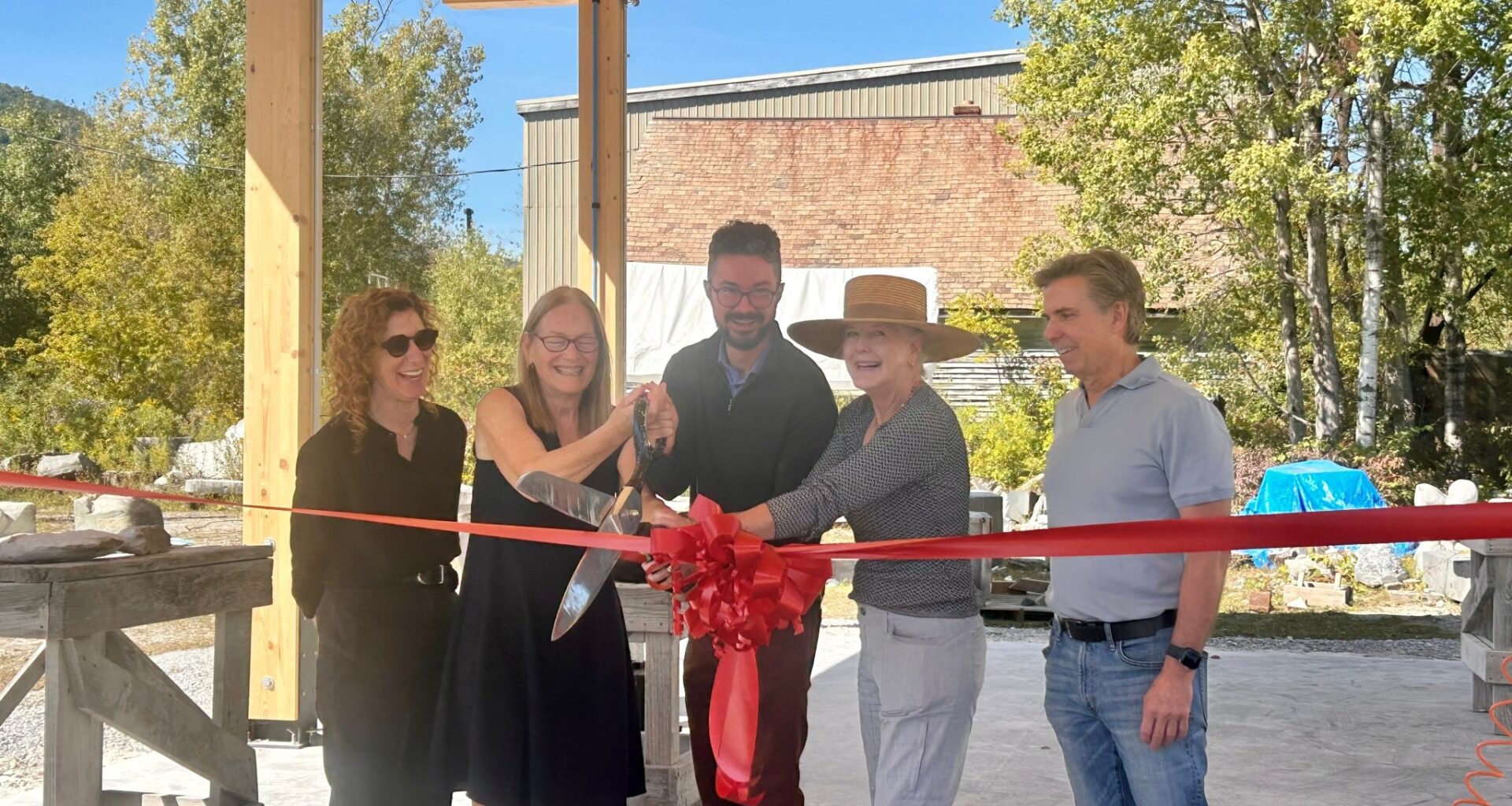
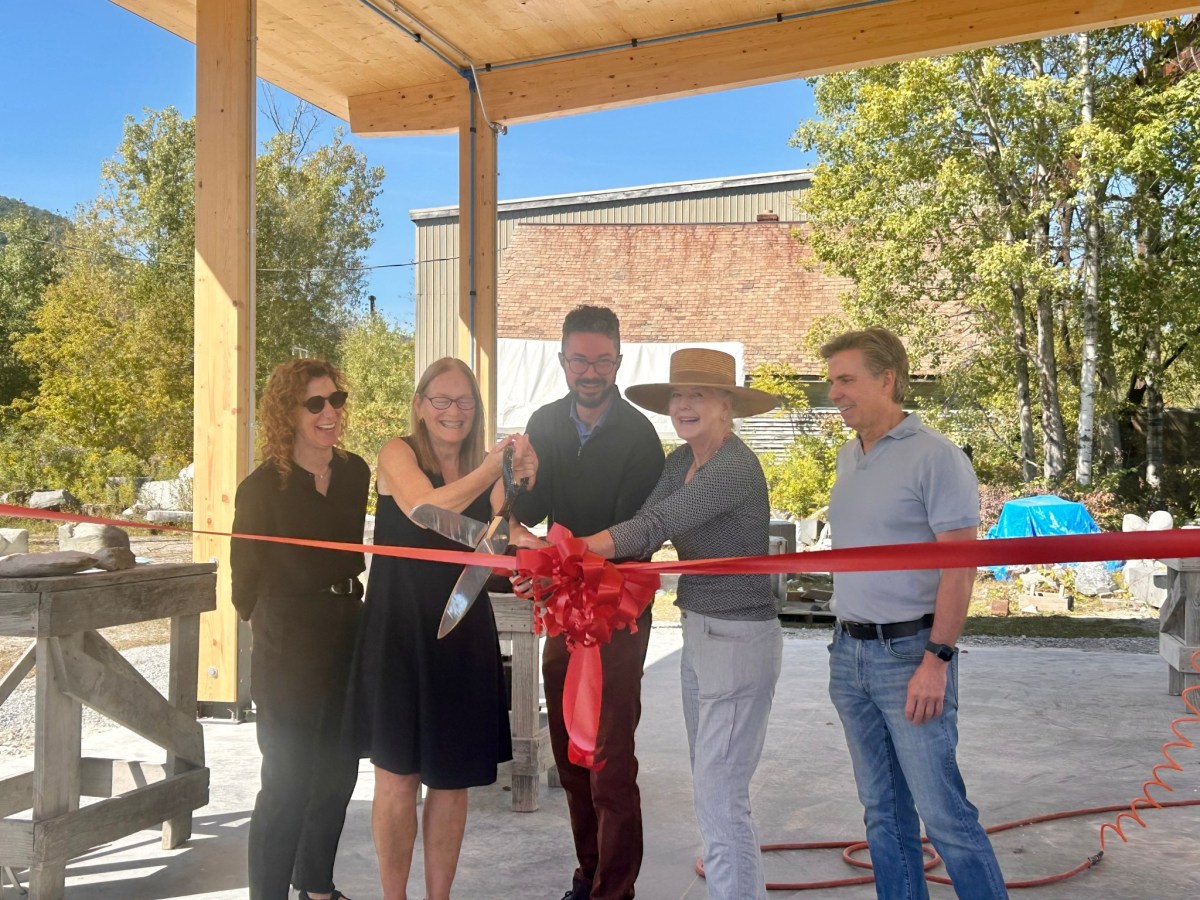
 From left to right, Marianne Klimchuk, Carol Driscoll, Noel Sinozich, Carolyn Enz Hack and Jeff Yates cut the ribbon unveiling the new pavilion at the Carving Studio & Sculpture Center in West Rutland. Photo by Madelyn Nonni/CNS
Madelyn Nonni is a reporter with the Community News Service, part of the University of Vermont’s Reporting & Documentary Storytelling program.
WEST RUTLAND — After stepping into his new role of executive director at West Rutland’s Carving Studio & Sculpture Center, Noel Sinozich is shaping the start of the organization next chapter with the unveiling of two new pavilions.
Following the retirement of longtime studio director Carol Driscoll, Sinozich stepped into the role earlier this summer and is taking on the responsibility of honoring the foundation Driscoll laid for the future.
With a long-time background in finance, working for companies such as Boston Globe Media and its umbrella companies as a business and financial analyst, Sinozich brings strong organizational management skills to the studio.
Sinozich’s arrival brings the organization more than just a new executive director, as the studio also welcomes new Board of Trustees President Jeff Yates and Vice President Marianne Klimchuk.
“We have a new director, we have a new president and vice president of the board. It’s a really fun reset moment. It’s really exciting that you come into this place that has all this history, and even now you’ll see alumni who have been coming here for 20 years,” Sinozich said.
One of Sinozich’s and the board’s goals for their new initiatives at the studio is to strengthen community outreach and connect with the surrounding neighborhoods more.
Two projects that already achieve this are the Downtown Rutland Sculpture Trail, featuring multiple artists creating marble monuments for notable Rutland figures; and the Stone Bench Project, bringing together local teens to work with limestone to create benches for neighboring towns.
“The board brought me on to grow the offerings of the studio. They want to do more for the local community of Rutland and West Rutland, neighboring Castleton, all the other towns as well. Do more stone programs, do more metal programs, bring in new mediums, get new equipment — you know, just be able for the studio to really kind of put itself in a place where it is at the forefront of, if you want to learn a really high barrier to entry form of sculpture, this is where you come,” Sinozich said.
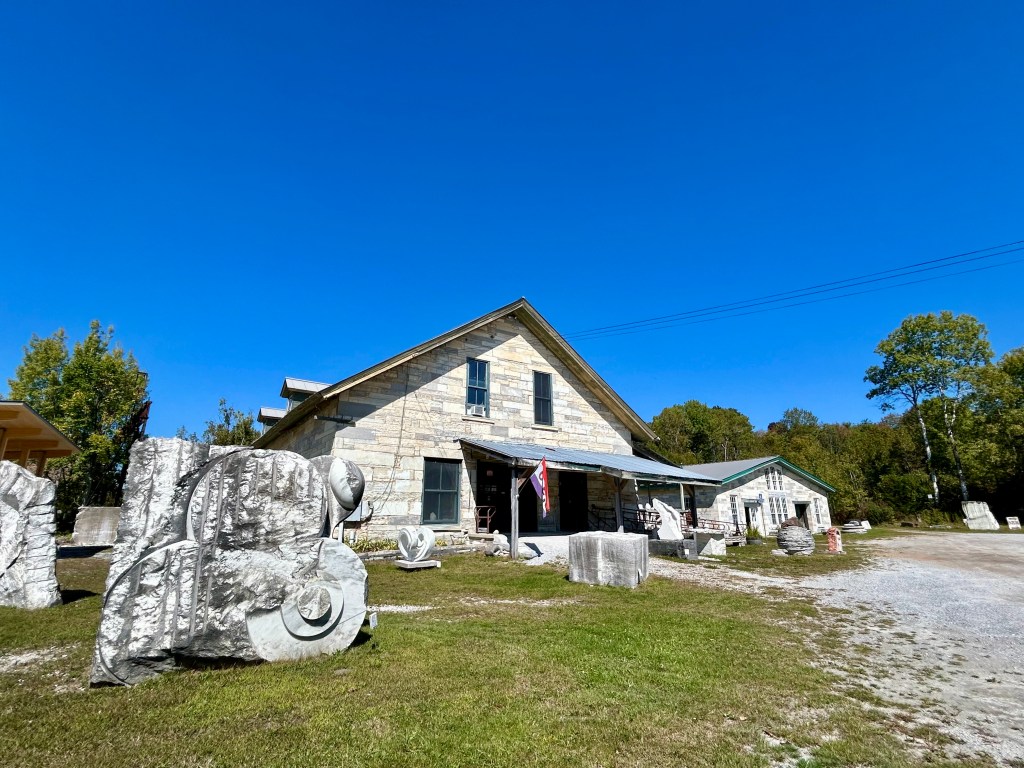 Marble sculptures outside the Carving Studio & Sculpture Center in West Rutland. Photo by Madelyn Nonni/CNS
Sinozich explained he sees these programs as just the beginning of wider efforts to engage the local community and make the studio a resource for people across Rutland County.
“I think our biggest thing is we want to make sure that people in this community, in West Rutland, know that this is a resource for them, too,” Yates said. “If we can reach out to the community, that’s what I would want to do. I feel like they’re right down there. I want to bring them up here. When I say to people, ‘Oh, I’m the president of a carving studio,’ and they go, ‘There’s a carving studio?’ And I go, ‘Yes! You should look it up, you should come here.’”
Yates and Sinozich are not the only two passionate about being a larger resource for the surrounding community.
“We feel like we’re an underutilized asset for the community, said longtime Board Member Carolyn Enz Hack. “We hope to see more people who live in the area come and visit us, come to our parties, come to walk in the sculpture garden.”
Other plans now in place since Sinozich has taken control of the studio include more winter programs and preparing the studio for working during the colder months.
“The key thing for me right now is to provide more programming year-round. Right now, a lot of the programming is really clustered from June to September. We have some programming before that in May, and after that in October, but I’ve been working on making sure that the insulation and heating systems are in place, and all that, so we can do some stuff in the winter,” Sinozich said.
Sinozich also discussed doing more partnerships with universities’ sculpture programs, both locally and nationally, to focus on stone. Stone is often hard for universities to let their students work on due to its weight, and many programs don’t have access to it. Sinozich said he is already in talks with professors to reach this goal.
In a symbolic passing of the torch, the studio unveiled two new 800-square-foot timber-framed pavilions last Friday. Originally planned and mostly constructed under Driscoll’s direction, Sinozich saw the pavilions to completion.
“We used to always be underneath these little plastic tents. They leak, they really don’t keep you cool in the summer. As the sun came in, you tried to hide somewhere in the shade. Everybody tries to get to one side because the sun slants in one way,” Yates said.
In addition to shielding artists from outdoor conditions, the new pavilions are also equipped fully for convenience.
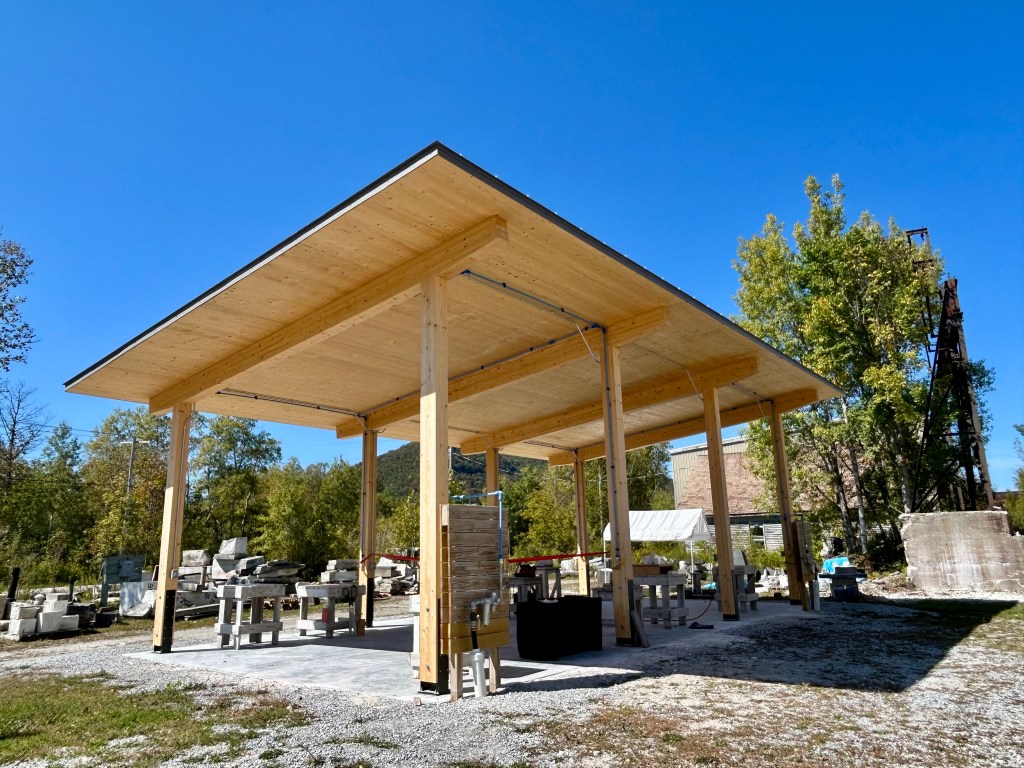 The new outdoor pavilion provides a workspace for artists. Photo by Madelyn Nonni/CNS
“Stone carvers use a lot of power, so each of the posts of the pavilions has its own dedicated circuit and air, and each of the pavilions has an underground air feed that powers their pneumatic tools, air chisels, and just makes the work so much faster. Being able to get everybody the right amount of air and power in a place that’s right by their workspace, so they’re not tripping on hoses and stuff like that, provides not only just a more pleasant experience, but a safer one,” Sinozich said.
The second pavilion, placed behind the studio, is geared toward the welding and metal workshop. Those outlets allow for more heavy-duty metal wielding and power tool usage. This allows for a seamless environment for students and teachers during programs and classes.
“People come here, and then they really just love the community. I mean, really come back for the community as much as the classes, but that really helps, you know, if you can get more people at a time, because we’ll run courses with whatever number,” Driscoll said.
With new programs and ideas on the horizon, and new leadership with Sinozich, the studio is hoping to continue gathering the community together and serving as a hub for aspiring and longtime artists. Trustee Klimchuk said she is looking forward to Sinozich’s approach and attitude for the future.
“He’s a visionary, he’s got great finance skills. He sees the great potential of this organization that we’ve all seen. He can really take it to the next level. He’s got such a can-do attitude,” Klimchuk said.
Klimchuk’s optimism in Sinozich’s leadership reflects the feeling throughout the entire studio, from staff to board members, that the studio is set on a good path for their future endeavors.
“We’re really excited about what the future brings, and broadly speaking, it’s just the kind of energy that begets energy. It’s an exciting time,” Sinozich said.