
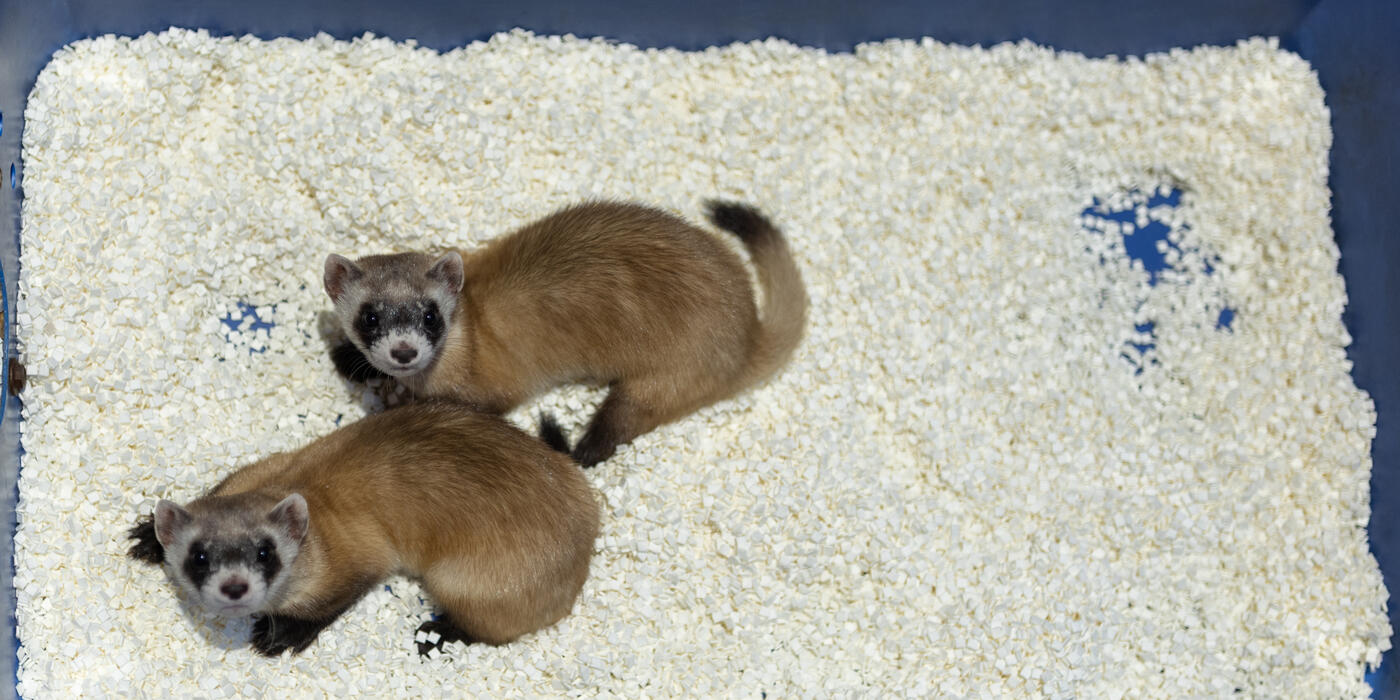
The Smithsonian’s National Zoo and Conservation Biology Institute (NZCBI), in collaboration with the U.S. Fish and Wildlife Service (USFWS) and partners, is excited to announce the birth of new black-footed ferret kits to cloned individuals — a step forward in the recovery efforts of one of North America’s most endangered mammals. The new offspring are the result of continuing genetic research on cloning technology to help recovery efforts for endangered species.
This year, three litters were born at NZCBI’s Front Royal, Virginia, conservation campus. The new kits came from Antonia, a cloned ferret, as well as Antonia’s offspring Sibert and Red Cloud, which were born in 2024.
Antonia, born in 2023, came from stored tissue samples of a black-footed ferret known as “Willa” that lived more than 30 years ago. In December 2020, the first clone of a U.S. endangered species was announced with the birth of Elizabeth Ann. A third clone, Noreen, was also born in 2023 and whelped one litter this year. Sadly, both Elizabeth Ann and Noreen passed away this year.
The reproduction of cloned black-footed ferrets is a significant milestone in conservation genetic research, demonstrating that cloning technology can potentially help restore genetic diversity and open new possibilities for species recovery.
Cloning offers an important tool in addressing genetic challenges and other threats to recovery efforts for black-footed ferrets. The USFWS is working with states, tribes, landowners and conservation partners to continue making progress toward recovery of this species through various efforts, including captive breeding programs, reintroduction into the wild, habitat restoration, disease management and public awareness. These are part of a broader strategy to restore the species to a sustainable population and return it to the wild.
This ongoing research is the result of extensive collaboration among NZCBI, USFWS, Revive & Restore, Viagen Pets & Equine, San Diego Zoo Wildlife Alliance and the Association of Zoos and Aquariums. The partners at Revive & Restore and ViaGen Pets & Equine have pioneered this technology for use in endangered species. In addition, cloning research today relies on the genetic material that was collected and stored by the Frozen Zoo at San Diego Zoo Wildlife Alliance starting 50 years ago. NZCBI and other facilities under the Association of Zoos and Aquariums provide the technical expertise to care and house the kits born in the cloning research as well as other black-footed ferrets in the captive breeding program.
NZCBI remains committed to recovering the species in the wild through reintroduction, habitat protection and ongoing monitoring. Cloning complements — but does not replace — these essential efforts.
Photo and video credits: Roshan Patel, Smithsonian’s National Zoo and Conservation Biology Institute
###