
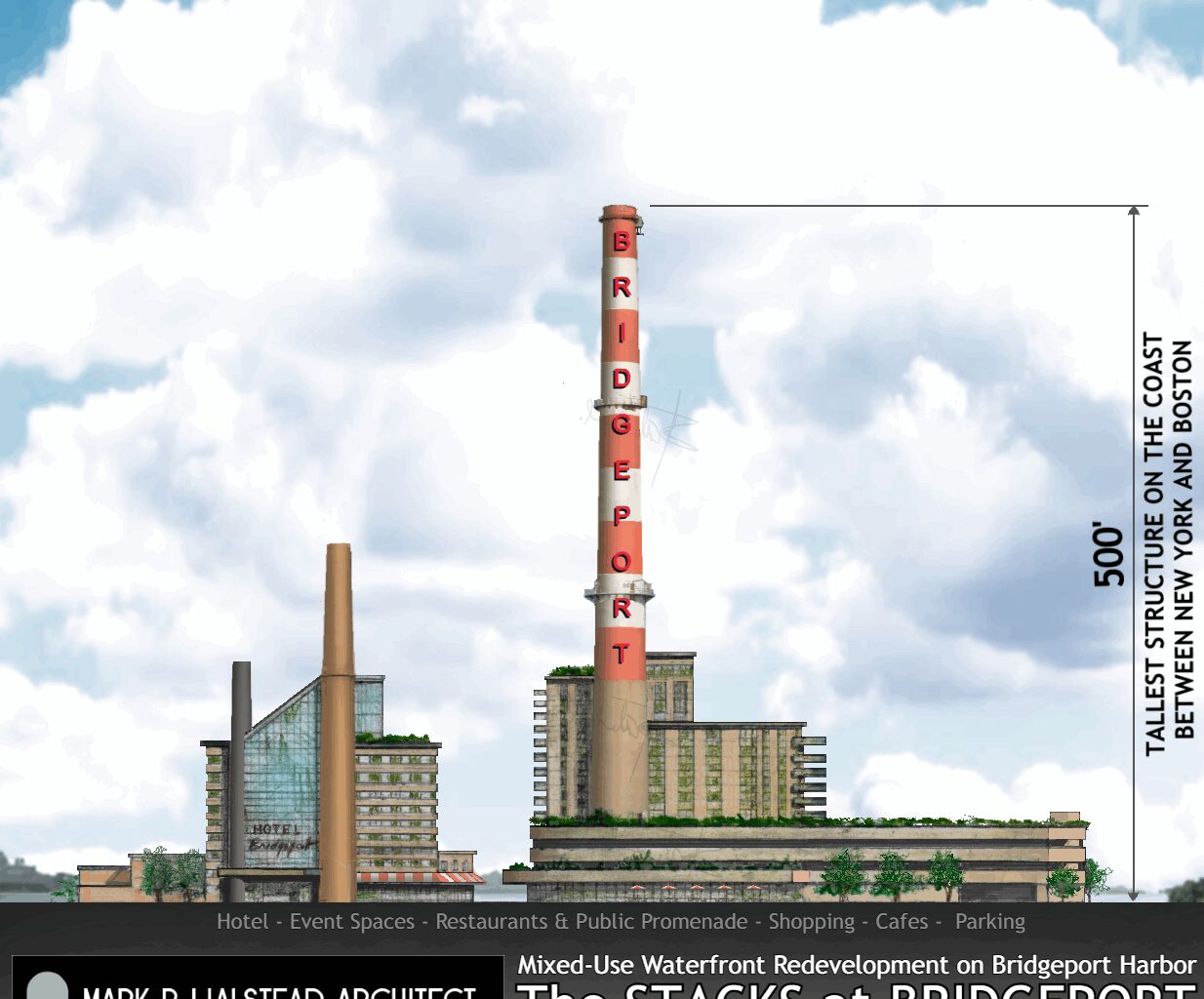
Local architect Mark Halstead’s proposal for saving the three smoke stacks rising from the soon-to-be-demolished South End power plant and incorporating them into a future redevelopment there.
Mark Halstead
Local architect Mark Halstead’s proposal for saving the three smoke stacks rising from the soon-to-be-demolished South End power plant and incorporating them into a future redevelopment there.
Mark Halstead
Local architect Mark Halstead’s proposal for saving the three smoke stacks rising from the soon-to-be-demolished South End power plant and incorporating them into a future redevelopment there.
Mark Halstead
BRIDGEPORT — Mark Halstead used to “hate” the towering red-and-white smokestack that looms over the city’s South End, downtown and harbor.

He recalled watching minor league baseball games in the since-shuttered stadium nearby, looking up from the stands at the 500-foot industrial edifice and thinking with disgust, “That thing.”
Article continues below this ad
But with the wrecking ball looming over Bridgeport’s so-called candy cane, Halstead is not cheering the pending demolition on. He is instead circulating renderings he drew up on social media that incorporate the landmark into a future redevelopment, hoping to inspire an effort to save the tower.
“It has so much potential,” Halstead said. “Make it something that looks clean and beautiful, rather than old and smoky. …. A beacon … that says, ‘We’re Bridgeport, welcome, come see.'”
The striped stack is the tallest and most distinctive of three jutting skyward from the shuttered coal-fired power plant along the harbor and, Halstead claims, the tallest structure along the coastline between New York City and Boston. New owner Bridgeport Station Development is preparing to raze the bulk of the facility Sept. 28. The trio of towers are scheduled to come down in the spring.
Born and raised in Bridgeport but now living in Fairfield, Halstead will celebrate his 40th anniversary as a professional architect next year. His primary business has been residential, though he has done some commercial and retail work, and also taught architectural history and been involved in other area preservation efforts. And he is president of the Greater Bridgeport Symphony’s board of trustees.
Article continues below this ad
Bridgeport Station Development announced in May that the candy cane would be torn down despite some local interest in preserving it. And that pending loss got Halstead thinking.
“I just had some night with nothing to do, so I just kept drawing,” he recalled.
While the owner has yet to make specific redevelopment plans public, it is expected housing will be the centerpiece. And Halstead incorporated all three smoke stacks into a two-building apartment/condominium and hotel complex, with large letters spelling “Bridgeport” and “BPT” displayed vertically on the candy cane.
“I know nothing (about what is planned),” he emphasized. “I’m looking at the architecture that exists and trying to think of something that can be done.”
Article continues below this ad
It does not seem impossible. A former power plant in Savannah, Georgia, was renovated into a J.W. Marriott hotel that opened in 2020, still boasting its looming stacks.
For months members of the Bridgeport community have debated whether the striped edifice should stay or go, with some agreeing with Halstead it is a landmark that helps to pinpoint and define the city, and others arguing it is a negative symbol of pollution whose time has passed.
Chad Parks, a partner with Bridgeport Station Development, said the plan remains for the stacks to be demolished, likely next April. Parks has previously stated the striped tower must come down because it would otherwise require significant maintenance and be much more difficult to remove in the future when surrounded by new construction.
“I know there’s a lot of work involved,” Halstead acknowledged. “I don’t kid myself. … The ongoing maintenance, painting, if you do lighting and such. There’s costs with that, yes. (But) this is something that benefits the city as well.”
Article continues below this ad
“There’s obviously no reuse for the stack,” Parks had insisted in May. “The only reason it would stay is if people wanted it to stay, (and) I’d say close to 80 percent want it down. The other 20 percent just kind of like it as an icon.”
Mayor Joe Ganim had previously advocated for salvaging the candy cane but his administration appears to have since backed off.
“It’s not viable for them (the three smokestacks) to stay,” said Constance Vickers, the mayor’s deputy chief of staff who has also expressed some sentimental feelings for the red-and-white tower. “In theory we’re all going to miss it. It’s a big part of the Bridgeport skyline.”
But, Vickers continued, “That plant hurt the health of a lot of South End residents. While it’s a symbol of nostalgia, it’s also a symbol of how industry impacts poor communities, especially communities of color.”
Article continues below this ad
Halstead understands, but argued the candy cane does not have to be torn down to turn the page.
“We had an industrial past that built this city. Now we’re looking for new things,” he said. “This is a symbol of the old industrial era of Bridgeport coming into a new age.”