
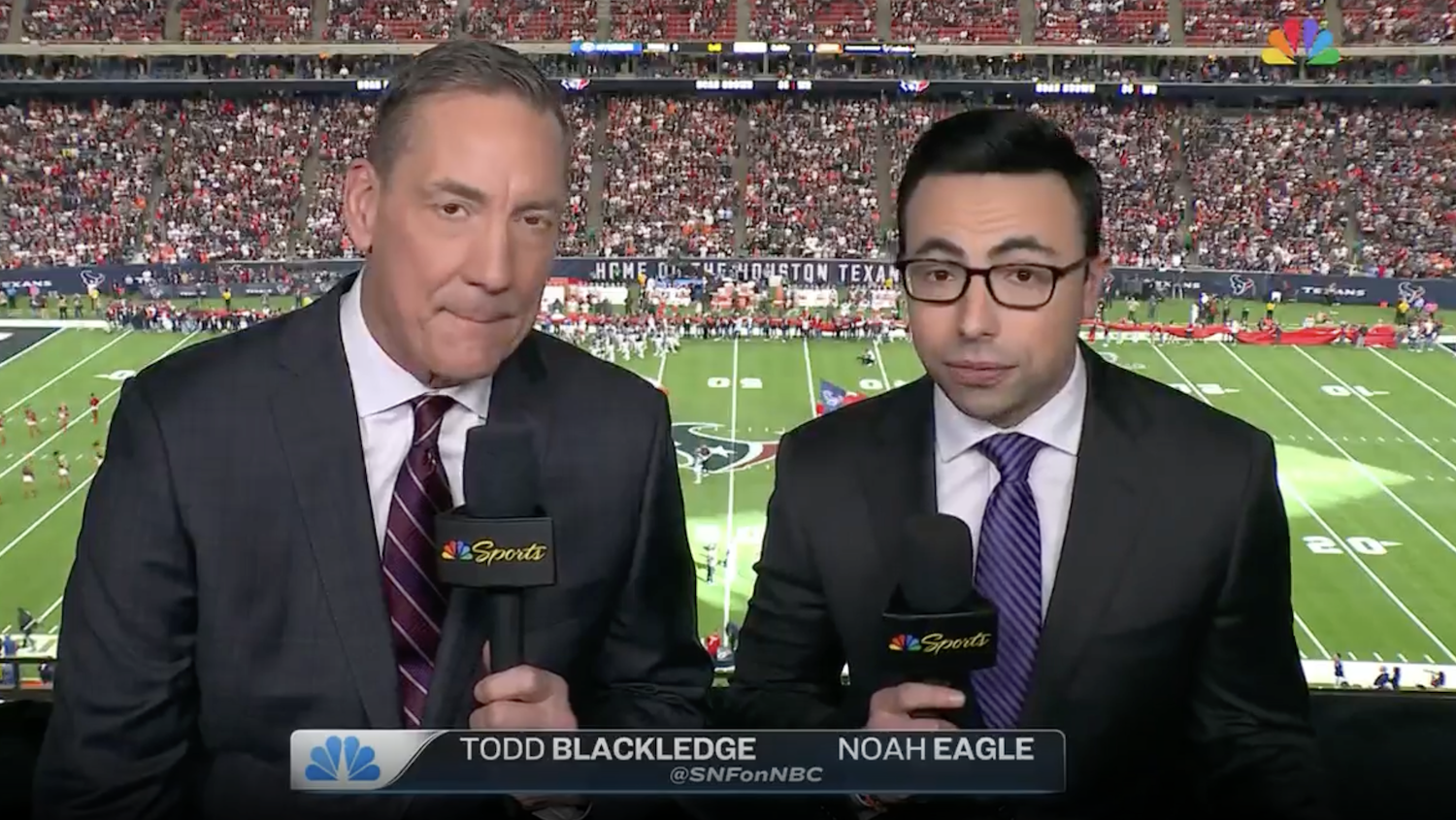
The biggest games that rising sports announcer Noah Eagle gets to call each week come from Big Ten football, where NBC’s Saturday night national window delivers some of the best matchups each weekend in college football.
Add in a healthy dose of NFL and Eagle, despite starting his impressive young career on the basketball side, he is developing quite a resume in football as well.
Coming of age during a period of significant evolution on the football field, Eagle had to learn a lot on the fly. And in a new interview on The Press Box podcast, Eagle explained why he keeps it simple when it comes to outlining schemes or strategy as a play-by-play announcer — and why he believes all young announcers should do the same.
“I talk to younger kids that are trying to get into football who are trying and trying to figure that same deal out of, OK, I don’t really know the specifics, now, of what goes into playcalling or defenses that are being played,” Eagle said.
“And I always say, ‘Look, it’s probably better if you don’t necessarily know the intricate detail. You want to have a base knowledge of what’s going on. So you want to know, probably, the most important things within packages or within formations. And then the most important thing you want to know is the rules.”
New PRESS BOX:
We live in a media age of X’s and O’s. How much schematic football does a play-by-play announcer need to know?
Full interview with @NoahEagle15 here: https://t.co/ZMIQiMIHhC pic.twitter.com/Z09VrUwzAc
— Bryan Curtis (@bryancurtis) September 26, 2025
Instead of worrying about how an offense or defense is lining up or what they run, Eagle makes sure he’s as close to perfect as possible when it comes to situational awareness. Eagle studies the rules and officiating trends, focusing on key recent moments across college football that can serve as a point of comparison on-air during the game he is calling.
Then, when interesting schematic wrinkles develop over the course of a game, Eagle leaves it to his analysts to break them down.
“That’s more important to me, because I know the analyst I’m working with is going to have the more detailed stuff, and I don’t want to step on their toes. It’s not my job,” Eagle explained. “My job is to tell you what and to tell you who. Their job is to tell you why and how things are happening. And so making sure that I still am just doing my part of it.”
Whether that is his NBC partner, Todd Blackledge, who will be on the call alongside Eagle for Oregon at Penn State this weekend, or his typical NFL partner, Nate Burleson, Eagle believes less is more on his end when it comes to the decisions made by players and coaches.
Sometimes that means getting in and out as quickly as possible when a specific play calls for expert analysis.
“A lot of times, the best course of action for me is to just stop talking altogether and then look at (Blackledge), because I know he’s ready for something,” Eagle said.
“And I think a lot of the analysts who are calling football now have that level of knowledge and that level of seeing the game. That if you’re a play-by-play person, your job should just be making sure you get the names right, making sure you’re on top of if there’s a fumble, an interception, a deflected pass, a blocked kick. Anything of that nature, you need to make sure that you’re on top of it. Other than that … I would just leave it for my analyst.”