
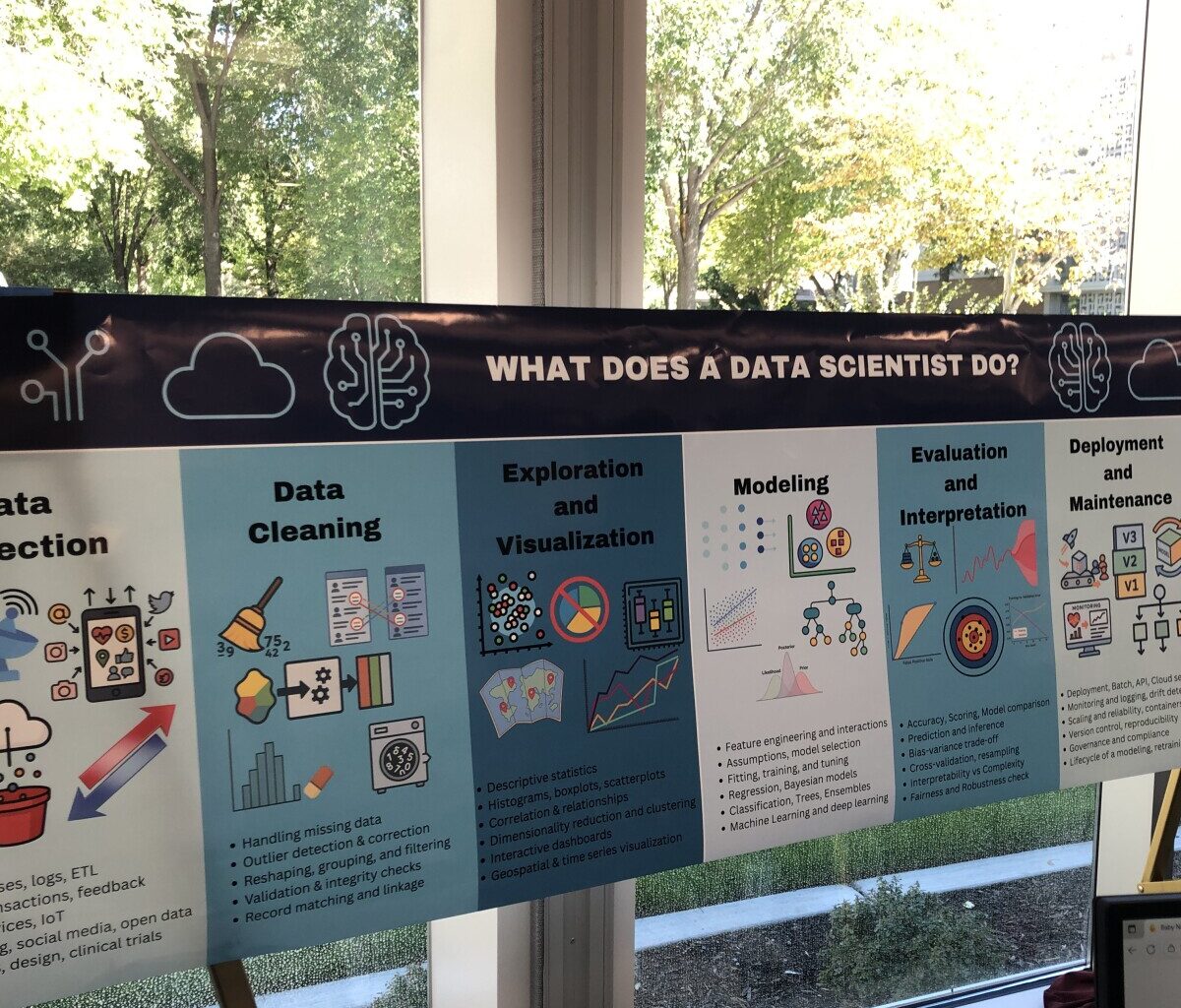
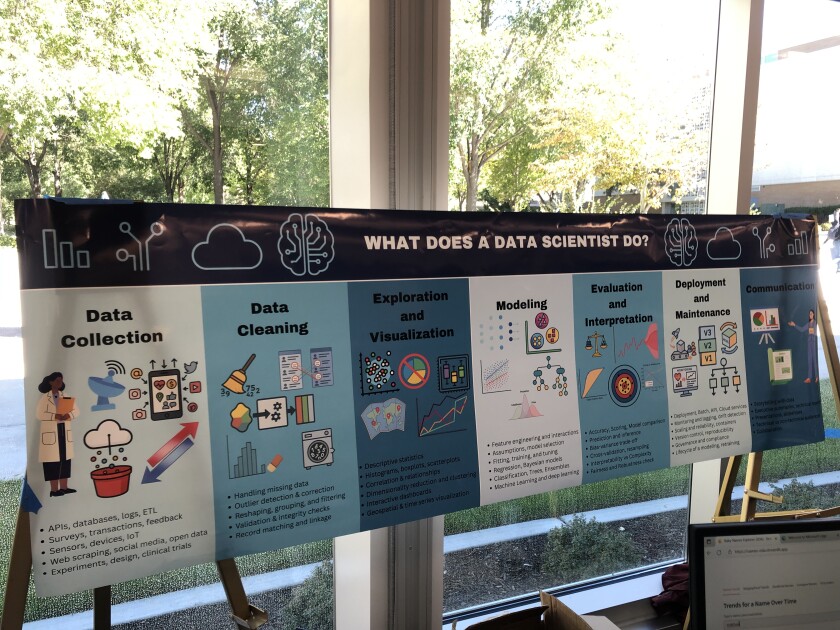
Data science is a new major at BYU. A map at the kick-off detailed all the major requirements. (Sariah Francis)
The BYU College of Computational, Mathematical and Physical Sciences (CMS) faculty and staff held a kick-off event to bring awareness to the AI and data science programs on Sept. 25 in the new Eyring Science Center Annex.
Recently, three new majors were developed in the CMS department to help give students a deeper dive into AI and data science. The kickoff event allowed students to come talk with professors and current students to discover which major or minor pathway would be the best fit for their interests.
Tyler Jarvis, chair of the College of CMS committee on AI and data science, explained that they have five majors that deal with AI, data science and machine learning.
“People think they want to do AI, but they don’t know which one to do. So the hope is when they come here, they can see which of these five is the best fit for their actual interests and long-term career goals,” Jarvis said.
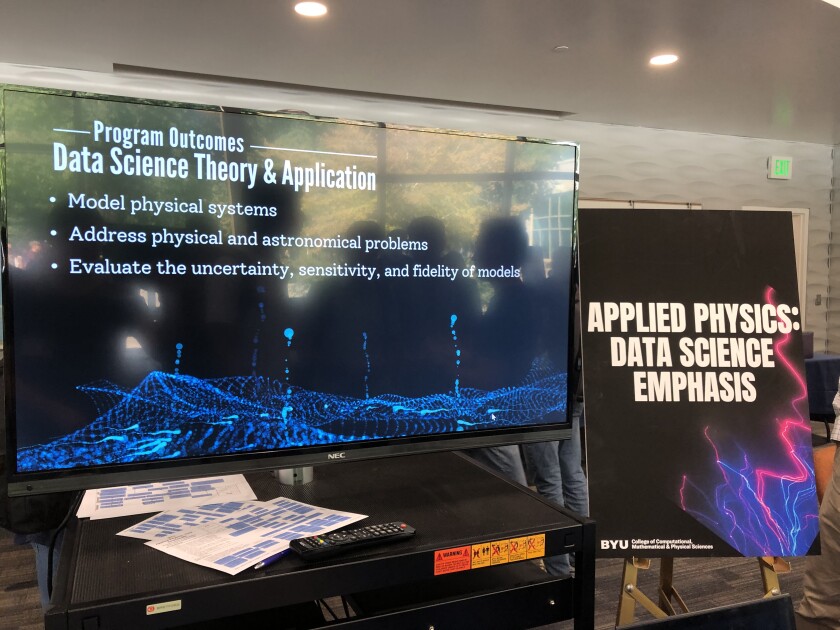
The physics major offers a new emphasis in data science. The program will allow students to dive deeper into application and theory. (Sariah Francis)
Jarvis described how BYU should be a place where AI is used to better the world, to advance medicine and learning.
He explained that it should be a place where students learn to use AI “better and differently than you would somewhere else.”
Daniela Einns, acting president of the data science association at BYU, said they work to build a community for data scientists and others interested in the program by having events, like this kick-off.
They do workshops on different topics within data science, which help students build their understanding of the field, along with networking events.
“Our ultimate goal is to build the future data scientists,” Einns said. “AI needs data science to function and data science is part of what goes into AI.”
David Wingate, faculty in the computer science department, teaches machine learning classes relating to the development of AI.
“Machine learning is building the predictive models that power AI. So machine learning people build things like ChatGPT, we build self-driving cars, we build Alexa, we build Siri. Machine learning is the science of finding patterns in data and then being able to use those patterns to solve new problems,” Wingate said.
Wingate further explained that machine learning majors think a little more about how to bring the data to life, making a scalable model of the algorithm.
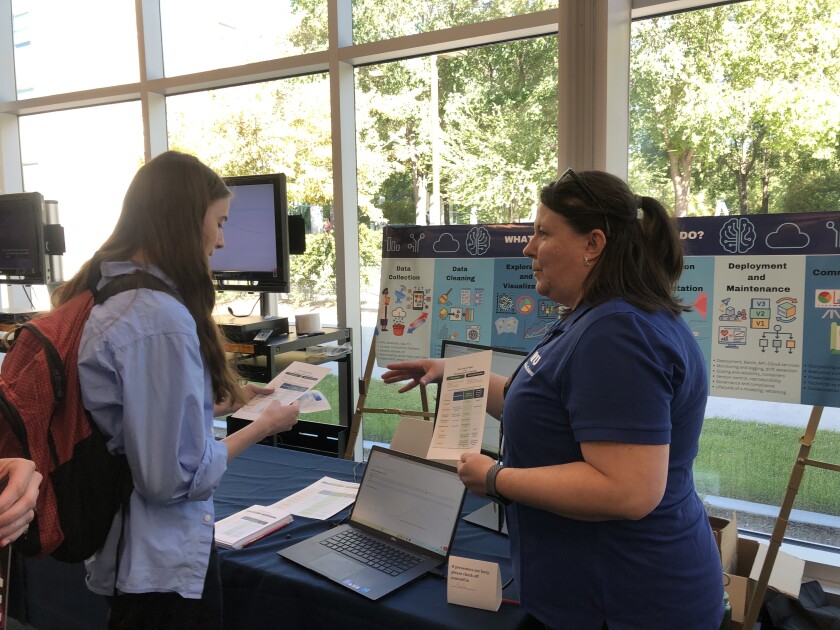
Shannon Tess talks to a student about the new data science major. The major was recently created within the College of Computational, Mathematical and Physical Sciences. (Sariah Francis)
Shannon Tess, a faculty member in the statistics department, said the data science program doesn’t go quite as deep as the statistics or computer science majors do, though it does teach students a little bit about everything related to data science.
“The modeling and evaluation and interpretation [within data science] would be kind of like machine learning,” Tess said. “That’s a part of the modeling, but then you have the exploration and data visualization. That’s kind of the part that sometimes gets overlooked.”
Tess explained that it is important to also understand the data, to explore it and learn to communicate it. This can sometimes be overlooked, but is also part of the overall process of data science.