
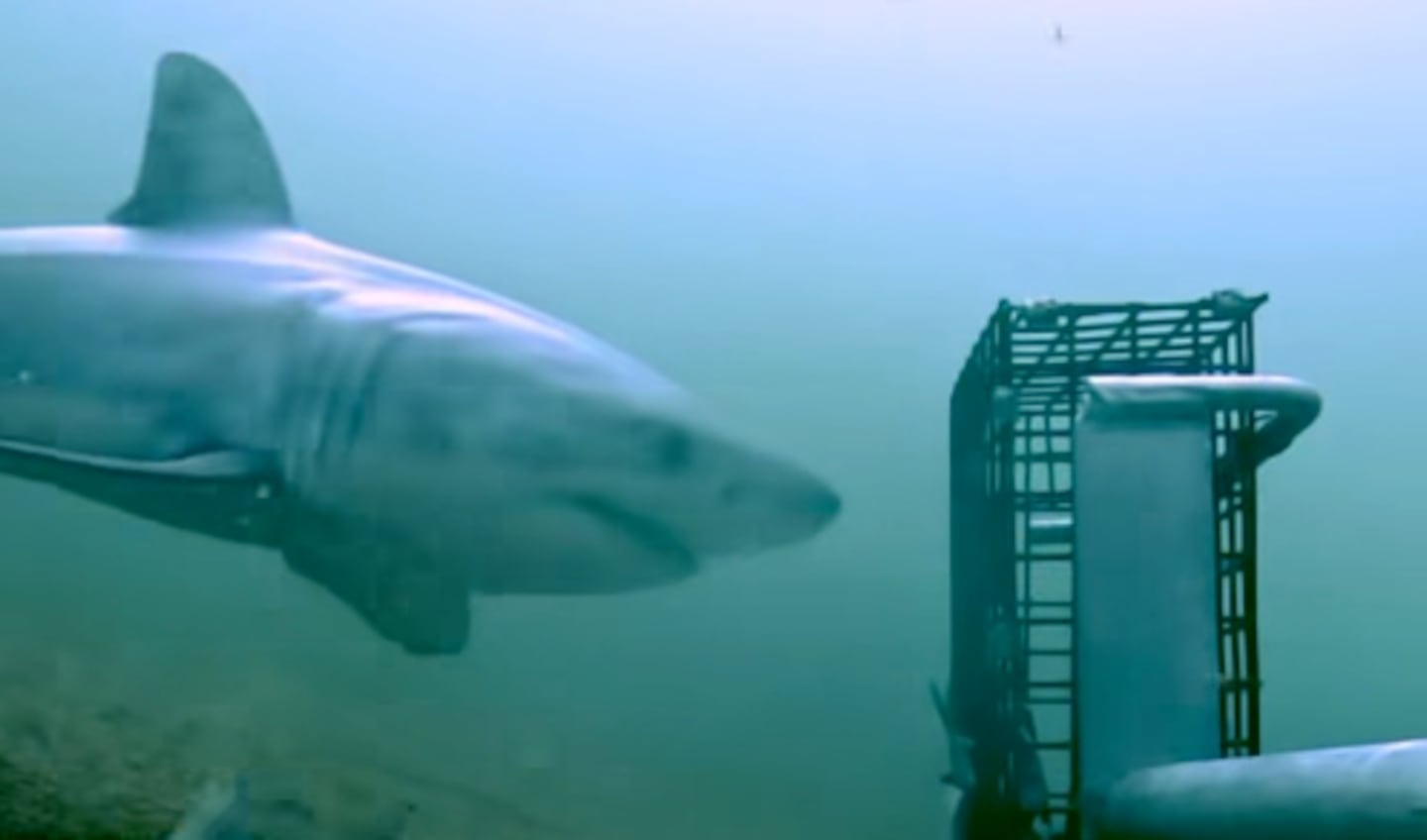
So, when a female juvenile great white shark graced the lens of the institute’s baited remote underwater video system last week near Block Island, having the moment preserved on video just seemed “a little surreal,” Dodd said Tuesday.
“We were really excited,” Dodd said. “We’ve been reviewing a lot of [the system’s] footage over the years and had to do a triple take on that one.”
The institute shared the 26-second clip on Facebook on Sunday, garnering thousands of “likes” and hundreds of shares in the days since it was posted.
In the footage, the shark can be seen close up, swimming past bait set by the institute. The video system is deployed about 10 times a season, similar to a lobster trap, and relies on a GoPro camera to capture the action in six-hour intervals, according to Dodd.
In the four years since the institute began using the system, it’s picked up images of tuna, sea turtles, and a host of other kinds of sharks, but never an encounter with a great white, Dodd said.
“It was really, really exciting to kind of finally look and say, ‘That is a great white,” Dodd said. “It was really special.”
According to the institute, great white sharks can be elusive and have a smaller population compared to other shark species in the local waters of the Atlantic Ocean.
“We don’t have the large white sharks, the subadults and adults, in Rhode Island,” Dodd said. “Those white sharks will cruise through at different parts of the season, typically earlier, May, June, maybe into July. They’re heading north. They’re heading up towards the Cape and in Maine and Canada to feed on seals.
“It’s the small ones that stick around,” Dodd added. “We’re seeing a greater propensity for the small ones to stick around Rhode Island because it’s a little safer for them … because these other large sharks will attack them.”
Part of what makes the sighting interesting is that this particular shark caught on camera “was likely never seen before” and “may never be seen again,” Dodd said.
Female great white sharks are not able to reproduce until after the age of 30, he said. This shark may not become a mother until close to 2060, if she survives.
“We get a glimpse, a very quick glimpse, into her life as a young shark trying to feed, survive, and stay away from predators and hopefully do it for decade after decade after decade, so she can replace herself,” he said.
Christopher Gavin can be reached at christopher.gavin@globe.com.