
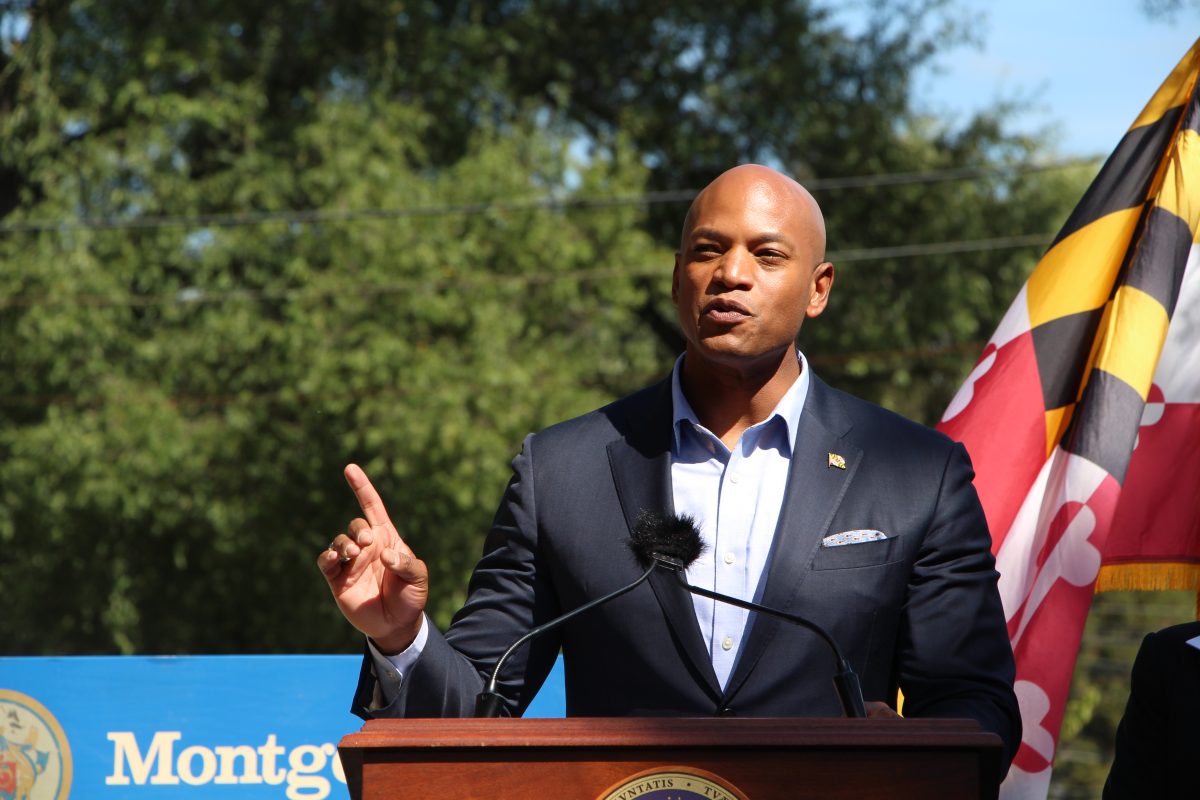
Maryland Gov. Wes Moore (D) on Friday announced a new program to help offset an expected rise in premiums for people enrolled in Maryland Health Connection as a result of Republican cuts to health care subsidies.
Moore announced the new program at a press conference outside the Montgomery County Department of Health and Human Services Silver Spring Center. Earlier in the day, he toured the Georgia Avenue facility without reporters.
During the press conference, Moore said more than 190,000 Marylanders rely on federal enhanced premium tax credits to afford health care.
Those people could see their premiums increase by an average of $825 per year in 2026 if Congress does not extend the tax credits, Moore said.
The Maryland Premium Assistance Program, Moore said, “will help to protect Marylanders from these premium increases should the federal government fail to act.”
Through the program, officials hope people covered through the state’s health insurance marketplace will see projected increases in their premiums reduced by two thirds, amounting to about $500 in cost savings. But officials still expect premiums to increase overall.
“There is frankly no state in this country that can fill the enormous gap that’s created when the federal government decides to look at us in our face and say ‘you’re on your own,’ ” Moore said. “But in Maryland, we are gonna do everything in our power … to make sure we are bringing health care costs down.”
In addition to letting tax credits expire, Republicans in Congress have introduced other cuts aimed at decreasing federal spending on health care. They have specifically taken aim at health care dollars going to the immigrant population.
Democrats argue that lowering health care spending at the federal level will shift costs onto states and people who may not be able to absorb them.
The cuts — which were part of the One Big Beautiful Bill Act passed earlier this year – prompted Democrats in Congress to withhold support for a resolution to keep funding the federal government through Nov. 21, leading to a shutdown that began Wednesday.
The shutdown is expected to last at least through the weekend, with the Senate scheduled to reconvene on Monday.
As a result of the cuts, some groups such as people with refugee or asylee status automatically became ineligible for Medicaid on Wednesday.
Other groups, such as those covered through the Affordable Care Act’s Medicaid expansion, will have to meet new work requirements and prove their eligibility more frequently than before.
More than 200,000 Montgomery County residents were enrolled in Medicaid as of March, according to the Maryland Medicaid Administration. Of those, more than 43,000 were covered under the Affordable Care Act expansion.
‘Worth fighting for’
Across the state, 175,000 people may lose health care coverage as a result of the cuts, Maryland Secretary of Health Meena Seshamani said during Friday’s press conference.
“Not only will these Medicaid cuts make it harder for people to access health care, but these cuts will reduce payments for health care organizations across the state, which will stall economic growth for one of our largest sectors,” Seshamani said.
“On top of that,” she continued, “tens of millions of dollars will be needed to implement and administer all of the new requirements – particularly those pertaining to eligibility changes such as work requirements.”
U.S. Rep. April McClain Delaney (D-Dist. 6), who represents the upper portion of the county in Congress, said during Friday’s press conference that the state’s federal delegation “worked very hard” to avert the shutdown.
“But some things are so important they are worth fighting for,” McClain Delaney said. “Like standing up for the health and well-being of Marylanders, protecting their health care, and not signing off on a budget which will make working families’ lives harder and less affordable.”
McClain Delaney on Wednesday organized a tour by elected officials of the Sidney Kramer Upcounty Regional Services Center in Germantown – another county facility that serves people receiving health care subsidies.
“That tour reinforced my view that health care is not a talking point, but a lifeline,” McClain Delaney said. “And when federal funding for Medicaid and critical services are cut, the impact is real and staggering.”
State Del. Jheanelle Wilkins, a Democrat whose district includes part of Silver Spring, said her family did not have consistent health care coverage until the passage of the Affordable Care Act in 2010.
“I remember the pain and the hurt of being a child and seeing my mother work so hard, but not being able to obtain health insurance,” Wilkins said at Friday’s press conference.
“I can say personally that, even with the Affordable Care Act, those premiums … are a challenge,” she continued. “The enhanced tax credit is essential to keeping health care premiums within reach for our residents.”
Moore did not say how long the state would be able to offset some of the increased premiums expected as part of Republican cuts to health care subsidies.
Johanna Fabian-Marks, deputy director of the Maryland Health Benefit Exchange, said the Maryland Premium Assistance Program is “not a silver bullet.”
“The state can’t afford to fully cover the value of these lost premium tax credits, and if Congress doesn’t act, the state can’t sustain these costs long term,” Fabian-Marks said. “Still, for 2026, we are able to offer meaningful financial help to our enrollees.”
Fabian-Marks said the Maryland Health Benefit Exchange will automatically offer premium assistance to eligible people when they enroll in Maryland Health Connection.
“No one will have to do anything to qualify for it,” she said.
To learn more about the state’s health insurance marketplace and access a new tool to calculate health care premiums, people can visit the Maryland Health Connection website and click “get an estimate.”
Open enrollment starts Nov. 1.