
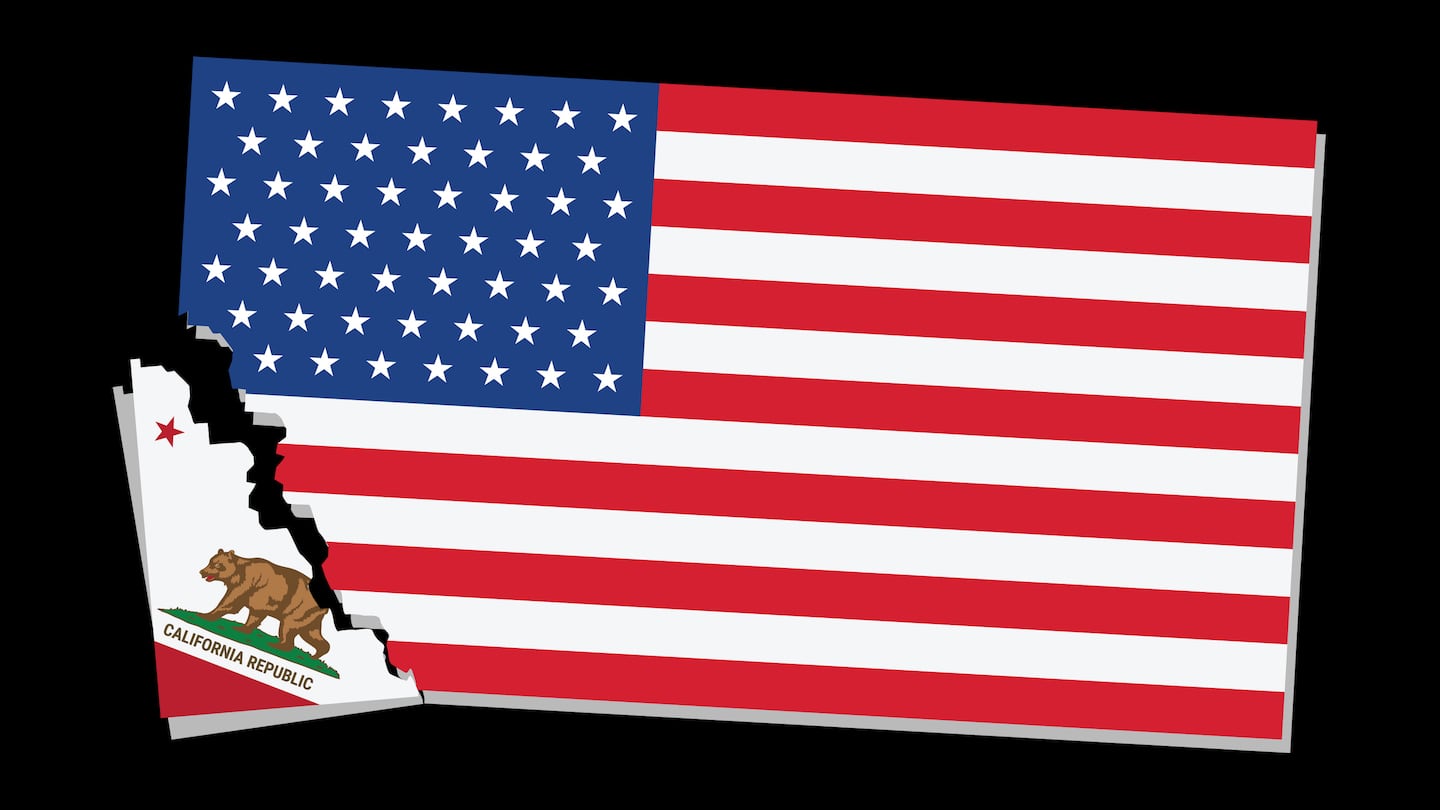
I was among those who wrote off the group as attention-seeking and kooky, and the idea as ridiculous. California may have been a breakaway state — briefly — from Mexico, but the law is clear that states can’t simply take off on their own. The last time a state tried ended in civil war. I saw “Cold Mountain” and “Glory.” No thank you.
The odds are not good for this measure either. It’s difficult and expensive to collect the amount, currently 546,651, of valid signatures needed to qualify for placement on a statewide ballot. That seems well beyond the means of an organization that for most of its existence has consisted of little more than a couple guys with a website and a crazy dream of a sovereign California.
But its chances of success are significantly better than they were even six months ago, given the military occupation of Los Angeles, with bands of masked, armed federal immigration agents regularly terrorizing residents and the daily insanity and corruption seeping out of Washington, D.C.
Secession — or independence, separation, partition, or whatever you call it — no longer sounds far-fetched but reasonable, maybe even inevitable.
That’s not just my assessment. Scholars, thinkers, and elected officials have started talking seriously about the possible dissolution of the union as federalism breaks down. “I do not think secession is likely,” Erwin Chemerinsky, dean of UC Berkeley’s law school and author of “No Democracy Lasts Forever” told the Guardian last year, “and I certainly don’t think it is desirable. But I think it is a possible path we could be discussing more in the years ahead if there are not changes.”
Meanwhile, folks in blue states have been sharing ideas about “soft secession,” in which a state withholds the tax revenue the federal government needs to function. Last month, California, Oregon, Washington, and Hawaii banded together as the “West Coast Health Alliance,” which sounds more impressive than it is. The alliance, formed to protest Health and Human Services Secretary Robert F. Kennedy Jr.’s anti-vaccine policies, is little more than symbolic. At least, for now.
Joe Mathews, a longtime California author and political columnist, argues in his new book, “The U.S. vs. Us,” that the nation has already abandoned California and divorce is imminent. Even some conservatives see the benefit of national break up. Republican Representative Marjorie Taylor Greene of Georgia wrote on X after Charlie Kirk was killed that she was done talking to liberals: “I want a peaceful national divorce.”
If there were ever a time when the idea of independence might ignite Californians, this is it. A YouGov poll conducted in June on behalf of the Independent California Institute, another organization dedicated to self-governance, found that 44 percent would vote for a peaceful and legal separation with the United States and 56 percent generally thought California would be better off as its own country.
Considering that the sample size was only 500 people in a state of 39.5 million, I’d take that with a big grain of salt. That said, Californians have been obsessed with secession from practically the moment the state was admitted into the union in 1850, though typically the proposals involved carving it into smaller states for better representation. One scheme dreamed up and funded by a Silicon Valley venture capitalist to break California up into three states actually qualified for the 2018 ballot. But the state Supreme Court kicked it off before election day for reasons that were never quite clear.
Marcus Ruiz Evans, one of the two founders of CalExit (the other is no longer involved), is upbeat about the prospects for the latest independence effort, which involves a vote of support from Californians followed by a negotiated release with Congress. He told me last week that CalExit now has things it didn’t have before: a much bigger network, staff, political connections, and more money, though not enough yet. More importantly, he believes the group has an offer that Californians, the president, the current ruling party, and nearly half of Americans who already see Californians as foreigners will love.
If California gets to go its own way, that includes its 43 Democratic House members and two Democratic senators, giving the Republicans the unfettered power they crave for the foreseeable future.
“We are of the opinion that Trump and Republicans hate us and will let us go,” Evans said. He might be right about the first part, but I am not going to hold my breath about the last. Trump might despise California, but he loves kicking it around.