
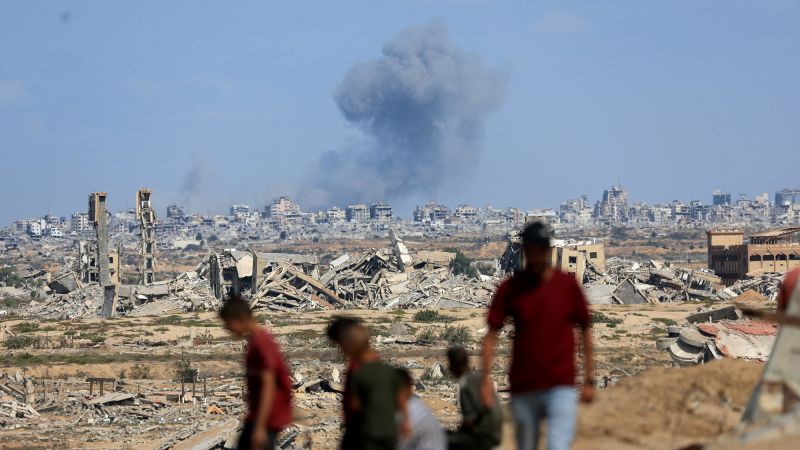
Hamas leader Khalil al-Hayya, who survived an Israeli airstrike in Qatar last month, faces an even greater existential threat in Gaza ceasefire talks in Egypt: the potential demise of his militant group.
This is what Israel and US President Donald Trump’s 20-point ceasefire plan for Gaza demands as Israel and Hamas enter indirect and secretive proximity talks in Sharm al Sheikh, Egypt’s luxurious Red Sea tourist hub.
Across the region, a sense of urgency and momentum had been building.
Over the weekend, Arab and Muslim foreign ministers whose countries signed off on Trump’s proposal, called these talks a “real opportunity for a comprehensive and sustainable ceasefire.”
Yet, despite the groundswell of optimism and increased pressure from Trump on both Israel and Hamas, early signs of a cooling are emerging.
In Cairo, the Egyptian hosts have been unusually, even by their opaque standards, tight lipped. So too has Hamas, whose officials brief reporters frequently when it is to their advantage. Even the high-level US delegation, led by Trump’s envoy Steve Witkoff and son in law Jared Kushner, have been off the radar for almost two days.
Both Trump and US Secretary of State Marco Rubio on Sunday told reporters, without offering detail, that talks were ongoing, but ambiguity on the makeup of the Israeli delegation, and a possible slowing of the talks’ timeline hint at the scale of the challenge.
Netanyahu’s confidant, Minister for Strategic Affairs Ron Dermer, isn’t going to the talk in person just yet, instead planning to lead the Israeli delegation remotely.
It was a subtle signal that gaps between the sides won’t be closed as quickly as hoped. Amid his oft repeated optimism that everything is on track, Trump said Sunday that talks could take “a couple of days.”
Talks may still succeed, but the potential to back flip is monumental.
A point in case in Trump’s 20-point plan, which calls for the “decommissioning” of Hamas’s weapons by “independent monitors,” language redolent of the head of Trump’s Gaza “Board of Peace,” Tony Blair. His 1998 ceasefire deal in Northern Ireland took a further seven years to fully “decommission” the weapons of the Irish Republican Army.
In speeches last week, Netanyahu spoke of Hamas’ disarmament, saying, “if they fail to do it – we will do it.”
Such is the gap on this and other issues that Hamas held pre-negotiation talks with Egyptian and Qatari officials in the hours before the Israeli delegation arrived, according to a senior Hamas official.
As in any peace talks, absent an absolute victor, and the seemingly vanquished refusing to admit defeat, the language surrounding talks is the best clue to potential success. As of now, compromise is not central in the public lexicon.