
About 13 miles up a winding national forest road near Three Rivers, Oregon, Alain Bonneville stands in the middle of a small clear-cut site called Pad 29. Bonneville is the chief geoscientist at Mazama Energy. It’s a geothermal development company that’s working on developing innovative techniques, approaches and methods to harvest heat from the ground.
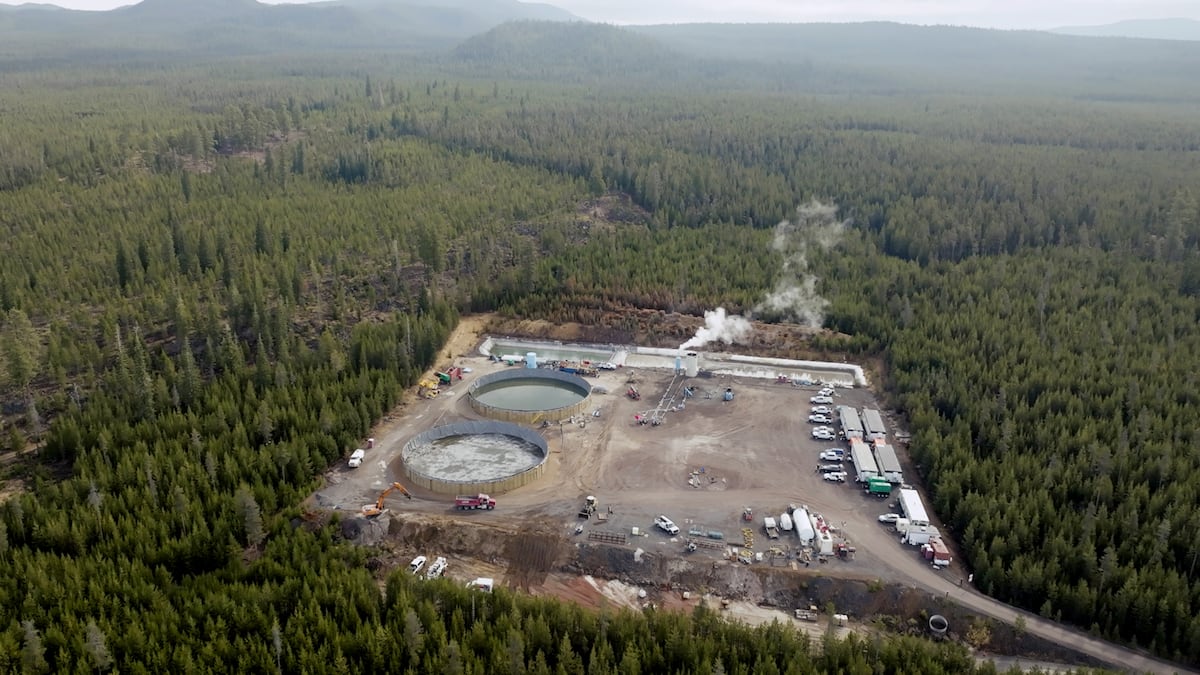
Pad 29 sits just above the clouds west of the Newberry Volcano, where it’s surrounded by trees. Though small, it’s a busy and noisy place where loud drills bore into the earth and workers drive huge trucks in and out of the area. There are also two huge water tanks at the site.
But a tall blue cylinder connected to two deep wells billowing clouds of steam is the main attraction of Pad 29.
Aerial shot of Mazama Energy’s Pad 29 on Sept. 9, 2025. The company and its partners are digging deep to harness heat from hot rocks in hopes to generate enough energy to someday power homes.
Brooke Herbert / OPB
“What we have done between these two wells, we have created an artificial reservoir where we will be injecting cold water and recovering steam, hot water — and the goal of this project is really to demonstrate that the techniques that we have been using were successful in creating this reservoir,” Bonneville says.
Mazama Energy, along with its partners, are trying to prove something that’s never been done in this way before — harnessing heat two miles deep beneath the earth’s surface to generate enough electricity to power homes.
But the company is hoping to harness heat from a very particular and unconventional source — “SUPER HOT ROCKS, YEAH!” Bonneville says as he stands near the blue cylinder.
Super Hot Rocks is a type of enhanced geothermal system.
Mazama Energy has successfully proven it can harness heat from a shallow surface. The steam coming out of the blue cylinders indicates success. The next phase is to go deeper into the ground to harness that heat.
Bonneville hopes the company and its partners can use this pilot project to increase the use of geothermal as a renewable energy source in Oregon and beyond.
“This will be sort of a world premiere because nobody has done that so far,” he says. “This is quite unique. So this is really a forefront development for cutting-edge research.”
The ‘world premiere’ for Super Hot Rocks
Conventional geothermal has long been used in places where hot water or steam are found close to the earth’s surface and have a natural flow circulating underground. Think of Yellowstone’s Old Faithful or those natural hot springs found throughout Oregon’s forests — they provide clues into what’s happening underneath.
And because geothermal uses the earth’s natural elements, it’s also a continuous and reliable source of renewable energy. It does not depend on wind to blow a turbine or the sun to shine to produce electricity. It’s considered a base-load energy source because it can run 24/7.
The Oregon Institute of Technology in Klamath Falls has been using geothermal energy to heat buildings and sidewalks since the mid-1960s, with a system based around naturally occurring underground hot springs. In 2010, the school built Oregon’s first geothermal power plant, and the university has since expanded it to generate nearly 2 megawatts of power — saving the school about $1 million in heating costs a year.
But conventional geothermal has its limits. It needs natural elements, like heat from a hot spring near the Earth’s surface, for it to work. And because of that, only certain regions are able to use this type of energy resource.
Super Hot Rocks may change that, and the Cascade Range offers this kind of enhanced geothermal system a place where this new technology can thrive.
“Central Oregon is a good place for this kind of project,” Bonneville said.
For the past 50 years, Newberry Volcano has been a hot spot for geothermal exploration. Universities, national laboratories and companies have studied, explored and drilled wells in the area to learn more about how geothermal works and figure out other ways heat can be harnessed.
Since the Newberry Volcano is active — it last erupted 1,300 years ago — there is a magma flow close to the surface, even if steam or geysers aren’t visible.
Mazama Energy’s wellhead that’s connected to tubes going thousands of feet deep in the ground, seen on Sept. 9, 2025. The company hopes to tap into an uncommon energy source that could help Oregon and the rest of the region meet its renewable energy goals — Super Hot Rocks.
Monica Samayoa / OPB
That’s where Super Hot Rocks comes in, as well as the unlikely help of the oil and gas industry’s technology — drills.
Although it uses the same technology as the oil and gas industry, geothermal is different from fracking in key ways. To extract oil and gas, a company drills into the ground and injects water and chemicals into the earth to create new fractures that pull fossil fuels to the surface. In conventional geothermal, the drills are used to locate natural water flows underground, which transfer the heat back up. For enhanced geothermal systems like Super Hot Rocks, only water is injected to create pathways in the hot rocks to transfer heat back up to the surface.
At Newberry, Mazama Energy is drilling wells nearly two miles deep beneath the earth’s surface and then injecting water into an engineered hot rock reservoir.
When the water gets that deep, it absorbs the Earth’s natural heat and becomes extremely hot.
As it returns to the surface, it turns into steam and drives a turbine to generate electricity.
Then the steam is cooled, converted back into water, and reinjected into the reservoir, allowing the cycle to continue.
The goal is to not only harness the heat at these depths, but also ensure the system is reliable, efficient and economical.
“If you are able to collect this heat from Super Hot Rocks, you will be much more efficient in producing electricity,” Bonneville said. “Each well will produce six to eight times the amount of electricity than a conventional one.”
A blue cylinder billows steam indicating success for Mazama Energy’s pilot project on Super Hot Rocks on Sept. 9, 2025.
Monica Samayoa / OPB
That type of energy can help Oregon and the rest of the Pacific Northwest tap into a new renewable energy source at a time when the region needs to produce more energy.
Using Super Hot Rocks technology, the western flank of Newberry could produce up to 200 megawatts of electricity, according to Bonneville. That’s enough electricity to power double the current residential population of Bend, he said.
“It doesn’t mean that this is our goal, but this is the estimate we can produce here on this part of Central Oregon,” he said.
Drills, waves, rocks and brains
Partnerships are an important element of Mazama Energy’s Super Hot Rocks pilot.
The project is currently funded through a $20 million grant from the U.S. Department of Energy, which has allowed the company to team with businesses, universities and federal research labs. Those include the Pacific Northwest National Laboratory, the Lawrence Berkeley National Laboratory and the National Renewable Energy Laboratory, as well as Oregon State University and the University of Oklahoma. Each entity provides the project with a special expertise or insight into how Super Hot Rocks technology might be successful.
“We have aligned research interests and we’re really able to work together to help move this technology forward,” PNNL geothermal portfolio manager Jana Simo said. “One of the things that we bring to this partnership is our expertise in geophysics, seismology and how you go to set up monitoring systems.”
PNNL is also looking into induced seismicity to understand the difference between a natural earthquake and one generated by geothermal drilling, Simo said.
“Having all of us work together with our different resources is super valuable, and that’s what makes these projects go,” she said. “It’s the skills and it is also the collaborative conversations and discussions that we have together as well.”
Enegis, a consulting firm for energy and natural resource projects, is another partner.
Enegis’s role is to find the best place to drill that makes Super Hot Rocks cost-effective, or to determine the cheapest way to do it.
“We’re to drill the geothermal wells to cut down the cost and make geothermal a more viable type of technology for good energy,” said Peter Malin, who is Enegis’ chief scientist for the project and also a professor emeritus of seismology, geology and geothermal energy at Duke University’s Nicholas School of the Environment.
To do this, Enegis uses a huge truck that vibrates the ground, sending earthquake-like waves, about a 2.0 on the Richter scale, over a span of 30 seconds. Unlike an actual earthquake, which sends sudden jolts, the truck vibrates the ground in waves.
In the surrounding area, there are more than 1,300 geophones, or sensors that detect ground vibrations, to pick up the wave signals.
“It’s used like a fish finder or a focusing device for a camera that allows you to see the interior of the earth and focus on the geological properties so that we can find out where to drill,” Malin said.

Enegis’ chief scientist Peter Malin stands near a vibrating truck that sends earthquake-like waves to find natural fractures in the ground. Enegis is a consulting firm for energy and natural resource projects. The technology the company is developing could make drilling geothermal wells cheaper. Photo taken on Sept. 9, 2025.
Monica Samayoa / OPB
This then helps Mazama Energy locate the best places to drill and, in turn, helps reduce the primary cost of geothermal energy — locating and drilling.
“We look forward to developing this technology for the benefit of all in terms of inexpensive energy and adoption of technology that has been developed over the last hundred years in oil and gas, but that can have significant parts transferred over to geothermal,” Malin said.
Super Hot Rocks proponents say this work could bring big changes for Oregon and the rest of the Pacific Northwest by diversifying renewable energy sources at a time when the region works to wean off fossil fuels like oil and natural gas to meet greenhouse gas reduction goals.
Geothermal’s potential in Oregon
As more people switch from gas to electric appliances in their homes and more power-hungry data centers connect to the power grid, the state needs to add more renewable energy to meet demands. Oregon is already behind on its renewable energy goals, and adding new sources to the grid could take years. The state has mandated utilities to fully eliminate greenhouse gas emissions associated with the electricity they provide by 2040.
President Donald Trump, however, has advanced policies that are often counter to Oregon’s renewable goals. The administration’s attacks on wind and solar production are making it harder to add these renewable energy resources to the grid. Trump is also rescinding billions of federal dollars previously allocated toward climate action, including funds that would have supported solar development in Oregon.
But the development of geothermal as a renewable energy source is something his administration does support, and it has provided millions in funding.
As of 2023, geothermal energy makes up less than 1% of the state’s electricity mix, according to the Oregon Department of Energy.
If Mazama Energy’s pilot project is successful, it could be a huge breakthrough for Oregon, said Amy Schlusser, Gov. Tina Kotek’s climate and energy advisor.
“We’re talking about renewable, reliable and affordable electricity, which is ultimately what the state is trying to gain access to for all electricity users,” she said. “It’s just a huge game changer.”
Schlusser said Super Hot Rocks also has the potential to boost the renewable energy workforce by creating jobs, from people involved in developing a power plant to those who maintain the facilities.
It would also make Oregon a frontrunner in developing this technology, she said.
“Oregon really has made an effort to be welcoming to new innovative technologies, and we’ve tried to build up a structure so that we can support these types of emerging technologies and emerging industries,” she said.
The state already has regulations in place that provide oversight and directives for geothermal energy production, Schlusser said, but Oregon will need to create a streamlined process to help companies better understand how long it will take to hook onto the grid and get online.
A closed-loop system, reaching a full circle moment
Mazama Energy geoscience intern Ashlynn Bowles is excited about the potential. The development of geothermal energy using Super Hot Rocks could help her hometown find a much-needed energy solution.
“We have a lot of data centers in Prineville and those use up a lot of electricity,” she said. “And so looking to the future for solutions for where we’re going to see that energy come from is very important.”

Mazama Energy geoscience intern Ashlynn Bowles and Mazama Energy’s chief geoscientist Alain Bonneville discuss Super Hot Rocks on Sept. 9, 2025.
Brooke Herbert / OPB
Bowles was born and raised in Bend and recently graduated from Oregon State University. She grew up hiking the Newberry area, picking up all kinds of rocks as a kid, she said. Her interest in geology began when she took an entry-level geology class at a community college in town.
Now, she’s helping Mazama Energy understand the geological and geophysical controls that are needed for geothermal sites.
“Trying to take in context geology and what creates the ideal situations for geothermal reservoirs,” she said.
Bowles said she’s always had an interest in renewable energy and now it has tied in with her love for rocks.
And working up close with a technology that’s inching closer to becoming a reality, a technology that could benefit her community, is something special, she said.
“I’ve had a poster of Newberry in my room since I started studying geology,” she said. “So it’s really a full circle moment for me to be working on a project out here.”
Mazama Energy will continue testing its technology and will conduct a test at deeper depths soon.
If successful, the company plans to build a larger project, big enough to produce electricity.
And if that is successful, Mazama Energy’s Bonneville says, Oregon could someday have Super Hot Rocks powering homes.