
Key Highlights
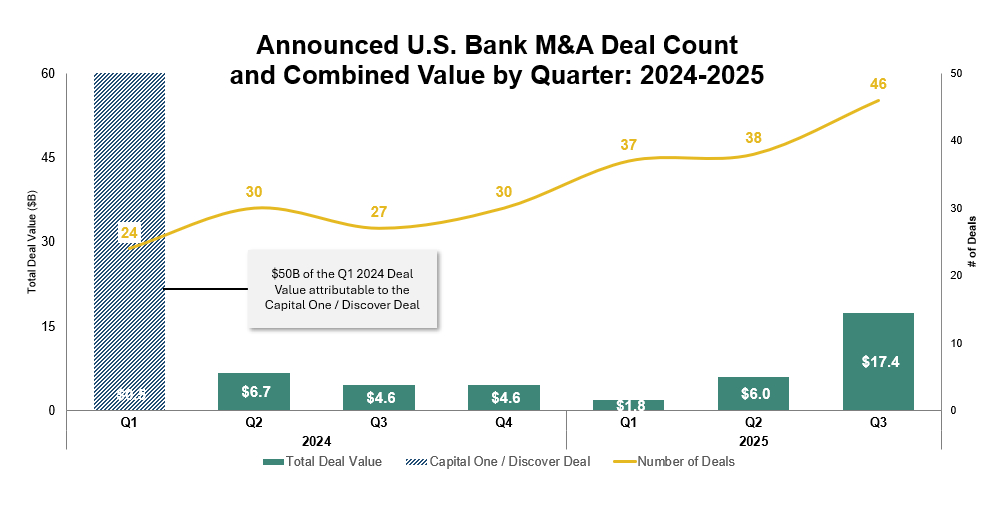
Active Q3: U.S. bank combinations continue to
accelerate with 46 transactions announced in Q3 totaling $17.4
billion in total deal value.
Year-over-Year Comparison: Deal activity
through September 2025 has surpassed the prior three years’
levels both in number of deals and total transaction value
(excluding Capital One-Discover).
Market Influences: Macroeconomic tailwinds such
as the recent and anticipated future rate cuts from the Federal
Reserve System are expected to further boost confidence and ease
the valuation challenges that have created friction in the past.
Also, a relaxed regulatory environment is expected to help deal
fundamentals and execution.
Positive Outlook: The current pace of U.S.
banking mergers and acquisitions (M&A) suggests a sustained
period of activity. Pro-growth regulatory policies and a more
consolidation-friendly environment suggest favorable conditions for
a strong finish to the year.
Notable Q3 Transactions
Q3 2025 has seen some significant transactions announced,
including:
Deal Overview
Pinnacle Financial Partners and Synovus Financial Corp.
combination: Announced on August 21, this $8.6 billion
all-stock merger of equals is the largest bank-on-bank deal of
2025. The transaction is set to create a combined entity with over
$140 billion in assets, solidifying its position as a leading
regional bank in the Southeast. The deal is strategically important
for Pinnacle, providing significant scale and a diverse platform to
compete more effectively with larger national institutions. For
Synovus, the merger offers shareholders a 10% premium and a
significant 48.5% ownership stake in the new company, allowing them
to participate in its future growth, with CEO Kevin Blair being
tapped as president and CEO of the combined entity.
PNC acquiring FirstBank: Announced on Sept. 8,
this $4.1 billion cash-and-stock deal will significantly expand
PNC’s presence in high-growth western markets, particularly
Colorado and Arizona. The acquisition of FirstBank, a privately
held bank with $26.8 billion in assets and 95 branches, is a
strategic move for PNC to become the number one bank in Denver in
terms of retail deposit and branch share. The deal will more than
triple PNC’s branch network in Colorado to 120 and increase its
Arizona branches to over 70. This transaction is part of PNC’s
broader strategy to grow its national franchise through both
organic expansion and strategic acquisitions, following its 2021
purchase of BBVA’s U.S. operations. The deal is expected to
close in early 2026.
Huntington Bancshares Inc. acquiring Veritex Holdings,
Inc.: On July 15, Huntington announced a $1.9 billion
definitive agreement to acquire Veritex. This deal is focused on
expanding Huntington’s presence in high-growth,
business-friendly markets in Texas, particularly in Dallas, Fort
Worth, and Houston, and is a clear example of strategic geographic
expansion.
TowneBank acquiring Dogwood State Bank:
Announced in early August, TowneBank’s approximately $476.2
million acquisition of Dogwood State Bank will expand its presence
in North Carolina and provide a platform for further growth in key
metropolitan areas.
Prosperity Bancshares, Inc. acquiring American Bank
Holding Corp.: This $321.5 million deal, announced on July
18, is a strategic move for Houston-based Prosperity Bancshares to
enhance its footprint in the Texas and Oklahoma markets by
acquiring a bank with a strong commercial lending portfolio and a
complementary branch network.
Themes
M&A Dominates Q2 Earnings Calls
The conversation around banking M&A has undergone a notable
change over the past year, shifting from a peripheral topic to a
strategic priority for much of the U.S. banking sector. An analysis
of Q2 2025 earnings call transcripts from over 100 banks confirms
this trend, revealing a significant change in strategic intent
compared to Q2 2024.
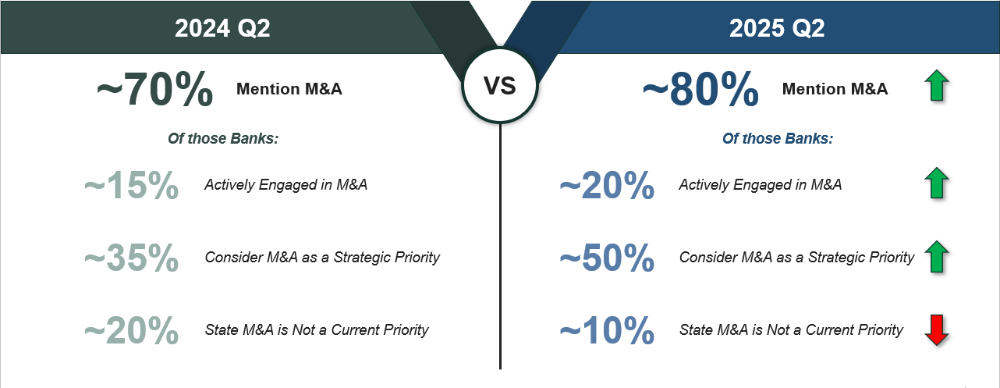
While the number of banks mentioning M&A rose from 70% to
80%, the more telling metric is the increase in commitment. The
proportion of banks explicitly identifying M&A as a strategic
priority jumped from 35% to 50%, signaling a decisive move from
passive consideration to active planning. At the same time, the
share of institutions dismissing M&A as a growth lever was cut
in half, falling from 20% to just 10%. This reduction underscores
the diminishing reluctance to pursue inorganic strategies.
The decisive shift in sentiment demonstrates that M&A is now
a fundamental strategy across the industry. With deal volume
increasing, pressure is mounting on banks to either join the
consolidation or risk being outmaneuvered.
Two Geographic Strategies Begin to Emerge
Geographically, U.S. banking M&A activity in 2025 has been
concentrated in a few key regions, particularly in the Midwest. Two
trends dominate the landscape:
Larger players buying into high-growth markets, and
Community banks consolidating for scale.
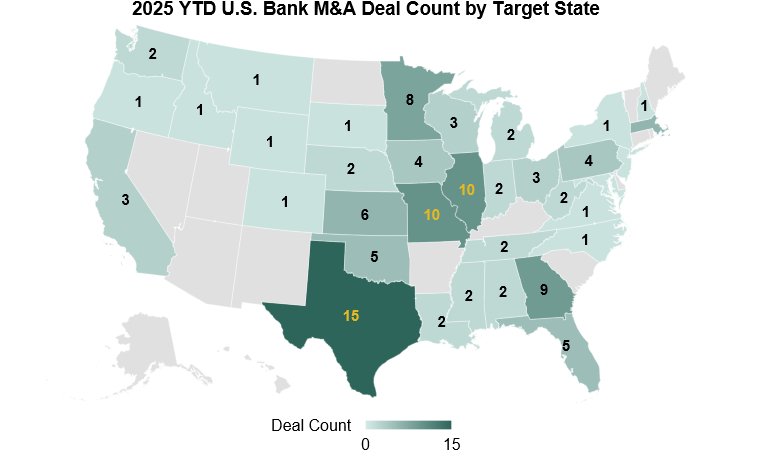
Texas remains the clear leader with 15 announced deals year to
date, with notable activity from larger out-of-state acquirers like
Huntington and Glacier Bank seeking a geographic foothold in one of
the nation’s most attractive, high-growth economies.
In contrast, Illinois and Missouri are examples of markets where
community banks are more focused on consolidation for scale. In
Illinois, eight of the 10 deals have been in-state, signaling a
maturing market where banks are merging to create efficiencies.
Missouri’s 10 deals all involved community banks under $10
billion, underscoring the pressure on smaller institutions to
partner up to remain competitive.
The concentration of activity in Texas and the Midwest
underscores the two afore-mentioned strategies: growth-driven
expansion in booming regions and efficiency-driven consolidation in
mature ones. Looking ahead, we expect these dynamics to persist,
with high-growth states continuing to attract out-of-market buyers
and community bank mergers accelerating in regions facing cost and
technology pressures.
Deregulatory Shift Expedites Closing Timelines
A pivotal shift in bank M&A regulation marked the third
quarter of 2025. Key policy reversals have created a more
predictable framework, directly accelerating transaction closing
times.
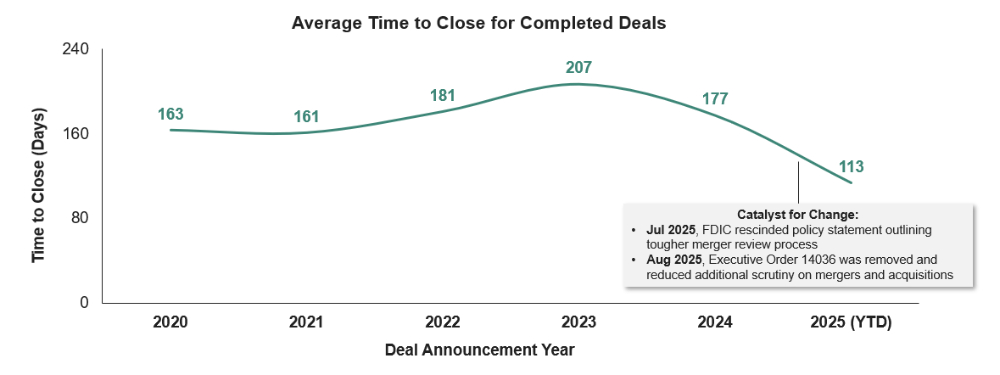
In July, the Federal Deposit Insurance Corporation (FDIC)
formally rescinded their 2024 policy statement that had outlined a
tougher review process for bank mergers and reinstated the more
transparent 1998 guidelines. Shortly thereafter, the revocation of
Executive Order 14036 signaled an end to the aggressive
“whole-of-government” stance against corporate
consolidation in favor of traditional antitrust principles.
Together with a Congressional Review Act resolution overturning a
similar Office of the Comptroller of the Currency (OCC) rule, these
policy changes mark a return to a more transparent, principle-based
evaluation of bank mergers by the primary regulators.
These recent regulatory adjustments have not only clarified the
regulatory framework but also contributed to shortened deal
execution timelines. Following a peak in 2023 with increasing
delays, there has been a dramatic acceleration in deal closing
times. The average time to close for deals announced in 2024
decreased by 30 days compared to 2023. This trend has continued,
with the average time at 117 days as of October 2025 — 64
days shorter than the 2024 average. A clearer regulatory
environment is boosting dealmaker confidence and restoring
predictability and efficiency to the M&A process.
New Wave of Non-Traditional Competitors
While recent regulatory changes have accelerated M&A
activity by reinstating clarity and predictability, they have also
opened the door for a new wave of non-traditional competitors to
enter the regulated banking system.
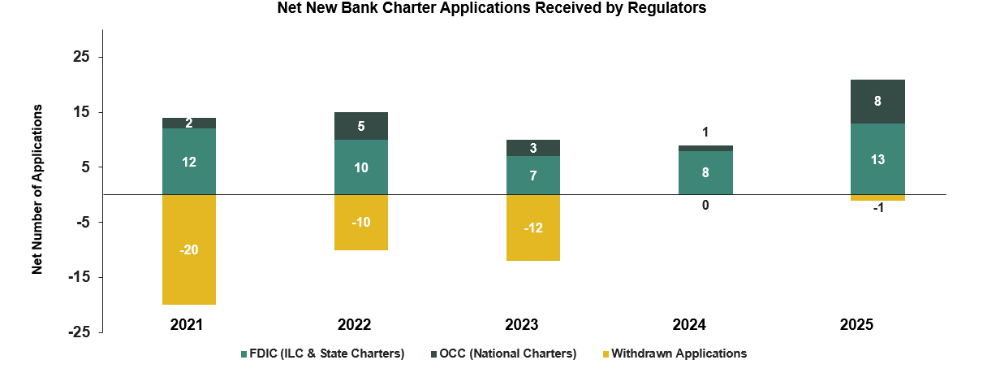
From 2021 to 2023, withdrawn charter applications averaged 13
per year, signaling a challenging approval process. As a result,
many FinTechs turned to back-door entry by acquiring small banks,
such as LendingClub’s acquisition of Radius Bank in 2020 or
SoFi’s acquisition of Golden Pacific Bank in 2022.
The GENIUS Act of 2025 changed this dynamic by creating a
clearer path to bank charters and encouraging new entrants into the
market. In 2025 so far, there has been one withdrawn application,
21 new filings, and the highest level of OCC national charter
activity in four years. FinTechs and other digital-first firms are
leveraging the new framework to gain direct access to the federal
banking system, rather than relying on acquisitive entry
strategies.
Over time, this could slow FinTech-on-bank M&A activity, but
it also sets the stage for a more competitive landscape. As these
tech-savvy entrants scale, they are likely to become larger and
more formidable M&A targets for traditional banks, increasing
competitive pressures and influencing future deal strategies across
the industry.
Completed Deals
27 deals closed in Q3. A detailed list of these deals, along
with primary and secondary reasons, is provided below:
Ann. Date
Comp. Date
Buyer Name
Target Name
Primary Reason
Secondary Reason
5/29/2025
9/5/2025
The Farmers State Bank of Oakley, Kansas
Kaw Valley State Bank
Geographic Expansion & Market Share Increase
Enhanced Product / Service Offerings & Capabilities
5/28/2025
8/15/2025
PSB Financial Shares, Inc.
First Community Bank
Geographic Expansion & Market Share Increase
5/16/2025
8/6/2025
First National Bank
Wyoming Bank & Trust
Geographic Expansion & Market Share Increase
5/12/2025
8/27/2025
Worthington Federal Savings Bank, FSB
Jackson Federal Savings & Loan Association
Geographic Expansion & Market Share Increase
Scale & Efficiency
4/25/2025
7/1/2025
Cadence Bank
Industry Bancshares, Inc.
Geographic Expansion & Market Share Increase
Scale & Efficiency
4/23/2025
8/31/2025
Columbia Banking System, Inc.
Pacific Premier Bancorp, Inc.
Strategic Positioning / Diversification
Scale & Efficiency
4/15/2025
9/2/2025
City National Bank of Colorado City
Citizens Bank NA
Geographic Expansion & Market Share Increase
4/3/2025
9/1/2025
TowneBank
Old Point Financial Corporation
Geographic Expansion & Market Share Increase
4/2/2025
7/3/2025
Equity Bancshares, Inc.
NBC Corp. of Oklahoma
Geographic Expansion & Market Share Increase
Strategic Positioning / Diversification
3/31/2025
7/1/2025
FB Financial Corporation
Southern States Bancshares, Inc.
Strategic Positioning / Diversification
Scale & Efficiency
3/31/2025
9/2/2025
Mechanics Bank
HomeStreet, Inc.
Strategic Positioning / Diversification
Geographic Expansion & Market Share Increase
3/21/2025
7/1/2025
BankFirst Capital Corporation
The Magnolia State Corporation
Geographic Expansion & Market Share Increase
3/13/2025
7/16/2025
Orion Bancorporation, Inc.
Mechanicsville Bancshares, Inc.
Geographic Expansion & Market Share Increase
3/11/2025
7/31/2025
Bar Harbor Bankshares
Guaranty Bancorp, Inc.
Geographic Expansion & Market Share Increase
Scale & Efficiency
2/27/2025
7/11/2025
Seacoast Banking Corporation of Florida
Heartland Bancshares, Inc.
Geographic Expansion & Market Share Increase
2/25/2025
7/1/2025
Old Second Bancorp, Inc.
Bancorp Financial, Inc.
Scale & Efficiency
1/31/2025
8/1/2025
One Community Bank
Intercity State Bank
Geographic Expansion & Market Share Increase
1/29/2025
7/1/2025
Plumas Bancorp
Cornerstone Community Bancorp
Geographic Expansion & Market Share Increase
1/18/2025
7/18/2025
Dieterich Bank
Community Bank of Trenton
Geographic Expansion & Market Share Increase
Enhanced Product / Service Offerings & Capabilities
1/10/2025
7/23/2025
CNB Financial Corporation
ESSA Bancorp, Inc.
Geographic Expansion & Market Share Increase
Scale & Efficiency
12/17/2024
7/25/2025
Northwest Bancshares, Inc.
Penns Woods Bancorp, Inc.
Geographic Expansion & Market Share Increase
Scale & Efficiency
12/16/2024
9/1/2025
Berkshire Hills Bancorp, Inc.
Brookline Bancorp, Inc.
Scale & Efficiency
Strategic Positioning / Diversification
12/13/2024
8/16/2025
Heritage Bancshares, Inc.
Fidelity State Bank and Trust Company
Geographic Expansion & Market Share Increase
Scale & Efficiency
12/9/2024
7/1/2025
Independent Bank Corp.
Enterprise Bancorp, Inc.
Geographic Expansion & Market Share Increase
Enhanced Product / Service Offerings & Capabilities
11/27/2024
7/1/2025
The Guilford Savings Bank
Eastern Connecticut Savings Bank
Scale & Efficiency
Geographic Expansion & Market Share Increase
10/23/2024
7/1/2025
Y-12 Federal Credit Union
First State Bank of The Southeast, Inc
Strategic Positioning / Diversification
Geographic Expansion & Market Share Increase
9/25/2024
8/1/2025
Mifflinburg Bancorp, Inc.
Northumberland Bancorp
Scale & Efficiency
Geographic Expansion & Market Share Increase
Looking Ahead
The U.S. banking M&A market has continued its positive
momentum through Q3. The combination of a definitive, more
accommodating regulatory environment and the announcement of
several multi-billion dollar deals in Q3 suggests a period of
sustained and robust activity. The underlying drivers of
consolidation remain strong, as institutions seek to acquire scale
to compete with larger players, invest in technology, and achieve
efficiency gains.
While macroeconomic factors like sustained high interest rates
may continue to influence deal valuations, the clarity provided by
regulators in Q3 has instilled greater confidence among potential
buyers and sellers. This shift, coupled with the strategic
imperative to grow and adapt to the digital age, points to a
continued healthy environment for bank M&A through the end of
2025 and into 2026. We anticipate that strategic combinations will
remain a key growth lever as institutions navigate a dynamic
market.
How Ankura Can Help
Ankura plays a crucial role in this process by providing expert
guidance and tailored solutions throughout the M&A lifecycle.
With deep industry knowledge and experience, our experts assist
banks in identifying strategic opportunities, conducting thorough
due diligence, and managing post-merger integrations. Our
comprehensive approach ensures that banks can maximize synergies,
mitigate risks, and achieve desired outcomes, ultimately driving
successful M&A transactions that align with their long-term
strategic objectives.
Methodology/Data Sources
The M&A transaction data presented in this report is
compiled through extensive research of publicly available
information. Our dataset includes transactions where either: 1)
banks are acquiring other banks; or 2) banks are being acquired by
non-bank financial institutions.
Our primary data sources for identifying and verifying these
transactions include:
Public Announcements and Press Releases: We
monitor newswires and company-specific press releases for official
announcements of M&A agreements.
Regulatory Filings: Key regulatory bodies
provide valuable public information. This includes, but is not
limited to, filings with the Securities and Exchange Commission
(SEC) for public companies. For financial institutions, we also
consult filings with the FDIC, the Federal Reserve, and other
relevant state and federal banking regulators.
Financial News Outlets and Industry
Publications: Reputable financial news services and
banking industry-specific publications are monitored for reported
transactions and market intelligence, which are then
cross-referenced with official sources.
Proprietary Databases and Aggregators: While
the core data is derived from public sources, we also leverage and
cross-reference information from commercial M&A databases and
data aggregators that synthesize publicly available financial and
transaction data to ensure comprehensive coverage and
accuracy.
Each identified transaction is carefully reviewed to confirm its
nature, deal value, participants, and announcement/completion
dates, ensuring the integrity of our M&A transaction
dataset.
The content of this article is intended to provide a general
guide to the subject matter. Specialist advice should be sought
about your specific circumstances.