

Thanks for reading the Her Hoop Stats newsletter. We’re excited to announce a new partnership with Hudl. Hudl’s industry-leading tools – Sportscode, Instat, and Fastmodel – elevate the preparation, performance, and player development of WNBA and NCAA teams. We appreciate their support and look forward to working with them to help bring more insight about the women’s game to you.
Haven’t subscribed to the Her Hoop Stats Newsletter yet?
By Chris Gunther, Charting Hoops: For some, the playoffs bring out their best. Pressure creates diamonds. For others, the playoffs highlight their worst flaws and biggest weaknesses. The bright lights are blinding.
There are countless examples from both ends of the spectrum across sports, but to me, two players stand out who epitomize the extremes, and they happened to face off in last year’s NBA playoffs.
The Ringer once described Jamal Murray of the Denver Nuggets as a “cold-blooded champion who knows how to meet the moment.” His performance against the Jazz in the 2020 Bubble is legendary, and following two playoff game winners in 2024, JxmyHighroller made a video called HE CAN’T KEEP GETTING AWAY WITH THIS!! in which he makes a clear argument that Murrary is the greatest playoff riser in NBA history (and saves me from making another chart).
That video also has a throwaway mention of a player on the other end of the riser-faller spectrum: “There’s James Harden, about where you would expect.” Since Harden’s Rockets infamously missed 27 straight threes in the 2018 Western Conference Finals, Harden has gone just 1-3 in Game 7s. In the last two, including one against Jamal Murray’s Nuggets last season, Harden averaged just eight points and a negative 30 on-off rating.
So who are the “Jamal Murrays” and “James Hardens” of the 2025 WNBA playoffs? There might not be as dramatic a rise or fall, but there are clearly some players who are stepping up their game this postseason, and others who are falling off.
Let’s start with scoring. The X-axis shows a player’s points per game during the regular season, the Y-axis is scoring in the playoffs.
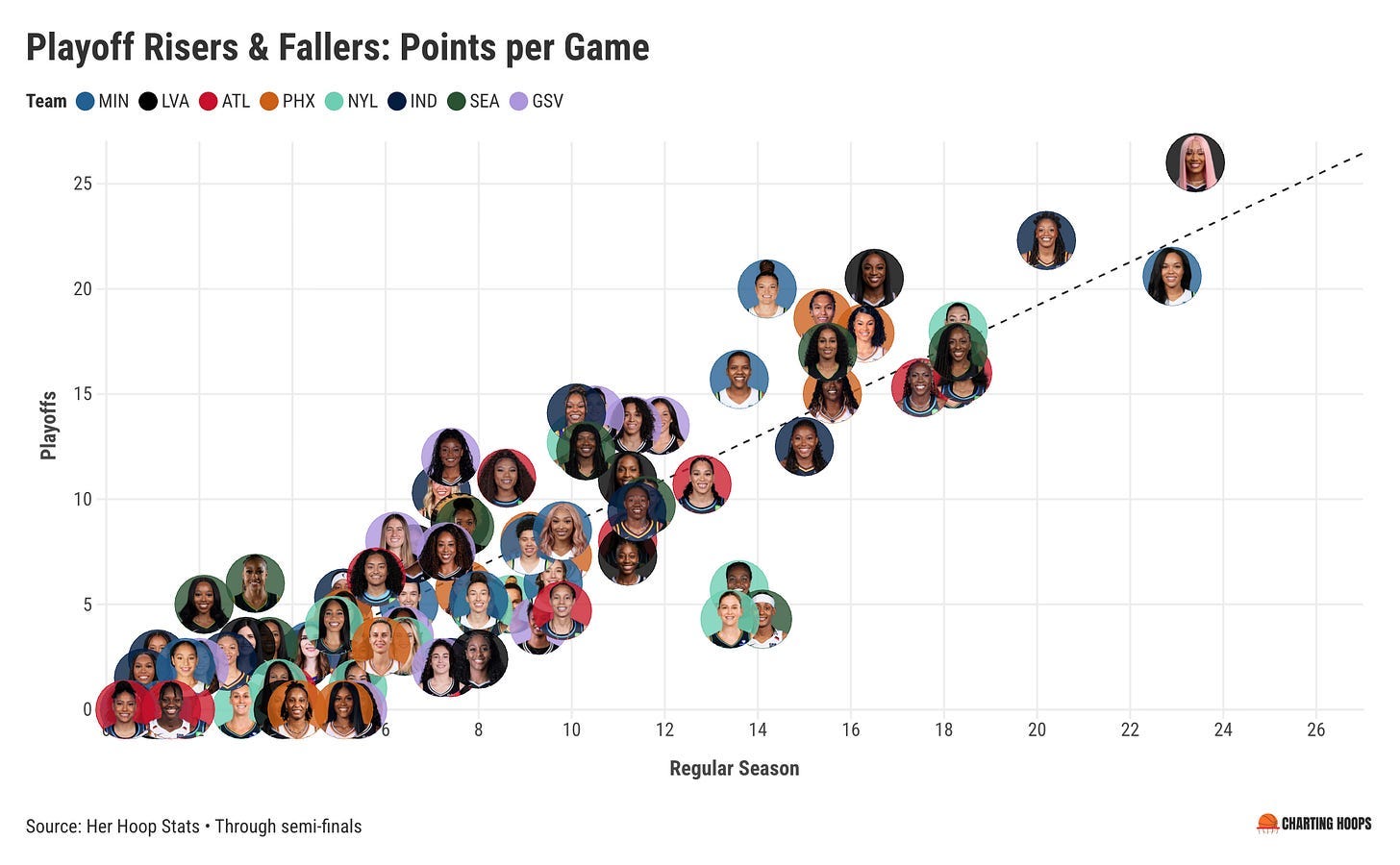
A’ja Wilson led the league in scoring during the regular season, and the MVP has taken it up another notch in the playoffs, separating herself from Napheesa Collier and Kelsey Mitchell. Her Aces were pushed to the brink in both rounds 1 and 2, but Wilson refused to have her season end, scoring 35 and 38 points in the two elimination games. Pressure creates diamonds.
But that wasn’t the biggest leap. Kayla McBride leveled up her scoring to the tune of six points per game. She finished 25th in scoring during the regular season but jumped up to 5th in the playoffs. She saved her best for last, with a 31-point outburst, leaving everything on the court to try to keep her season alive as an injured Collier sat out Game 4 against the Mercury. It wasn’t enough to overcome clutch Alyssa Thomas and the Mercury, but it did secure her place as one of the best performers of these playoffs.
On the flip side, Brittney Sykes of the Seattle Storm and Jonquel Jones and Emma Meesseman of the New York Liberty came up empty for their teams this postseason. Each only mustered about five points per game, a 10-point drop off from their regular season production.
It’s important to note the small sample size here for teams like the Storm and Liberty. Despite the expanded format this season, the Storm, Liberty, and Dream only played three playoff games, and the Valkyries played just two. All were against a single opponent. Matchup problems and off days can therefore create some statistical noise which may not reflect a player’s broader portfolio of postseason performance. For instance, Jonquel Jones came up big in the pivotal Game 5 of last year’s Finals and Meesseman won Finals MVP in 2019. Nevertheless, playoffs are always smaller sample sizes by design and to accomplish the goal of the whole season, to win a championship, you need your players to rise to the occasion in these few, critical moments.
If you want to explore more from this year’s playoff scoring, check out the interactive chart here. Click the team names to filter and hover over the photos to view the stats. You’ll notice things like:
Every Dream starter took a scoring dip as they were upset by the Fever in round 1.
Every Mercury player has been incredibly consistent, after a regular season with very little lineup consistency.
Fever and Lynx scoring shifted away from their Forwards and Centers, toward their Guards.
Points aren’t everything of course, so let’s look at some more stat changes. Here’s rebounding:
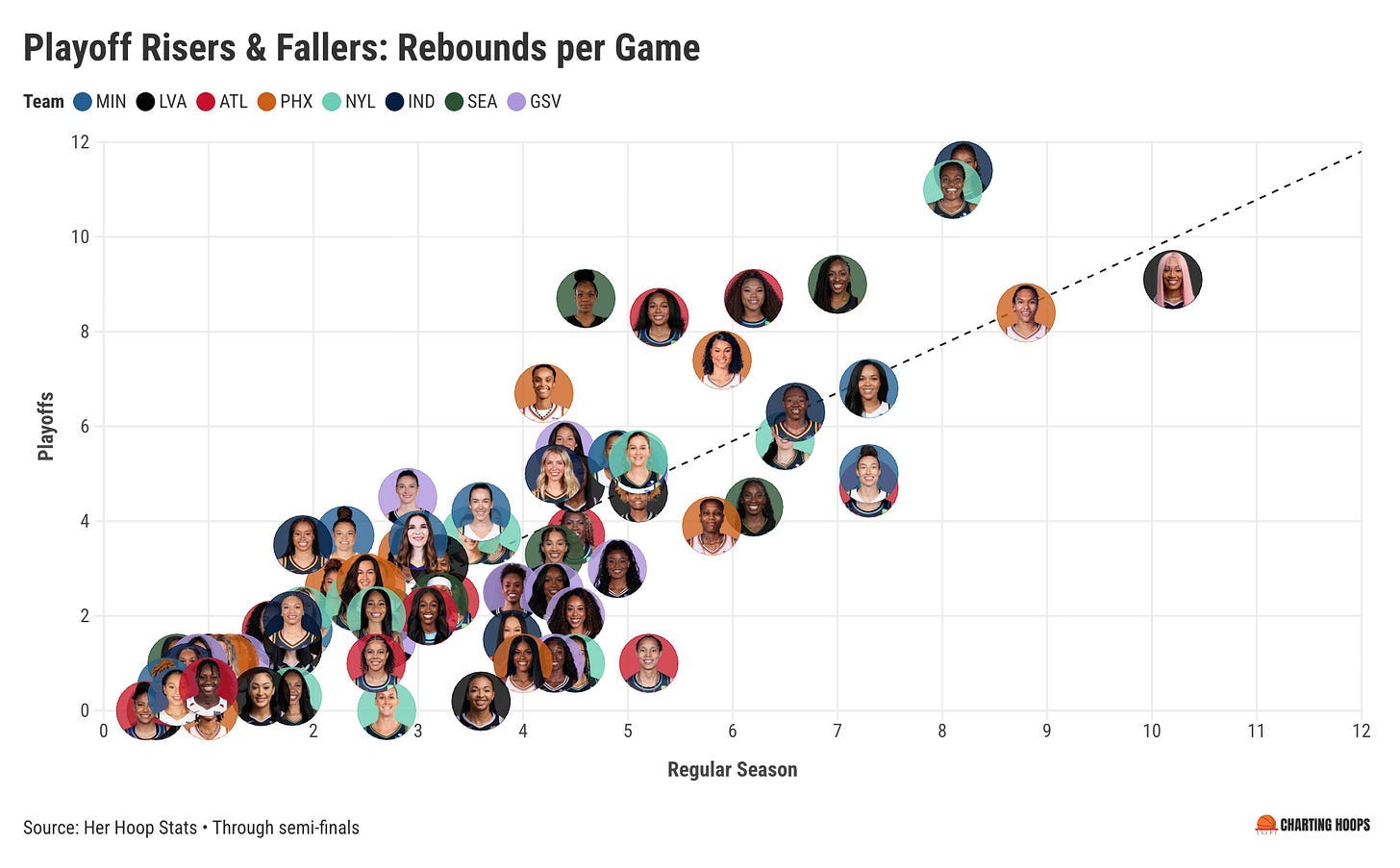
While their scoring fell off, Jones and Aliyah Boston did grab two to three more rebounds per game. Dominique Malonga had the biggest jump though; the Storm slow-rolled the 19-year-old rookie, playing her just 14 minutes per game during the regular season. That jumped to 22 minutes in the postseason, and she pulled down nearly twice as many rebounds, up to about nine per game, the fifth most in these playoffs.
Brittney Griner, the tallest player in the league, who averaged more rebounds than Malonga in the regular season, managed just one per game in the playoffs, the biggest drop off. Her minutes were cut in half as she became essentially unplayable against the Fever.
How about assists?
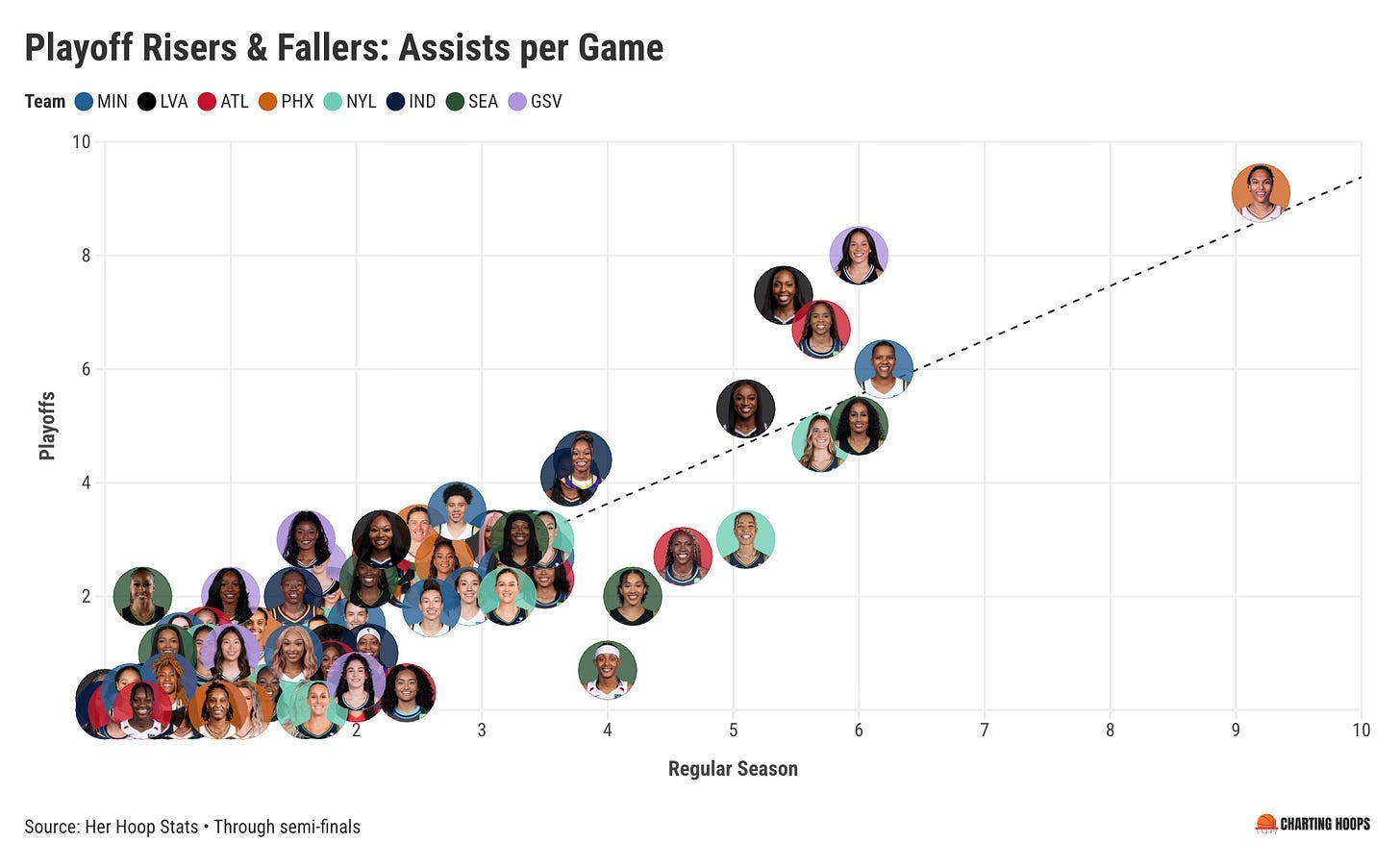
Alyssa Thomas was miles ahead of every other passer during the regular season and has maintained her numbers in the playoffs. Veronica Burton, Chelsea Grey, and Jordin Canada inched a little closer, each increasing their passing by one or two assists per game.
Brittney Sykes in Seattle is, again, the biggest faller, dropping from four assists per game in the regular season to fewer than one in the playoffs. Maybe we should have seen this drop off coming. Sykes was traded to Seattle at the deadline and never seemed to find her role with the Storm. Despite playing a similar number of minutes in Seattle as in Washington, D.C., she averaged four fewer points and one fewer rebound and assist in the Pacific Northwest. So in the playoffs, her minutes were cut significantly and her production even more.
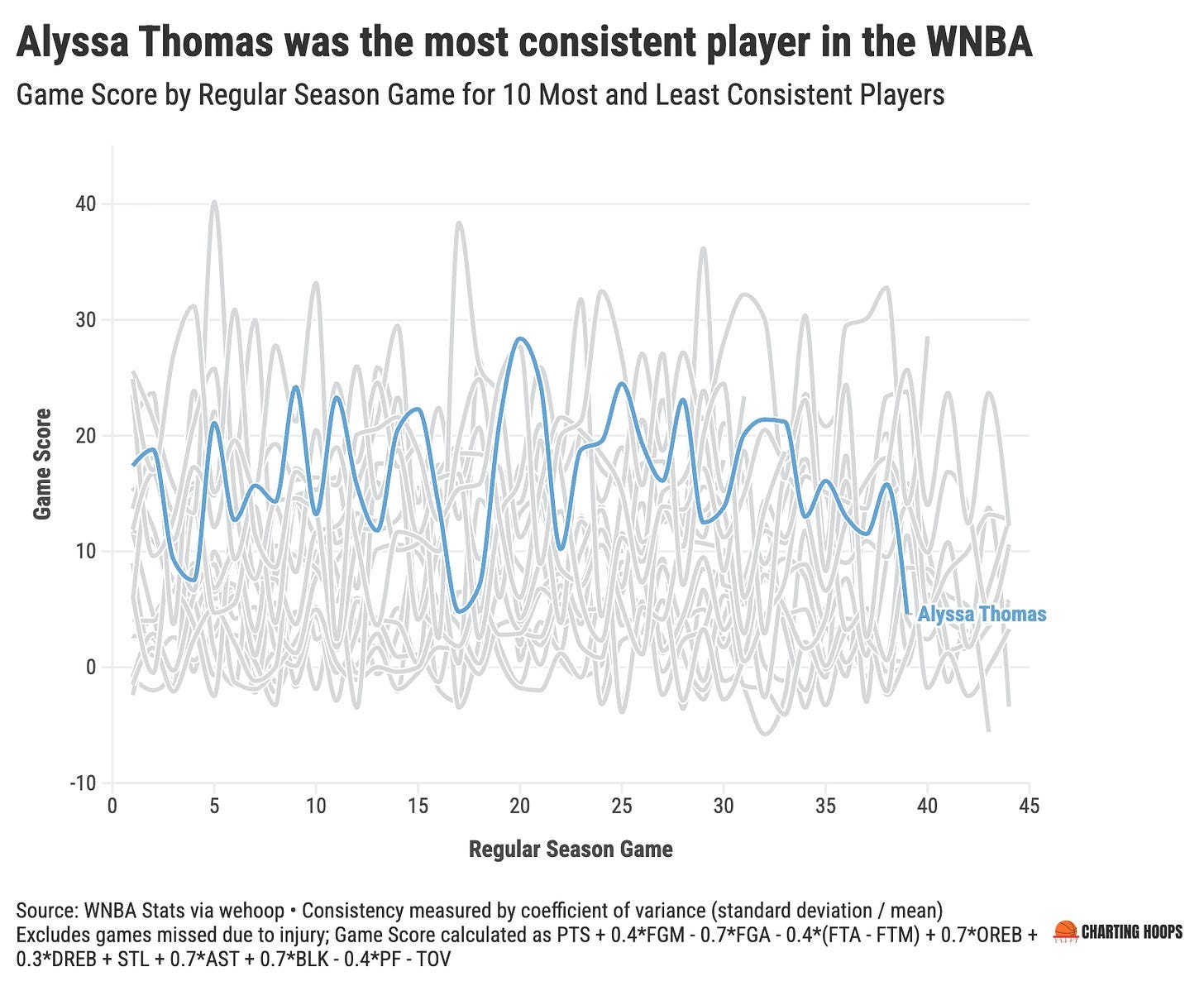
Which raises the question, who was the most consistent WNBA player this season?
Well that would be Alyssa Thomas. She posted a game score, a metric meant to capture a player’s total contribution each game, between 10 and 25 in 85% of her games this season. During a season with very little consistency in Phoenix, Alyssa Thomas provided the steadying force that guided the team to home court advantage in the playoffs and a WNBA Finals berth.
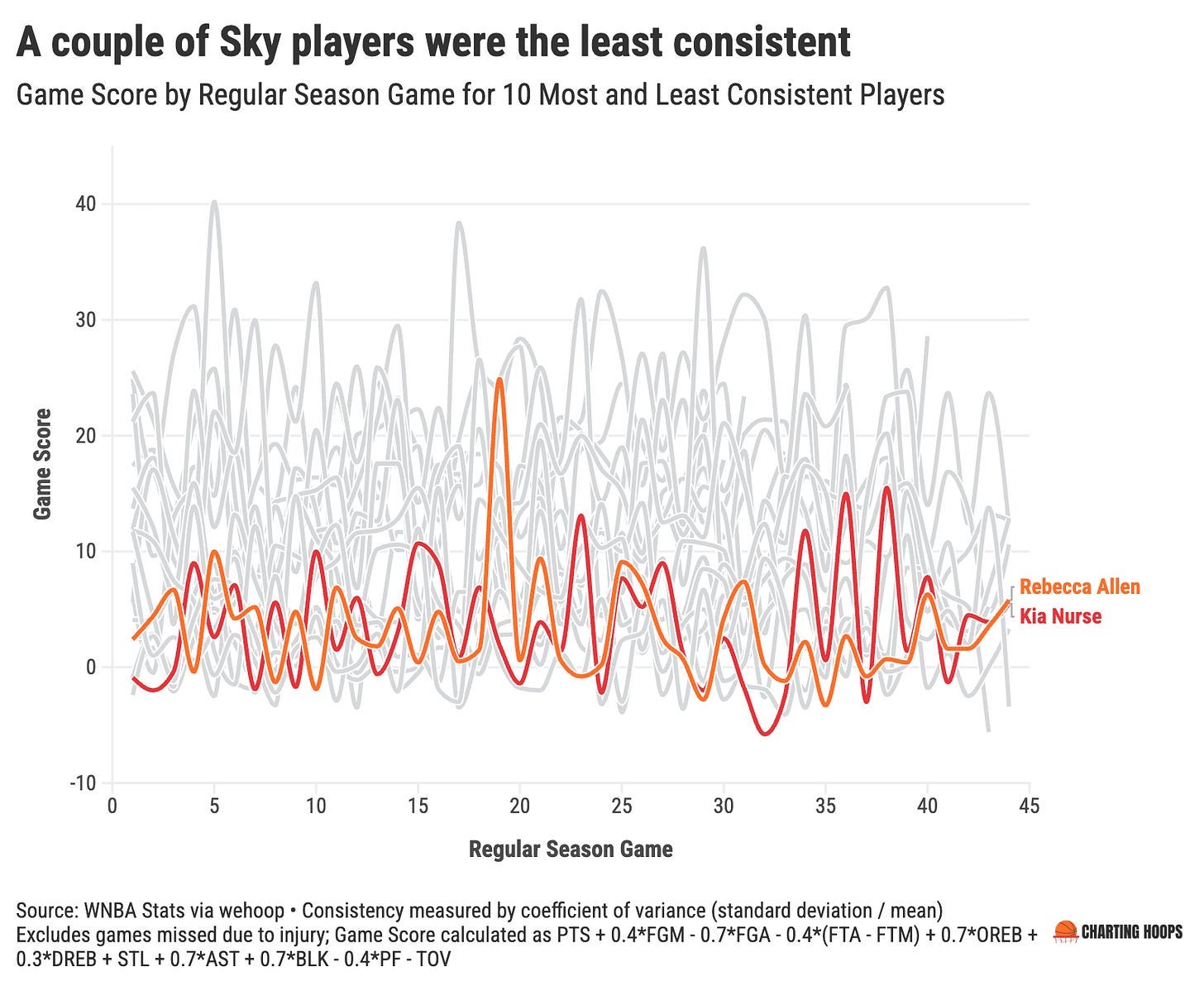
Sykes was not the least consistent player; that dubious honor goes to a couple of Chicago wings. Kia Nurse and Rebecca Allen were brought in to provide veteran presence and steadiness, but they stood no chance against the chaotic season that was in the Windy City. Both played all 44 games, but you didn’t know what to expect from them in any one.
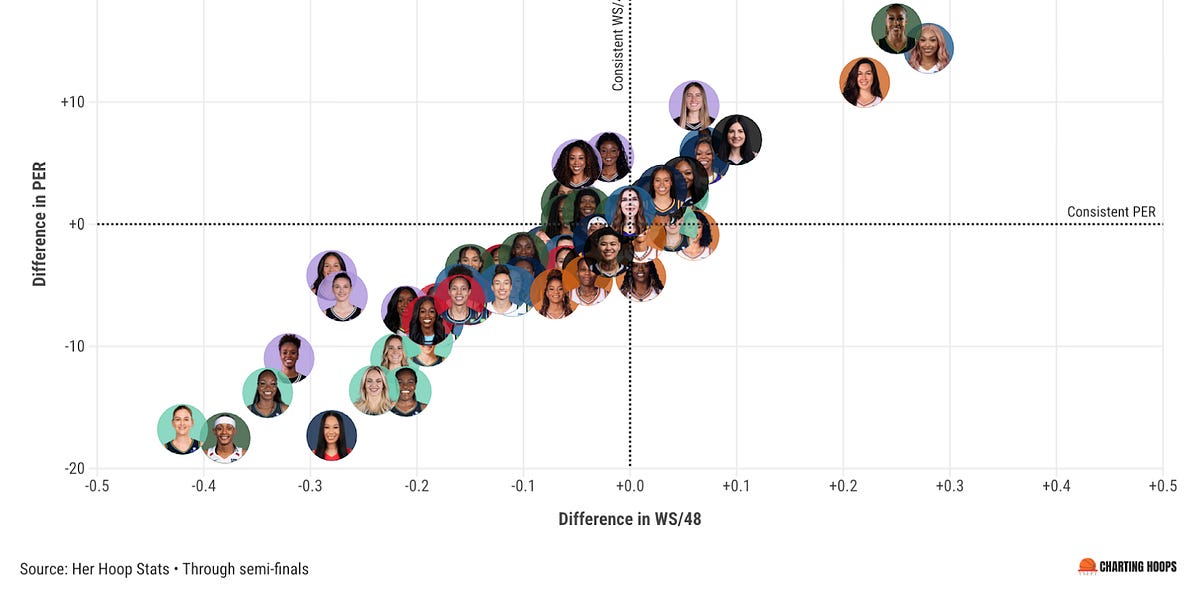
Ok, let’s bring it back to the teams that made the playoffs. We saw Kayla McBride had the biggest jump in points (+6), Dominique Malonga in rebounds (+4), and Veronica Burton in assists (+2). So who leveled up the most overall? Let’s go back to the JxmyHighroller video for inspiration, and look at the change from the regular season to the postseason in two advanced stats.
The chart below shows the differences inn player efficiency rating (PER) on the Y-axis and win shares per 40 minutes (WS/40) on the X-axis.
The further up a player is, the more productive and efficient she has been in the postseason relative to the regular season.
The further right a player is, the more she has contributed to her team’s wins in the postseason relative to the regular season.
Like the previous charts, being in the upper right is good, representing the biggest playoff risers.
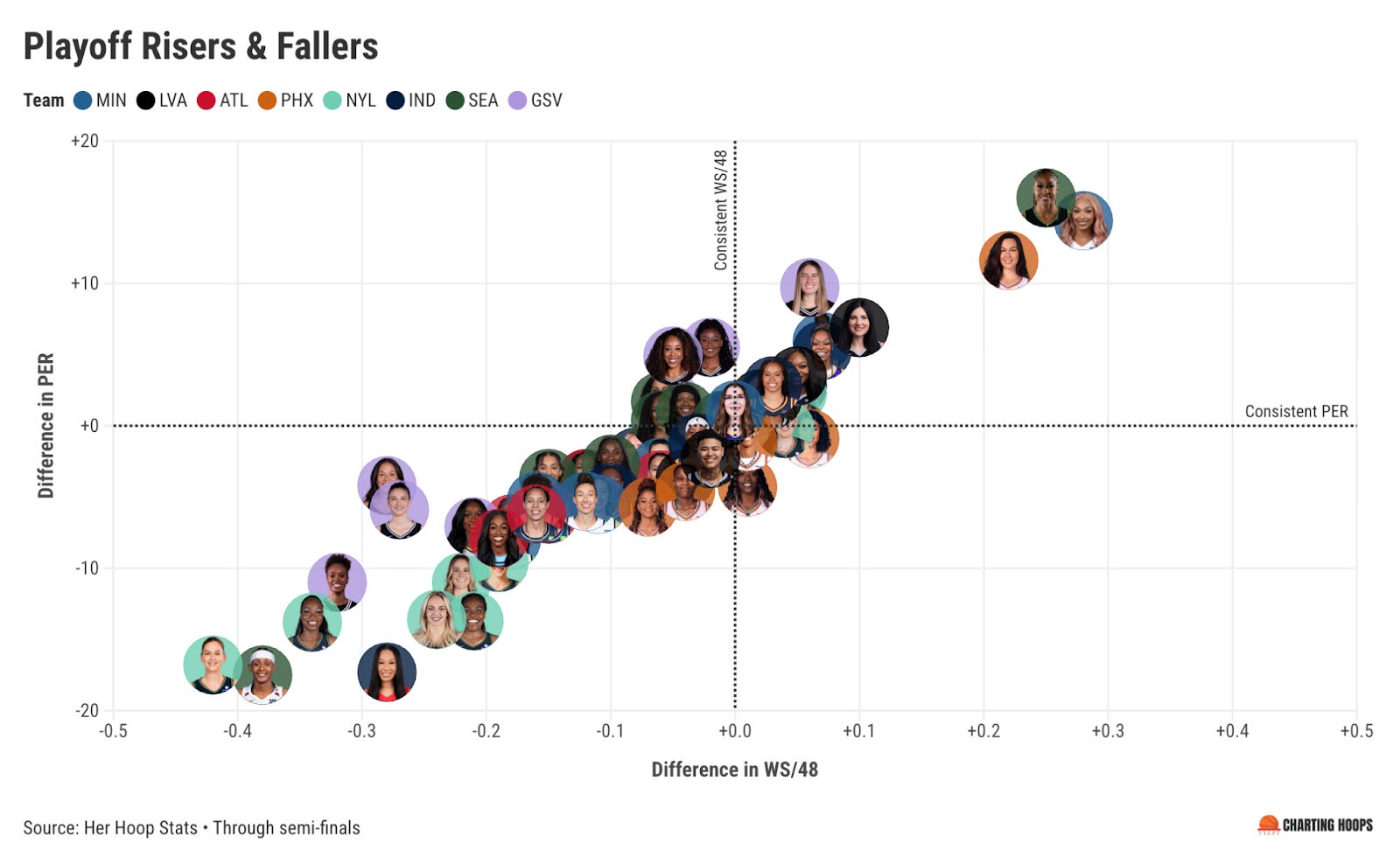
So, DiJonai Carrington is the biggest playoff ris … wait, she missed most of the playoffs with a foot sprain. Similarly, Tiffany Mitchell, Kat Westbeld, and Megan Gustafson have only played ~12 minutes per game this postseason. Kate Martin came up big for the Valkyries (she doesn’t shy away from big moments), but as mentioned above, that was over just two-games as her Valkyries were swept by the Lynx in the first round.
If we tighten up the filters a bit, the biggest playoff riser has been Odyssey Sims of the Indiana Fever. That seems fitting. In a season in which the Fever lost their entire backcourt and then some, they brought in Sims as Option D or E. She finished the season as Option A. With no Caitlin Clark or Sophie Cunningham all postseason, and no Kelsey Mitchell or Aliyah Boston down the stretch in Game 5 of the semi-finals, Sims took the dynasty-seeking Las Vegas Aces to overtime. She scored 14 points in the final 15 minutes, after averaging just 10 per game during the regular season. That’s rising to the occasion, even if she couldn’t lift her team quite enough.
Meanwhile, I hate to end on a negative note, but it’s hard not to notice the six seafoam green Liberty bubbles in the bottom left quadrant of that chart above. Again acknowledging the three-game sample size, only Breanna Stewart and Natasha Cloud were close to their regular season selves; everyone else dropped the ball for the Liberty, sending them to an early offseason and the end of the Sandy Brondello era in Brooklyn.
Of course, there’s still a few games left to be played, and we might see some new faces emerge. For instance, I didn’t have Dana Evans scoring 21 and doing the Game 1 postgame interview with Holly Rowe on my bingo card, then Jackie Young went crazy in Game 2. I’m excited to see who levels up for the rest of the series.
Thanks for reading the Her Hoop Stats Newsletter. If you like our work, be sure to check out our stats site, our podcast, our YouTube page, and our social media accounts on Bluesky, Instagram, Twitter, and Facebook.