
The study, which was published in Proceedings of the National Academy of Sciences (PNAS), sheds new light on one of science’s most enduring questions: what did the first animals on Earth truly look like? Led by scientists at the Massachusetts Institute of Technology (MIT), the research provides compelling evidence that sponges, simple, soft-bodied creatures, may have been among the very first animals to appear on Earth. By analyzing chemical signatures found in ancient rocks, the team has brought us closer to understanding the origins of animal life.
Digging Into Earth’s Past
Since sponges and other soft-bodied animals didn’t have bones or shells, they didn’t leave much evidence behind. Fossils are usually made from harder materials like bones and cartilage, so finding traces of soft creatures like sponges or comb jellies is especially tough.
But scientists have gotten creative in their search. Instead of just looki-ng for traditional fossils, they’ve started searching for chemical clues, small traces that could point to ancient life. In this case, the team focused on sterols, a type of molecule found in the cell membranes of more complex organisms. While simpler life forms don’t produce these sterols, modern sponges do, and that gave the researchers the key they needed.
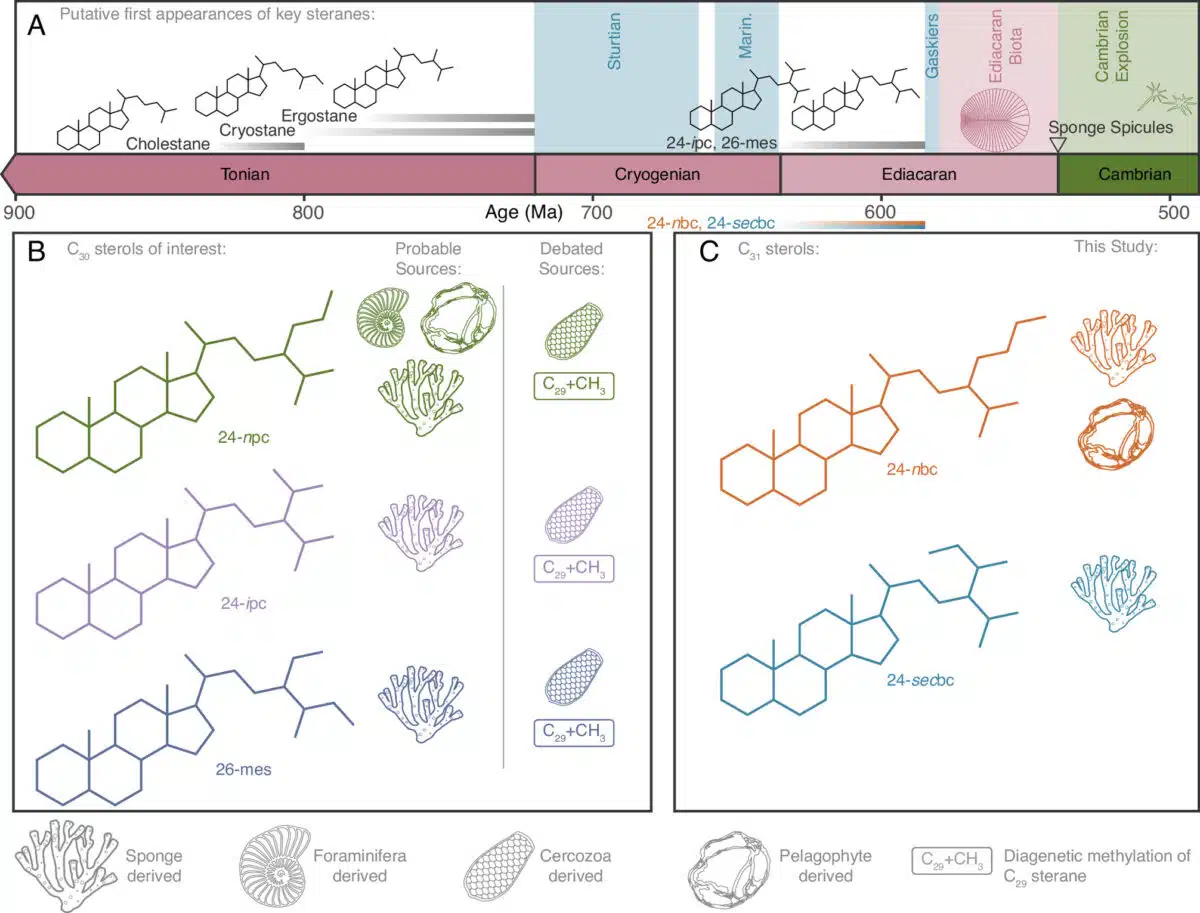 A visual timeline showcasing the ancient steranes, highlighting key compounds and their potential biological sources. Credit: PNAS
Tracing Sponges Back Over 500 Million Years
Back in 2009, MIT geobiologist Roger Summons and his team found sponge-like sterols in Marinoan rocks from Oman. These fatty compounds, called C30 sterols, gave scientists a rare glimpse into the early days of life on Earth. However, some researchers were still unsure. Could these chemical traces have come from something other than sponges?
To settle the question, the team kept digging and eventually discovered a second chemical signal, C31 sterols, that gave them even more confidence. These sterols were produced by the same gene found in modern sponges, confirming that sponges were indeed the source of the C30 sterols. This solid evidence strengthened their case that sponges were likely among the first animals to appear on Earth.
From Chemical Markers to Ancient Animals: A Scientific Journey
The research team, led by Lubna Shawar, used a detailed process to confirm the ancient molecules, even simulating the fossilization process in the lab to match the ancient sterols with their modern counterparts.
“We don’t know exactly what these organisms would have looked like back then, but they absolutely would have lived in the ocean, they would have been soft-bodied, and we presume they didn’t have a silica skeleton,” said Roger Summons.
Building on this evidence, the team plans to explore more ancient rocks to uncover even more traces of early life. Shawar explained that this discovery was made possible by combining multiple pieces of evidence:
“It’s a combination of what’s in the rock, what’s in the sponge, and what you can make in a chemistry laboratory.(…)These special steranes were there all along,” he concluded, “It took asking the right questions to seek them out and to really understand their meaning.”
These chemical fossils have opened up a new way to understand the emergence of complex life, and for now, the evidence strongly supports sponges as Earth’s first animals.