
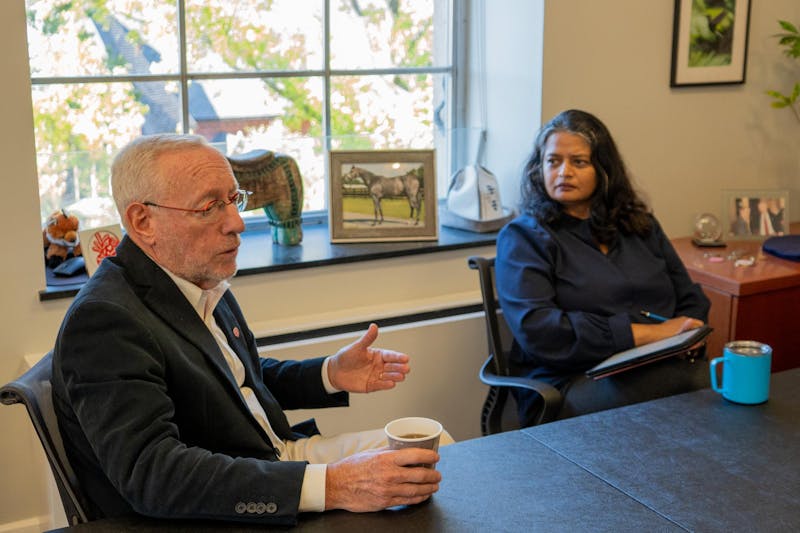
The Sun sat down with President Michael Kotlikoff and Provost Kavita Bala for an update on the ongoing challenges that the University is facing amid the Cornell funding freeze from the Trump administration since its last interview with the University’s top two administrators in May.
In the 45-minute interview, the administrators explained that around $80 million is owed to Cornell from the federal government for “programs for which we’ve made expenditures and we haven’t been reimbursed,” adding to the $250 million already cut by the Trump administration due to ongoing and continued stop-work orders. The Sun also questioned the administrators on reported body camera footage from the March Pathways to Peace event, ongoing litigation, University office name changes, sexual assault on campus, artificial intelligence and much more.
Below is the transcript of The Sun’s wide-ranging, exclusive interview with Kotlikoff and Bala. The transcript has been lightly edited, reorganized and condensed for clarity.
Pathways to Peace Body Camera Footage
The Sun: We recently reported that body camera footage from the Pathways to Peace event revealed that the chief administrator for the office of the president and provost, Kristin Hopkins, explained that someone referred to as “Mike” was hoping that the number of the detainments would be “more than eight.” Who was the Mike referenced in this instance?
Kotlikoff: Well, I assume that the Mike reference was to me, but the comment really referred to the fact that what we were trying to do was make sure that everyone that was at the event that violated our policies and prevented people hearing the speakers, and prevented the speakers from from essentially speaking, was identified and referred for appropriate violation of our policies. That’s what the comment, I believe, referred to, and wasn’t about arresting a certain number of people or certainly not doing anything to individuals that had nothing to do with violating the rights of others.
Funding Freeze
The Sun: So, on to the funding freeze and stop work orders. In our last sit-down interview with two of you in May, you told The Sun that there were approximately 120 stop work orders at the University, totaling approximately $250 million in federal funding cuts. Stop work orders remain after 90 days after the orders were delivered, meaning that the original orders from the spring semester would have expired or been extended by now.
So with that being said, can you provide us with an update on these stop work orders, including both the number of active stop work orders and the total funding cut through stop work orders?
Kotlikoff: I don’t know the number of active stop-work orders.
Bala: It hasn’t changed, essentially. The ones that were stopped stayed stopped.
Kotlikoff: So they stayed stopped. With this, we have two real challenges here. One is the stop-work orders. The other are grants from the federal government that haven’t been stopped, that are not being paid, so we’re not being reimbursed for the expenditures that we’ve made. And both of those are continuing challenges.
The Sun: You previously told us in the last interview that [beyond stop work orders] you [have to account] for the grants that have been canceled, as well as those that have not been paid. So could you tell us what the status of these grants that have not been paid by our interview in May, and then what and then accounting for both the stop-orders and grants, how much total federal funding has been cut from the University so far?
Kotlikoff: I think we’re in the range of $80 million that’s owed to Cornell by the federal government for programs for which we’ve made expenditures and we haven’t been reimbursed.
The Sun: Is that additional to the $250 million?
Bala: Yes.
Kotlikoff: It’s in addition to the stop-work orders.
The Sun: So the stop-work orders remain at $250 million, and now there’s about $80 million in grants?
Bala: $250 million was stop-work orders and terminations. And we’ve had a few more terminations since then that have come in, not in that big wave, but that’s the approximate range.
The Sun: Terminations of grants?
Bala: That’s correct.
The Sun: Sort of relating to that, how much money has the University been paying out of pocket to support research due to the funding that has been pulled?
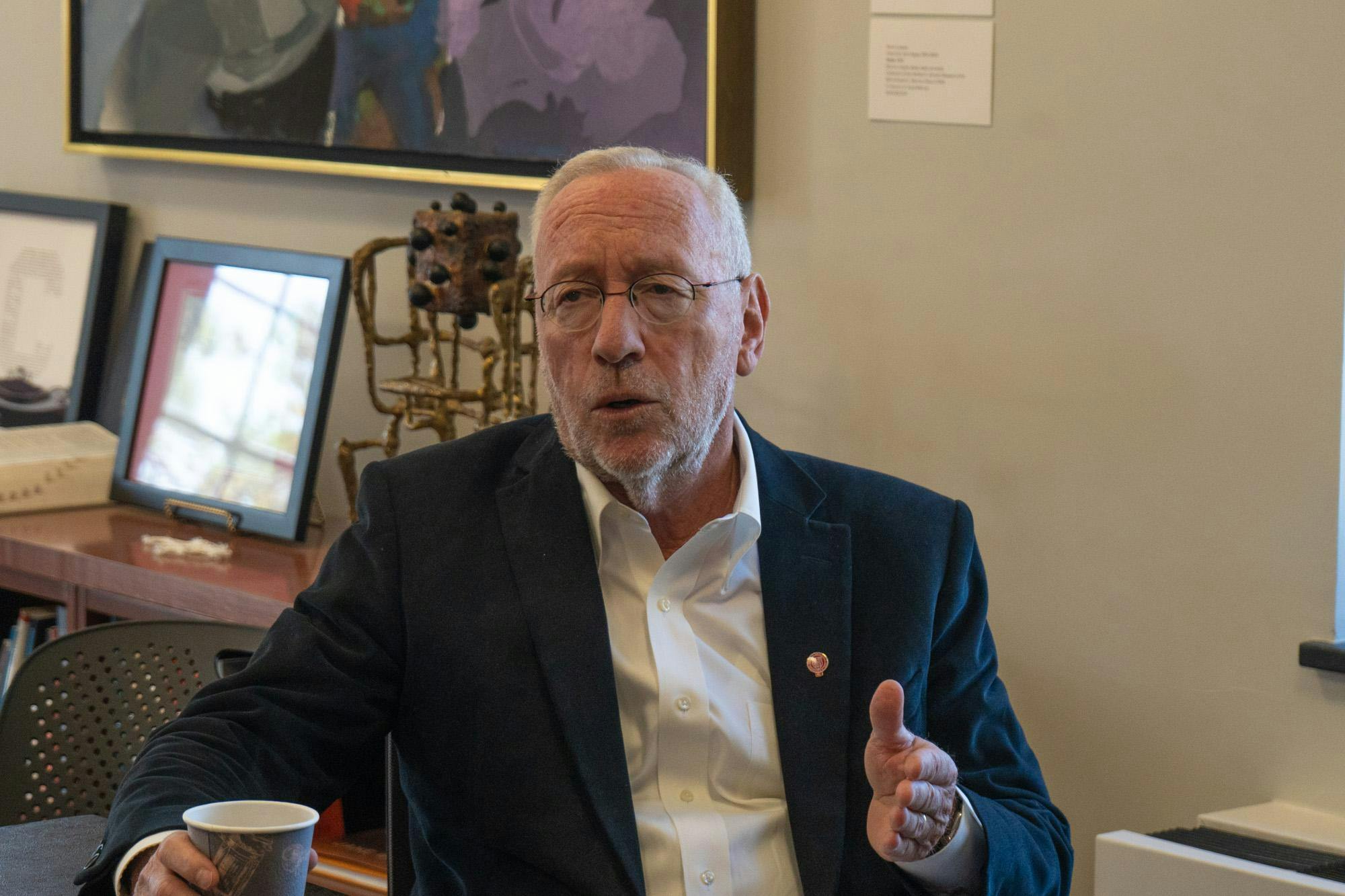
President Kotlikoff told The Sun that around $80 million is owed to Cornell from the federal government for programs that the University has made expenditures and hasn’t been reimbursed.
Bala: I don’t have an exact number there. I’ll talk about different mechanisms we’ve used to support. So, there is a Provost’s [Research] Resiliency Fund, which we use that to give funding, not the full grant amount, but a small amount of bridge funding to the terminated grants so that they can find a bridge to a new source of funding. So that’s one mechanism.
Additionally, the colleges and the departments and the principal investigators, the PIs, all found funding for, particularly the stop-work orders, if a student happened to be on a graduate assistantship and they had to be put on a TA or they had to put on discretionary funds, that has also been taken care of or supported through these various units. And it’s distributed across the whole campus. And those are sort of the main mechanisms. I don’t have an exact number.
Kotlikoff: I just add to that, the [National Institute of Health] grants and [United States Department of Agriculture] grants are not being paid. Those are ongoing, so the University is back-stopping those grants.
The Sun: In August, Bloomberg reported that Cornell was in active talks with the Trump administration to reach a settlement of up to $100 million. And according to reporting from the New York Times as well, in September, talks have now stalled. So was the reporting about settlement talks, both in their existence and in reporting numbers, accurate? And then what is the current state of settlement talks between Cornell and the Trump administration?
Kotlikoff: That information certainly did not come from Cornell, so not sure exactly where that information came from. I wouldn’t agree that we’re necessarily very close to a settlement, and I wouldn’t agree with a number that was published. For us, we are continuing to have conversations. We have a number of existing OCR or Office of Civil Rights complaints, and we’ve been trying to resolve those. We’ve been told that our status with the federal government really relates largely to those OCR complaints and resolving them.
So we’ve been in discussions to try and resolve those complaints. Hopefully, we can resolve them and get back to a normal relationship with the federal government.
The Sun: And in May, you told The Sun that the Trump administration has not given the University a list of demands. Has this evolved since our last conversation?
Kotlikoff: No, we’ve never gotten a formal letter that outlined the reasons underlying these stop-work orders or the failure to pay.
The Sun: In their settlements, Colombia agreed to pay $221 million with the Trump administration, and in the settlement, Colombia agreed to provide data on its admissions process, including students’ race, GPA and standardized test scores to the federal government. Penn agreed to reconcile its policies of transgender inclusion in sports with those of the Trump administration. And then Brown agreed to pay $50 million to a Rhode Island workforce development organization over 10 years to adopt the Trump administration’s definition of male and female for housing and athletics.
So with that said, was there anything [that] other institutions agreed to that you are not willing to compromise on in settlement talks?
Kotlikoff: Well, let me just say, I don’t want to speak about other university settlements, but let me just say that the notion that the federal government would control the University’s policies, would tell us how to enforce our policies, how we hire people, who we hire, how we admit students, who we admit — that is all beyond the appropriate relationship between the federal government and the University.
So for that we would, we would not agree to terms that place the federal government in an intrusive position relative to a private university.
The Sun: Seeing Harvard in their federal court win against the Trump administration for freezing more than $2 billion of federal research grants — is Cornell pursuing, or considering, to pursue a non-settlement legal path to restore funding?
Kotlikoff: We’re in a different legal position than Harvard. Because we didn’t get a letter from the federal government outlining the rationale for their actions, which was really a First Amendment case that Harvard was able to turn around and go to district court. Because we haven’t received that, our legal options are different, and we’re told by our advisors that our most likely source of legal remedy would be the Court of Claims.
The Court of Claims doesn’t have the ability to provide [an] instant remedy, so what we would have to do is have a prolonged case with the Court of Claims, at the end of which, our funding would be restored. That’s still an option for us, but it’s not one we’ve chosen to pursue yet.
The Sun: So you said that the $100 million settlement did not come from someone at Cornell and did not really reflect reality. So what numbers was Cornell looking at for the settlement then?
Kotlikoff: I’m not really, I’m not going to get. … One of the things that Cornell’s done has been very disciplined about not negotiating in public and not leaking to the press. So I’m not going to talk about that.
The Sun: The Washington Post recently reported that the White House was developing a plan that could change how universities receive research grants due to their adherence to “policies of the Trump administration on admissions, hiring and other matters.” This proposal was sent recently to nine universities, including many peer institutions. So would Cornell consider signing onto this proposal to obtain preferences and funding in the future?
Kotlikoff: Again, I’m really not going to talk about that in public.
The Sun: The Sun recently reported that the College of Arts is seeing a $11 million cut from its budget, announced at a meeting with arts and sciences department chairs and the provost. This accounts for approximately a 2.4 percent cut, and the college’s nearly $456 million budget. So what are the budget shifts at other colleges in the University looking like, both in the quantity of money cut and what is cut within the college, and how is it decided which colleges see the most funding cuts?
Bala: There wasn’t a department meeting between the chairs and the Provost. So that was, unfortunately, misreported. I think there was an internal meeting within the college where there was discussion on budget cuts, but I don’t actually know the details of that. I was not in the room, and don’t know who called the meeting or how it progressed for that matter.
Across the board, the whole University has gotten cuts. Every single unit across the University that happens to be one meeting you happen to hear about, I’m sure everybody’s having meetings about their cuts. This is an incredibly difficult time financially for higher education. You’ve heard about it, probably from our peers too, and we are all working across the University. We’re working together to get Cornell to a strong financial position so we can weather the extremely difficult time we’re going to be going through [over] the next few years.
So the first set of discussions was around these cuts. They’re related to different parts, our financial aid, our benefits, these changes in our funding that are coming from the government. All of those are reflected in cuts across the board. And as I said, every unit across campus is getting cuts. And now we’re moving forward to thinking about, how do we restructure — and this could be calling this financial re-engineering, we’ll probably send an announcement to the University next week — and how do we restructure how we do everything we do, so that we can have a little more flexibility in our budget to deal with the headwinds that are coming our way? So that’s an ongoing process. It’ll go on for the whole year.
Federal Lobbying
The Sun: Cornell spent $444,000 on federal lobbying in the second quarter of 2025, which is the University’s highest record investment in a single quarter, according to data from the U.S. Senate. The University has already spent nearly $700,000 this year, which is a 69 percent increase from the same period in 2024. So, what effect has this had in federal policy, especially relating to the recent Republican budget bill that was passed over the summer, which threatened to offer fundamental changes to the endowment tax?
Kotlikoff: Well, what effect has it had? I think, on the one hand, a number of universities have come together and lobbied and gone to Washington. I’ve been to Washington numerous times trying to talk to representatives both from this state and others, to try and talk about issues like endowment tax, NIH budget, etc. Clearly, on the endowment tax, the final passed bill was not as Draconian as some of its predecessors.
And I think the lobbying that we’ve undertaken has really provided us with the ability to send our message to individuals around what Cornell is, what Cornell supports, how it doesn’t engage in discrimination. As I’ve said [it] takes seriously its Title VI and Title IX obligations. Has that been successful so far in terms of an agreement with the federal government? Not yet, but we’ll see.
The Sun: Could you share with us who is exactly in charge of the process and who lobbies for the federal government on behalf of Cornell?
Kotlikoff: Well, who’s in charge of the process? It’s a consultative process. The Board [of Trustees], the Provost, me, our chief counsel [and] certainly our University Relations vice president. All of that is part of thinking about what would be effective, how to effectively represent the University.
Ongoing Lawsuits
The Sun: Last spring, the Office of Civil Rights announced the opening of an investigation of Cornell and 44 other universities under Title VI. The OCR explained that the investigations came amid allegations that the universities violated title six of the Civil Rights Act of 1964 by working with The Ph.D. Project — which “purports to provide doctoral students with insights into obtaining a Ph.D. networking opportunities, but limits eligibility based on the race of participants,” according to the OCR.
Cornell was also one of the 60 schools that was sent letters from the Department of Education on March 10 warning universities to fulfill their obligations under Title VI of the Civil Rights Act to protect Jewish students on campus or see enforcement actions. What is the current status of these investigations, and has Cornell seen any enforcement actions by the Department of Education, or have they complied?
Kotlikoff: So the status of those is still ongoing. We’re trying to close those OCR complaints. Our belief is that we have obeyed the law. There have not been violations of Title VI on campus that have not gone unaddressed and that we will continue to follow our Title VI obligations.
The Sun: In June, Cornell was one of the only two Ivy League universities that decided not to join an amicus brief to support Harvard’s litigation against the Trump administration over its funding freeze. What was the reason for Cornell not joining this brief?
Kotlikoff: Well, I would point out we joined and were a lead in a number of other lawsuits around this time. Really, this was just a question of whether this was actually going to materially affect that lawsuit or not. I think some people saw this as a sort of a gesture of defiance, but in reality, we didn’t see it as a meaningful either help or hindrance to Harvard’s lawsuit.
The Sun: And why did you think it was not a helpful addition?
Kotlikoff: Because there were plenty of amicus briefs that were already on board, and the amicus briefs, by their nature, are not really determinative for that lawsuit. We’re very supportive of the lawsuit, and we were pleased to see the result of that lawsuit.
The Sun: Has Cornell continued its talks, especially within the Office of Civil Rights in the Department of Education, due to investigations revolving around Title VI and antisemitism and how has Cornell tried to answer these concerns?
Kotlikoff: We have continued talks, both with individuals in the education department, in the Justice Department, in the White House. And those are really answering concerns around specific incidents that may or may not have occurred. Really, in fact, we haven’t had a lot of specific inquiries. There is a legal process by which Title VI cases are adjudicated. The government really hasn’t gone through those processes, so these become sort of more informal discussions about what is going on at Cornell, just educationally, and how we’re making sure that there’s no discrimination on campus against anyone.
The Sun: Cornell has been involved in litigation against the National Institutes of Health and the U.S. Department of Energy and the U.S. Department of Defense regarding a proposal to cut indirect costs associated with research. Do you have any updates on what has happened regarding these cases since our last discussion?
Bala: I mean, in all of those cases, they’re in different states of play, but in all of those cases, those actions did not go through. However, we are currently, as you know, there’s a government shutdown going on right now. The OMB — which is the Office of Management and Budget — is the one that is working on indirect rates now and determining the next set of indirect rates.
There are proposals in front of the OMB. There’s a proposal called FAIR. … [which stands for] Financial Accountability in Research. So there’s a model called FAIR that they are considering which might be adopted next year or the year after, and we are keeping an eye on it to understand the impacts on us.
Kotlikoff: I was just gonna say I’m smiling a little bit because for our current NIH grants at the Ithaca campus, we’re getting neither the direct costs or the indirect costs. So it’s a bit theoretical at the moment.
Office Name Changes
The Sun: In June, the Office of Civil Rights was created in Cornell, replacing the Office of Institutional Equity and Title IX. The University reorganized and expanded the Title IX enforcement on campus by creating the Office of Civil Rights, and it launched with new staff hired to investigate alleged bias incidents, including antisemitism. Considering fighting antisemitism and the protecting civil rights page, which was also launched, was the launching of this department in relation to federal pressure and open investigations on antisemitism on campus?
Kotlikoff: The launching of the department of this unit was really a reorganization that allowed us to more effectively assure ourselves that we were providing the Title VI protections that we should for the University. So what we were trying to do, was just like Title IX was in a separate office that oversaw the legal requirements of Title IX, to really bring Title VI into that same environment where it’s overseen by an individual who has legal background and legal training, and remove it from the code officers who don’t have that kind of training.
The Sun: In August, Cornell renamed the Office of Academic Diversity Initiatives to the Office of Academic Discovery and Impact. Was the name change related to pressure from the Trump administration?
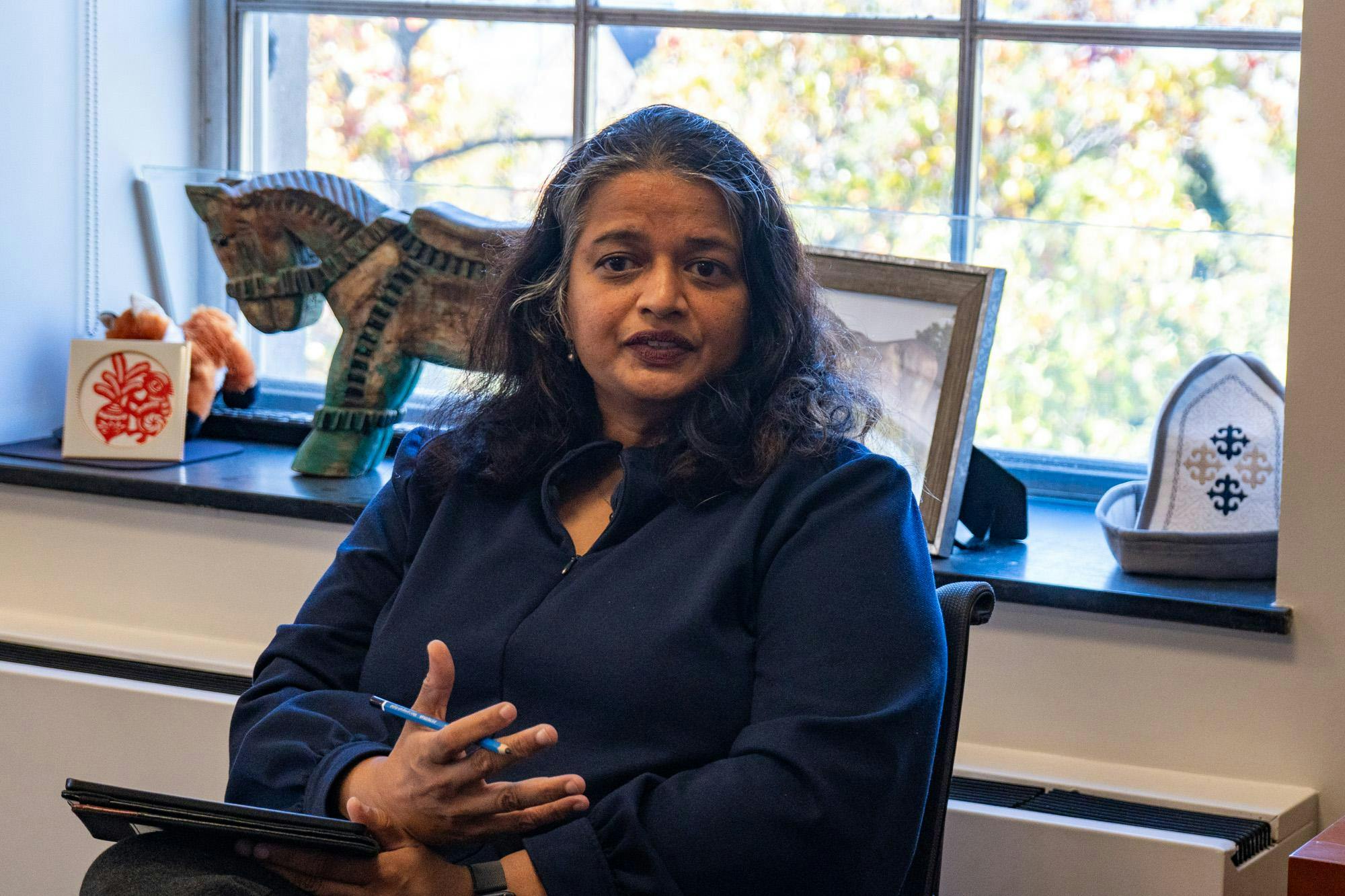
Provost Bala told The Sun that name changes being made to an existing Cornell office were due to an ongoing process as they were “undertaking and defining what it wanted to be.”
Kotlikoff: No, none of these are. None of these changes have been discussed with the Trump administration or result of any pressure.
The Sun: What was the reason for this name change in the organization then?
Bala: This was an internal process that actually that unit was undertaking and defining what it wanted to be. And in fact, they explained that in their letter, if I remember correctly. You should read the letter — I think that explains directly what they intended and what they were hoping to achieve.
The Sun: In August, a lawsuit was filed against Cornell and 32 other colleges and universities, accusing the institutions of colluding by sharing admitted students lists and misleading applicants that early decision early decision policies were binding. Do you have any comments on these allegations?
Kotlikoff: We don’t think there’s merit to that lawsuit.
Prof. Cheyfitz Suspension
The Sun: Moving on to some ongoing coverage unrelated to current lawsuits. In emails to another faculty member, you voiced criticisms of Eric Cheyfitz’s course: “Gaza, Indigeneity, Resistance.” In an email reported by the Jewish Telegraph Agency, you reportedly wrote, “I share your concerns, and I’m extremely disappointed with the school curriculum committee’s decision to offer the course and the course’s apparent lack of openness and objectivity.”
Do you plan to take a more involved role in curriculum decisions in the future, and do you believe that there should be more restrictions and limitations in place regarding the approval of classes?
Kotlikoff: I don’t plan to take any action or be involved to a greater degree in curriculum, and that course went on unchanged, despite my confidential comments that were leaked.
The Sun: Under the separation procedures of the Faculty Handbook, section 6.6C outlines that the President’s decision will be final if suspension is recommended, referencing the current charge against Cheyfitz
Given your public comments critiquing Cheyfitz and Cheyfitz’s course in question, do you feel that you are an objective source to make a decision on the matter, and how could you assuage fears amongst your faculty of your bias?
Kotlikoff: I don’t really have any bias. These are two separate issues. One is whether a course should be open and objective or essentially dictate a certain definition or a certain interpretation of events. On the one hand, my understanding of the issues you’re referring to were really around the Title VI violation.
Sexual Assault on Campus
The Sun: On the Presidential Task Force for Campus Sexual Assault. So last year, we saw that there were some public sexual assault incidents on campus, which were addressed by administration. And then, in 2019, there was a study conducted by the Association for American Universities alongside Cornell, with Cornell administration being one of the 33 universities that found some pretty striking statistics on-campus sexual assault.
These statistics include the fact that one in four women experiences sexual assault during their time in University, and one in 20 women experiences attempted or completed penetration during their time at university. What are the updates on this presidential this Presidential Task Force on campus sexual assault, and has the University taken any tangible measures since 2019, and since these incidents last year, to ensure that this doesn’t happen on campus and to increase preventative measures rather than reactive measures?
Bala: I can comment on some part of this, and then Mike can talk about some of the history of this perhaps. I can just say that the task force has been doing an amazing amount of work, talking to a lot of student groups. A lot of staff were involved in supporting students through this. And across the board, they’re working on producing their report, which we hope we will have some time by this semester towards the end, and we will start execution of the kinds of recommendations starting next semester. That’s the current thinking around that.
I just want to comment a little bit about the statistics. First, it’s not only women. It’s across the board. Sexual assault is experienced by all. I think that’s an important point to make, and we are not different from the national average. Unfortunately, just all universities suffer from this problem, and that’s why we stood up this task force, because our belief is that as universities, we should be taking steps, even though we’re just like everybody else, and it’s not a good situation to be in; that was the logic in creating the task force. … They’re thinking exactly about the kinds of educational offerings we need to consider, different mechanisms so that we can take preventative — exactly, preventative approaches. That’s very much, the vision of how we’re going to approach this, and we’re looking forward to that report coming in and then us executing.
Kotlikoff: I guess the only thing I’d add is following that AAU survey, the University took a number of steps. One of the ideas of this task force is really to understand what impact those steps had on the situation. So I think we’re anxiously awaiting some recommendations and some analysis of where we are currently.
Free Speech
The Sun: The Fighting Anti-semitism and Protecting Civil Rights website details that, “The Cornell administration consulted with Jewish students and canceled the performance of the all-campus ‘Slope Day’ of a singer who had expressed antisemetic views on social media,” — with last year’s move with Slope Day now being used as an example of fighting antisemitism. What will future administrative and student control over Slope Day look like?
Kotlikoff: Well, I think Slope Day is really a function of Student and Campus Life. I think that what we’ve discussed is a full survey of students’ interest to try and broaden this discussion about what, what are the preferences of students for Slope Day entertainer, which is meant to be an all-campus party, then followed by narrowing that down and a full vetting of the individuals, where we just want to make sure that entertainers that are chosen are entertainers that are really uniting of the of the community and the choice of the community, not a very small section.
The Sun: There was recently a report by FIRE, the Foundation for Individual Rights and Expression, that ranked Cornell’s free speech on campus at a level F, and one of their examples was the fact that Kehlani was not invited onto Slope Day due to her statements on social media. You also mentioned that in a previous interview with The Sun, you said that the fundamental issue to [you regarding] Slope Day was the views of the students. One, do you agree with FIRE’s use of Kehlani not being invited to campus as an issue of free speech? And two, how are you looking to both measure free speech and also the views of the students on campus, one way or the other, generally, in your decisions?
Kotlikoff: Yeah, I’m not sure I quite understand your second question, but the first one, I would say, you know, we were not restricting Khelani’s free speech. If Kehlani were invited by a club or a group to speak on campus, you could speak on campus. What we were trying to do was not have an entertainment choice that a significant segment of our community felt was offensive and therefore wouldn’t attend. I can understand how people will see this as a free speech issue, but I really saw it as a community inclusiveness issue. And when I spoke to the group that had chosen Kehlani, I think they also were unaware of much of this when they made the choice.
The Sun: Do you have a general comment on that overall ranking that, according to this Foundation of Individual Rights and Expression report, the University earned a score of 51.66 out of 100 points, based on criteria, including student surveys, campus policies and recent speech related controversies. [The controversies include] a student investigated and suspended due to expressing — this was two years ago — “Zionist must die” on social media, and as well as Pro Palestinian students disrupting the University’s Pathways for Peace event and also the detainment or arrest of at least 17 individuals.
Do you have a general comment on how this has been lowering free speech rankings — by admittedly a separate institution from the University — but also how students may feel that they don’t have free speech or expression on campus right now?
Kotlikoff: Well, I would say in virtually every statement that I make to students — at commencement, at convocation — I talk about free speech and the importance of expressing ideas and being comfortable expressing ideas. So I really can’t comment on a third party’s evaluation of Cornell, but it’s something that both KB and I have talked about consistently around first of all, supporting free expression, supporting academic freedom, supporting First Amendment rights of individuals, but also as part of First Amendment rights, is understanding when your first amendment rights end and you’re now infringing on someone else’s rights. So those comments I’ve tried to continually make will continue to try and emphasize that, and we wholeheartedly support free expression, free speech on campus.
Admissions, Financial Aid
The Sun: We asked about this last year in our fall interview, that financial costs of the University had been reaching 100k and this year it surpassed that for some students. Is the University working on or planning to take any measures to assist students in need of financial aid, or to limit these costs for students?
Bala: We are continuing to look at financial aid, and I’ll actually say we’re continuing to fundraise towards increasing the financial aid we can offer. We were having discussions about it this morning. It remains one of the important challenges for the students and the University alike, and it is ongoing in how we assess it.
Kotlikoff: I think it’s also important to point out, of course, that despite that sticker price that you stay, almost 50 percent of our students don’t pay that sticker price, and then many students really pay nothing, either in tuition or room and board. And we are committed to need blind admissions and meeting full need.
The Sun: Similar peer institutions in the Ivy League have expanded their financial aid programs this year, including Princeton, which offers families with incomes up to 150k a year to pay nothing for their cost of attendance. Does the University have similar plans to ensure affordability for low-income students?
Kotlikoff: No — I mean, it’s quite difficult for us to keep up with the program of Princeton, or some others, for a couple of reasons. First of all, obviously, we have a lower endowment per student, but importantly, we have many, many more students. We’re almost three times the size of Princeton. So I’m very proud of the fact that Cornell, every year, graduates the most students on full financial aid of any of our Ivy or Ivy plus peers — the most Pell Grant recipients of any of our Ivy or Ivy plus peers.
The Sun: Generally, we got emails and letters and we got a statement about how Cornell is intending to cut costs internally, to mitigate the cost cuts and lack of federal grants. Are there any other measures that Cornell is taking to both fundraise to meet this new need, without those grants and without that?
Kotlikoff: Yeah, we do have a fundraising effort to try and support us. I was just in Boston talking to the Cornell Club of Boston to support us. You know, my point to our alumni is, if you’ve ever felt the desire to support your alma mater, this is the time to do it.
The Sun: And was that separate from the conversations you mentioned earlier, like the meet with President Kotlikoff conversations? Just a separate discussion with the Cornell Club?
Kotlikoff: No, it’s part of that. Every time I speak, I’m trying to raise money for the University.
Artificial Intelligence
The Sun: Provost Bala, about the Cornell AI initiative. So this launched in 2021 the Cornell AI initiative supports breakthroughs in artificial intelligence across campus disciplines and campuses. … So, what are some of the updates on this AI initiative, and what updates have you seen on campus in regards to AI research and advancement?
Bala: Essentially, there’s been a ton more that’s been happening since then. So, the AI initiative — we are leaders in artificial intelligence, in the research space and in the education space. The initiative is much broader than that, and I think of it as having three major pillars: research, education and administration.
So, in research, and that’s this page actually reflects a little more of the research initiatives, as I said, we are leaders in the space, and we have been thinking about both research for AI and research with AI. We sort of bring that technology to all three of those pillars that I was talking about.
So in research for AI, it’s not only technologists who have to think about the future of AI, methodologies and algorithms, etc. You need to have lawyers, policy, designers, sociologists, philosophers, ethicists. Across the board, the whole University has a lot to contribute towards thinking about how AI research should progress.
So that’s one part of research. The other is research with AI. There is immense potential in scientific breakthroughs, medical breakthroughs, using AI to drive scientific discovery. We are leaders in that space as well.
So we have there, we have a very broad set of amazing talent across campus working together, AI researchers and disciplinary researchers, working in sustainability, in physics and material discovery, and much more. I’m not doing justice to the whole list there.
So that’s on the research pillar of the AI initiative. On the education, that’s currently being led by [Interim Bowers Dean] Prof. Thorsten Joachims, [computer science and information science]. On the education side, we’re thinking again about education with AI and education, you know, for AI, and here we are thinking about AI literacy across the board, not only for students, who I think have adopted the technology pretty readily, but also staff and faculty and bringing everybody, not only knowledge about AI as tools and skills, but also understanding ethical and socially responsible use of AI.
So our Vice Provost for Academic Innovation, Steve Jackson, is leading this initiative on thinking about how we bring that kind of knowledge and training — and they have workshops, et cetera, from their team — to the whole University. They’re also funding different grants to allow teaching with AI. So, very creative uses of AI in your classroom. We have historians and we have textile designers. We have philosophers who, I think, yes, we’re using AI in their class, for Socratic Dialogue, for example. So I’m not sure if it’s a philosopher. I don’t remember which department that faculty member’s from.
But that kind of creative use of generative AI is another piece. Our motto there, which this group has come up with, it’s “AI on tap, not AI on top.” So we want AI to serve our goals in each of these pillars.
In that piece, also, there is a question of academic integrity and AI. How do we design policies? How do we help our instructors and faculty across the University in administering courses? Why there might be tension between the use of these tools and the critical thinking we want our students to develop, so that’s part of this work.
The third pillar is, how do we run the University using AI tools? So we have an AI innovation lab. They have, we have about 30 to 60 projects. This group is looking at where they’re working with teams across campus to look at what work they do. Bring a generative AI tool to improve a workflow, for example, so that instead of spending hours per day doing something, we have our staff taking minutes per day to do that. We see this as actually an important part of how we restructure and run the University going forward.
Committee on the Future of the American University
The Sun: Provost Bala, you recently announced the Committee on the Future of the American University, which “will explore the challenges and opportunities of this moment, engaging thoughtfully with both supporters and skeptics — within our university and beyond.” So with that being said, can you elaborate on this committee and specifically what you mean by engaging with skeptics?
Bala: It’s an amazing committee, by the way. I think of them as a think tank for us [and a great] set of big thinkers. … We’re looking at this question [at a] defining moment for higher education, with a loss of public trust in what we do and whether there’s a value of getting a degree in universities like ours. There’s a break in the relationship between the government and the long-term relationship between the government and universities. … And that relationship is being renegotiated in front of our eyes.
We are at a moment of also a tremendous change because of technological change, scientific discovery, technologies — like AI. So in this moment, [higher education] has to think about what the next 50 years will look like, and in that framework, we want to think about, firstly, our missions, undergraduate and graduate education, research and scholarship — our external engagement. And we want to address, among other things, when we think “do this thinking,” how will we address this loss of public trust? And that’s where we want to engage with everybody who believes in what we do, and we have many in that category, and at least some number of people who are skeptical about what we are trying to do. And that’s the both sides of the discussion.
Meet President Kotlikoff in Your City
The Sun: President Kotlikoff, you recently talked in Boston and are said to talk in New Jersey and Houston across the next two months. What have you been talking about in the “meet President Kotlikoff in your city” events?
Kotlikoff: I’ve been talking about a few things. One, of course, is federal relations, and people are hearing a lot about this, they’re reading a lot about it. And I’ve tried to explain a little bit where we are just to provide some context for the situation. I’ve also introduced myself. I’m a long-time Cornellian, been here 25 years. … But for many people, they haven’t [gotten to know me].
And then the third thing I’m really talking about is community, because periods of stress and challenges can both divide communities or bring them together. And one of the real strengths, historical strengths of Cornell has always been the sort of ties within the community. And so I’m trying to build those, trying to continue to build those. In addition to New Jersey and Texas, I’ll be going to China. I want to make sure that people continue to see our long-term commitments and relationships with international students.

Dorothy France-Miller
Dorothy France-Miller ’27 is the Managing Editor of the Cornell Daily Sun. She is a student in the College of Agriculture and Life Sciences.

Matthew Kiviat
Matthew Kiviat is a member of the Class of 2027 in the College of Arts and Sciences. He is the assistant managing editor for the 143rd Editorial Board and was a news editor for the 142nd Editorial Board. He can be reached at mkiviat@cornellsun.com.
Read More